


Whether you are stepping onto a freshly paved community court or planning to tape lines onto your own driveway, understanding the exact layout of the playing surface is the first step to mastering the game. As the sport continues to explode in popularity through 2026, more players and homeowners are asking the exact same question: Just how big is the court?
The Quick Answer: Exact Pickleball Court Size in Feet
If you are looking for the fast, definitive numbers to start measuring your space, here is exactly what you need to know.
Official USAPA Dimensions
According to the official USA Pickleball Association (USAPA) rulebook, the standard pickleball court size in feet is 20 feet wide by 44 feet long.
Unlike tennis, which uses "alley" lines to expand the court width for doubles, the pickleball court dimensions are exactly the same for both singles and doubles play. The 20x44 feet measurement encompasses the entire playing area inside the outer boundary lines.
The Total Recommended Playing Area
If you are building a court in your backyard, simply pouring a 20x44 foot concrete slab will be disastrous. Players need adequate room to serve, chase down deep lobs, and hit wide angled shots without crashing into a fence or tripping off the edge of the concrete.
For safety and proper movement, the official recommended total playing area (the envelope) is 30 feet wide by 60 feet long. For professional tournament play or optimal comfort, a larger footprint of 34 feet wide by 64 feet long is heavily preferred.

Quick Reference Dimension Table
|
Court Element |
Exact Dimension |
|
Total Court Length |
44 feet |
|
Total Court Width |
20 feet |
|
Recommended Safe Play Area |
30 feet x 60 feet |
|
Non-Volley Zone (Kitchen) Depth |
7 feet (from the net) |
|
Service Court Length |
15 feet |
|
Service Court Width |
10 feet |
Breaking Down the Court Boundaries: Section by Section
To truly understand the pickleball court size in feet, it helps to break the 20x44 rectangle down into its geometric sections. Every line dictates a specific rule and strategy.
The Non-Volley Zone (The Kitchen) Dimensions
The most famous area of a pickleball court is the Non-Volley Zone, universally nicknamed "The Kitchen."
This area extends exactly 7 feet away from the net on both sides and spans the entire 20 feet of the court's width. It is crucial to remember that the 7-foot Kitchen line itself is considered part of the Non-Volley Zone. If your toe touches that line while hitting a volley out of the air, it is a fault.
The Service Areas (Left and Right Service Courts)
Behind the Kitchen line lies the serving area, which is divided down the middle by the centerline.
If you take the total length of one side of the court (22 feet) and subtract the depth of the Kitchen (7 feet), you are left with 15 feet. Because the court is 20 feet wide and divided perfectly in half, each individual service court measures exactly 15 feet long by 10 feet wide.
Baseline and Sideline Specifications
When painting or taping your court, line thickness is just as important as the overall dimensions. All official boundary lines (baselines, sidelines, centerlines, and NVZ lines) must be exactly 2 inches wide. Additionally, these lines must be painted in a highly contrasting color relative to the court surface (typically white against a blue or green court) to ensure clear visibility during fast-paced rallies.
Official Pickleball Net Height Requirements
You cannot have a perfect pickleball court size in feet without the correct net height. The net serves as the ultimate equalizer in the game, and its height actually varies depending on where you measure it.
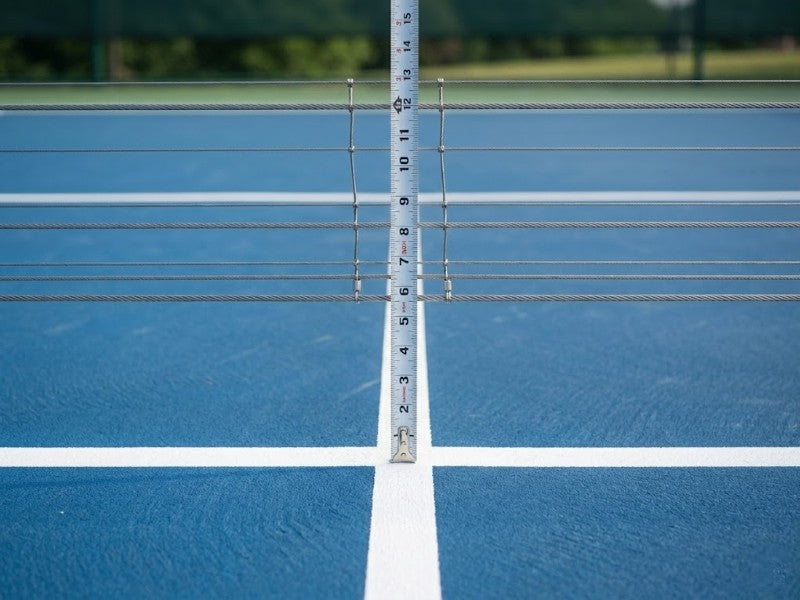
- At the Sidelines: The net must be exactly 36 inches (3 feet) tall at the net posts, where it crosses the sidelines.
- At the Center: The net must droop slightly in the middle, held down by a center strap. At the exact center of the court, the net height must measure exactly 34 inches.
This 2-inch dip in the middle is not a manufacturing defect; it is a vital part of the game's design, incentivizing players to drive their shots low through the center of the court.
Pickleball Court Size vs. Tennis Court Size
Because pickleball is so frequently played on converted or shared tennis courts, the two sports are constantly compared. However, understanding the dramatic difference in their dimensions explains exactly why pickleball is experiencing such explosive growth.
A standard tennis court measures 36 feet wide by 78 feet long for doubles play. However, a tennis court requires a massive total footprint (including the safe run-out areas) of at least 60 feet by 120 feet.
Compare that to the pickleball envelope of 30 feet by 60 feet, and a fascinating mathematical reality emerges: You can comfortably fit exactly four standard pickleball courts into the footprint of one traditional tennis court.
This spatial efficiency is a massive driver of the sport's popularity. Local parks departments, recreation centers, and country clubs can easily quadruple their player capacity and revitalize unused space without the massive financial burden of pouring brand-new concrete slabs.

DIY Guide: How to Lay Out a Pickleball Court in Your Driveway
If you have an empty driveway, a large backyard patio, or a quiet cul-de-sac, you have everything you need to create your own playing space. Here is a quick, actionable guide to drawing your own exact 20x44 foot court.
Step 1: Check Your Space
Before you buy any tape, take out a tape measure and confirm you have the minimum recommended safe playing area of 30 feet by 60 feet. If you try to squeeze a court flush against a brick wall or a garage door, players will inevitably crash into it while chasing deep shots. Ensure the surface is flat and clear of debris.
Step 2: Gather Your Materials
You will need a few basic tools to get the geometry right:
- A long measuring tape (at least 50 feet is highly recommended)
- Sidewalk chalk (for your initial draft lines)
- 2-inch wide outdoor court tape or a court stencil kit with outdoor paint
- A carpenter’s square
Step 3: Establish the Net and Baselines
Start by drawing a 20-foot straight line directly in the middle of your space to represent the net. From the exact center of your net line, measure exactly 22 feet straight back to establish your baseline.
Pro-Tip: Use the "3-4-5 rule" (the Pythagorean theorem) to guarantee perfect 90-degree corners. Measure 3 feet down the net line, 4 feet down the sideline, and the diagonal distance between those two points should be exactly 5 feet. If it is, your corner is perfectly square!
Step 4: Mark the Kitchen and Center Lines
Once your 20x44 foot outer boundary is established, measure exactly 7 feet away from the net on both sides to draw your Non-Volley Zone (Kitchen) lines.
Finally, find the exact midpoint of your Kitchen line and your Baseline (10 feet in from the sidelines). Draw a straight line connecting these midpoints to create the center line, giving you your two 10x15 foot service courts.
Frequently Asked Questions
Q: Are singles and doubles pickleball courts the same size?
A: Yes! Unlike tennis, which uses a wider court for doubles play, the pickleball court size in feet remains exactly the same—20 feet wide by 44 feet long—for both singles and doubles matches.
Q: What is the minimum space required to build a backyard pickleball court?
A: While the painted boundary lines are 20x44 feet, you should never build a court in a space exactly that size. To ensure player safety and provide enough room to chase deep shots, the official recommended minimum space (the envelope) is 30 feet by 60 feet.
Q: How tall should a pickleball net be?
A: A standard pickleball net has two height requirements. It must be exactly 36 inches (3 feet) tall at the sidelines near the posts, and it must dip to exactly 34 inches tall in the center of the court.
Q: How thick should the lines on a pickleball court be?
A: All official lines on a pickleball court—including the baseline, sideline, centerline, and Non-Volley Zone (Kitchen) line—must be exactly 2 inches wide and painted in a contrasting color to the court surface.
Q: Is the Kitchen line included in the 7-foot measurement?
A: Yes. The Non-Volley Zone extends 7 feet from the net, and the 2-inch Kitchen line itself is considered part of that zone. If your foot touches the line during a volley, it is a fault.
Q: How many pickleball courts can fit on one tennis court?
A: Because a standard tennis court pad has a much larger overall footprint (typically 60x120 feet), you can comfortably fit four standard 20x44 feet pickleball courts inside of it, provided you set them up properly with adequate safe zones.

Leave a comment
This site is protected by hCaptcha and the hCaptcha Privacy Policy and Terms of Service apply.