


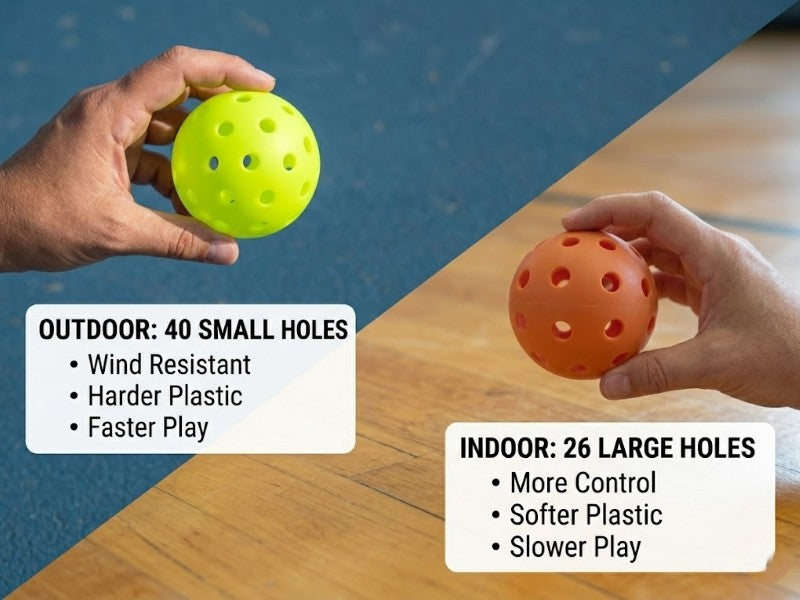
When you first step onto a court and pick up a pickleball, it is incredibly easy to assume that it is just a generic, mass-produced plastic sphere. Covered in perforations and feeling completely hollow, it looks more like a retro backyard toy than a piece of highly engineered sports equipment.
The exact number, size, and placement of those perforations act as the absolute aerodynamic engine of the game. If you are playing with the wrong hole count for your environment, you are fundamentally breaking the physics of your match.
TL;DR: The Quick Answer
If you are just looking for the hard numbers to settle a debate at the baseline, here is the exact hole count you need to know:
- Outdoor Pickleballs: Feature exactly 40 holes.
- Indoor Pickleballs: Feature exactly 26 holes.
The USAPA Tournament Standard:
You cannot just drill random holes into a plastic ball and call it a day. According to the official USA Pickleball (USAPA) equipment rulebook, to be considered tournament-legal, a ball must be entirely smooth and possess a minimum of 26 and a maximum of 40 circular holes. The spacing and design must ensure a perfectly straight, predictable flight path.
Outdoor Pickleballs: The 40-Hole Aerodynamic Marvel
When you play pickleball outdoors, your biggest and most relentless opponent is not the person standing on the other side of the net—it is the unpredictable natural wind.
Even a mild, 5-mph crosswind is enough to completely ruin a delicate drop shot or blow a baseline drive entirely off the court. To combat this massive environmental challenge, outdoor pickleballs undergo strict engineering.
Here is a deep dive into exactly why outdoor balls require a 40-hole architecture:
1. Fluid Dynamics and Wind Resistance
- Smaller Perforations: An outdoor ball features 40 tightly spaced holes that are significantly smaller in diameter than those on an indoor ball.
- Slicing the Air: From a fluid dynamics perspective, these 40 smaller holes act as high-speed aerodynamic channels. Instead of the wind getting "trapped" inside the hollow core, the air is forced to pass smoothly and rapidly through the numerous small openings.
- The Result: This drastically reduces the ball's drag coefficient. When you hit a powerful drive, the 40-hole design allows the ball to aggressively cut through heavy crosswinds, maintaining a fiercely straight and predictable flight trajectory.
2. Maximum Weight Specifications
- Combating the Elements: You cannot fight the wind with a feather. To keep the 40-hole ball stable, outdoor models are manufactured to sit at the absolute top of the USAPA weight limits (typically weighing right around 0.90 to 0.93 ounces).
- Momentum: This extra mass, perfectly paired with the 40 aerodynamic holes, ensures the ball carries enough forward momentum to reach the baseline without being blown off course.
3. Material Rigidity and The Signature "Pop"
- Hard Polymer Construction: Outdoor courts are notoriously unforgiving. Raw asphalt, painted concrete, and grit-textured surfaces will shred soft plastic in minutes. Therefore, 40-hole balls are molded from incredibly hard, high-density polyethylene.
- The Acoustic Impact: Because the plastic is so hard and heavy, striking a 40-hole ball squarely in the sweet spot of a carbon-fiber paddle produces the sport's iconic, echoing "Pop!" sound.
- Pro Tip (Temperature Warning): Because outdoor balls are so rigid, they are highly susceptible to cold weather. If the temperature drops below 50°F, the plastic contracts and becomes brittle. A single, aggressive overhead smash in the winter can easily shatter a 40-hole ball into pieces.

Indoor Pickleballs: The 26-Hole Control Sphere
Transitioning your game inside to a climate-controlled gymnasium, a YMCA, or a dedicated indoor pickleball club completely rewrites the physical laws of the sport.
Indoors, the wind is completely eliminated. The ground transitions from highly abrasive, gritty concrete to slick, polished hardwood or smooth synthetic PVC sports flooring. Because the environment is perfectly controlled, the ball no longer needs to rely on brute force and heavy mass. Instead, the design pivots entirely toward maximizing player control and strategic precision.
Here is exactly why the 26-hole design dominates the indoor game:
1. The Aerodynamic "Parachute Effect"
- Larger Perforations: Indoor balls feature exactly 26 holes, but these holes are noticeably larger in diameter than their outdoor counterparts.
- Intentional Drag: Because there is zero wind interference indoors, manufacturers actually want the ball to catch a little bit of air. The 26 larger holes create a subtle aerodynamic "parachute effect."
- The Result: As the ball travels over the net, this intentional drag forces it to slow down and "float" in the air for a fraction of a second longer. This slightly slower flight speed naturally encourages much longer rallies, highly technical net play, and strategic "dinking" battles, actively rewarding players with soft hands over those who just rely on pure power.
2. Lighter Mass for Superior Control
- The Lower Weight Limit: Without the need to cut through heavy gusts of wind, indoor balls are manufactured to sit near the very bottom of the USAPA weight threshold (often weighing closer to 0.78 to 0.82 ounces).
- Reduced Impact: This lighter weight makes the ball feel significantly more manageable off the paddle face, allowing players to execute precise, sharply angled drop shots with incredible accuracy.
3. Soft Plastic for Crucial Floor Traction
- The Skidding Problem: If you were to bounce a hard, 40-hole outdoor ball on a polished wooden basketball court, it would lack the necessary friction. It would simply slide and skid dangerously fast, completely ruining the rhythm of the game.
- The Soft Solution: To solve this, 26-hole indoor balls are molded from a noticeably softer, more pliable plastic. When the ball strikes the hard gym floor, the soft material compresses slightly, allowing it to "grip" the polished wood. This ensures a true, consistent, and predictable upward bounce every single time.
- The Acoustic "Thud": This softer plastic also drastically changes the acoustics of the game. Instead of a piercing "Pop," indoor balls produce a much quieter, muffled "Thud." This is highly intentional, as it prevents the noise from becoming deafening as it echoes off the hard walls of an enclosed gymnasium.
Quick Comparison: 26-Hole vs. 40-Hole Pickleballs
Still not entirely sure which ball you just pulled out of your equipment bag? Use this rapid-fire cheat sheet to instantly identify your gear before you step up to the service line:
|
Feature |
Indoor Pickleballs |
Outdoor Pickleballs |
|
Exact Hole Count |
26 Holes |
40 Holes |
|
Diameter of Holes |
Larger (Creates drag) |
Smaller (Cuts through wind) |
|
Weight Profile |
Lighter (~0.80 ounces) |
Heavier (~0.92 ounces) |
|
Plastic Hardness |
Softer & More Flexible |
Harder & Highly Rigid |
|
Ideal Court Surface |
Hardwood, Polished Concrete |
Asphalt, Painted Concrete |
|
Flight Speed |
Slower (Floats slightly) |
Faster (Direct & Driven) |
|
Acoustic Sound |
Muffled "Thud" |
Loud, crisp "Pop" |
|
Cold Weather Risk |
Maintains shape well |
Highly prone to cracking |
Why Do Pickleballs Need Holes Anyway?
The answer is a fascinating combination of accidental history and absolute aerodynamic necessity.
The perforations on a pickleball were not originally designed by a team of sports scientists in a multi-million-dollar laboratory. They were a complete accident of history.
When the sport was invented on Bainbridge Island in the summer of 1965, the founders were simply trying to set up a backyard badminton game. They had the net and the ping-pong paddles, but they could not find the feathered shuttlecock.
To improvise, they grabbed a perforated plastic Wiffle ball left over from a children's bat-and-ball set. The Wiffle ball bounced surprisingly well on the hard asphalt, and the basic mechanics of the sport were born. But as the game evolved, scientists realized those holes were actually a physical necessity.

Frequently Asked Questions (FAQ)
1. Can I use a 26-hole indoor ball on an outdoor court?
You can, but you will instantly regret it. Because the indoor ball is lighter and features larger holes designed to catch the air, even the slightest 5-mph breeze will blow the ball entirely off its flight path. Your serves will float wildly out of bounds.
2. Are there balls with 32 or 38 holes?
Yes, but they are outliers. The USAPA rulebook explicitly states a ball must have between 26 and 40 holes. While a few niche brands have experimented with 32 or 38 holes to create a "hybrid" indoor/outdoor ball, the industry standard remains strictly 40 for outdoor play and 26 for indoor play.
3. How do I know if my outdoor ball is broken?
You do not have to wait for the ball to split in half. Gently squeeze the plastic with your thumbs and inspect the edges of the 40 holes. If you see a tiny, millimeter-long "hairline crack" extending from a hole, the structural integrity is ruined. Throw it away immediately, as it will no longer bounce evenly.


Leave a comment
This site is protected by hCaptcha and the hCaptcha Privacy Policy and Terms of Service apply.