


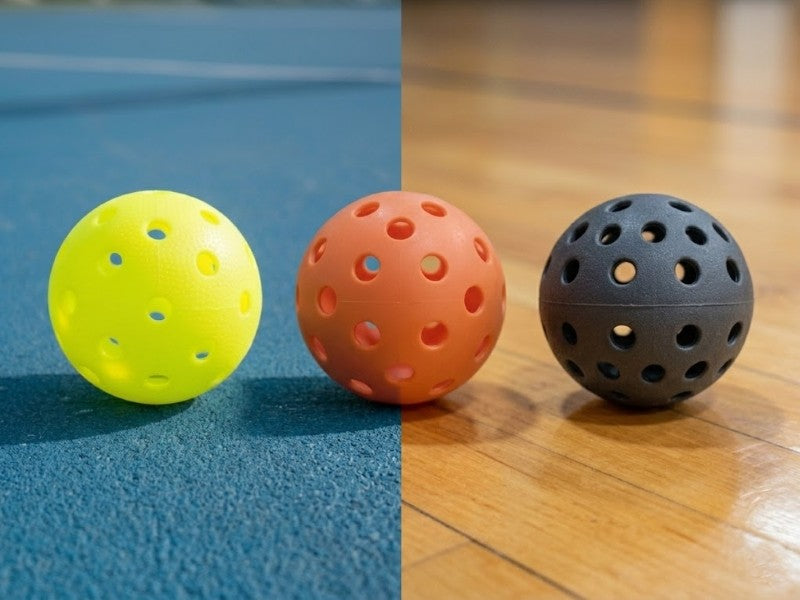
When you pick up a pickleball for the very first time, the tactile experience is deceptively simple. It feels incredibly lightweight, completely hollow, and looks strikingly similar to a retro backyard toy. It immediately begs the question: how on earth does this thin piece of perforated plastic withstand a blistering 60 mph overhead smash from a professional athlete without shattering into a million pieces?
The Anatomy of a Pickleball: USAPA Specifications
If you want to play the game correctly—and especially if you plan on entering any sanctioned tournaments—you cannot play with just any plastic ball you find at a discount store. The manufacturing process and official specifications are strictly governed to ensure fair, consistent gameplay.
Material and Manufacturing Engineering
Modern pickleballs are primarily constructed from high-density rigid plastics, most commonly advanced blends of polyethylene or similar high-molecular-weight polymers. This specific material is chosen for its unique ability to retain its shape after extreme blunt-force impact while remaining incredibly lightweight.
The manufacturing process itself typically falls into one of two distinct categories, which heavily dictates the ball's price and durability:
- Injection and Welded Seam (Two-Piece): This is the traditional method where two separate hemispheres of plastic are injection-molded and then fused together using heat. While cost-effective, the "seam" where the two halves meet can sometimes create a microscopic weak point, making the ball slightly more prone to cracking under extreme stress.
- Rotational Molding (Seamless / One-Piece): Premium and professional-grade balls utilize rotational molding. Liquid plastic is poured into a spinning spherical mold, coating the inside evenly as it cools and hardens. This creates a completely seamless ball with uniform wall thickness, resulting in a perfectly balanced center of gravity, a truer flight path, and vastly superior durability.
Strict USA Pickleball (USAPA) Testing Standards
To receive the coveted "USA Pickleball Approved" stamp, a ball must survive a gauntlet of laboratory tests. The governing body leaves absolutely zero room for guesswork.
- Size Requirements: The diameter of the ball must measure exactly between 2.87 and 2.97 inches. It must be perfectly spherical; any "out of round" manufacturing defects will cause it to instantly fail inspection.
- Weight Limits: A tournament-legal ball must weigh between 0.78 and 0.935 ounces. This incredibly narrow weight window ensures the ball is heavy enough to push through light wind, but light enough to prevent severe physical injury or paddle damage upon impact.
- The Granite Drop Test (Bounce Consistency): To ensure every ball plays identically, the USAPA utilizes a strict drop test. A ball is dropped from a height of exactly 78 inches onto a solid granite surface plate. To pass the test, the ball must bounce upwards to a height between 30 and 34 inches. If it bounces too high (too bouncy) or too low (a dead ball), it is disqualified from sanctioned play.

The Ultimate Showdown: Indoor vs. Outdoor Pickleball Balls
The single most critical piece of knowledge any pickleball player can possess is understanding the fundamental divide between indoor and outdoor balls. While they may look identical to the untrained eye, playing with the wrong ball in the wrong environment will completely destroy the physics of your game.
Outdoor Balls: Engineered for the Elements
Outdoor pickleball is a battle against the elements—specifically wind, extreme temperatures, and incredibly abrasive court surfaces like raw asphalt and painted concrete. To combat this, outdoor balls are designed with brute force and stability in mind.
- The 40-Hole Aerodynamic Design: Outdoor balls are universally recognized by their exactly 40 circular holes. These holes are intentionally drilled smaller than those on an indoor ball. From a fluid dynamics perspective, these smaller holes minimize air drag. When a gust of wind hits the court, the heavier weight of the ball combined with the 40-hole design allows it to cut through the crosswind, maintaining a remarkably straight and predictable flight trajectory.
- Extreme Hardness and The Signature "Pop": Outdoor balls are molded from the hardest, thickest plastic available in the sport. This hardness is required to withstand the severe friction of rubbing against gritty outdoor concrete. It also provides a much faster, sharper bounce off the ground. When you strike an outdoor ball squarely in the sweet spot of a carbon fiber paddle, the stiff plastic creates that incredibly loud, signature "Pop!" sound that echoes across the park.
Indoor Balls: Built for Precision and Control
When you move indoors to a climate-controlled gymnasium or a dedicated indoor facility, the elements disappear. There is no wind to fight, and the ground transitions from abrasive concrete to smooth hardwood, polished concrete, or synthetic PVC sports flooring. The ball must adapt accordingly.
- The 26-Hole Control Design: Indoor balls typically feature exactly 26 holes. Because there is zero wind interference indoors, the ball does not need to be as heavy. The larger holes combined with the lighter weight create a subtle parachute effect. The ball essentially "floats" a fraction of a second longer in the air, creating a slightly slower, highly strategic game that favors precise shot placement and extended, exhausting rallies over pure power.
- Anti-Skid Flexibility: The most crucial feature of an indoor ball is its softer, more pliable plastic construction. If you were to bounce a hard outdoor ball on a polished wooden basketball court, it would simply slide and skid dangerously out of bounds. The softer material of an indoor ball compresses slightly upon impact, allowing it to "grip" the slick floor and generate a true, predictable upward bounce. This softer material also makes the ball dramatically quieter off the paddle, which is ideal for echoing indoor gymnasiums.
Top Pickleball Brands Compared: Which Should You Buy?
Now that you understand the complex engineering and the crucial differences between indoor and outdoor construction, it is time to look at the actual market. If you search for pickleballs online, you will be instantly overwhelmed by hundreds of different brands, all claiming to be the best.
To save you time and money, here is a definitive, side-by-side comparison of the most popular, USAPA-approved tournament balls dominating the industry today.
Franklin X-40 (The Crowd Favorite)
If you walk up to any public outdoor court in the country, there is a 90% chance the players are rallying with a neon optic-yellow Franklin X-40. It has cemented itself as the gold standard for recreational and advanced players alike, and it serves as the official ball of the US Open Pickleball Championships.
- The Pros: The X-40 strikes a perfect balance. It is manufactured from a slightly softer plastic than its hardcore professional rivals. This subtle softness gives the ball a fantastic, predictable bounce and makes it slightly easier to control for dinking and drop shots. It is highly durable and offers excellent visibility.
- The Cons: Because the plastic is marginally softer, the X-40 can become noticeably "mushy" and lose some of its bounce when exposed to extreme summer heat (90°F and above) for prolonged periods.
Dura Fast 40 (The Pro's Choice)
If you watch the professional athletes on the Professional Pickleball Association (PPA) tour, they are almost exclusively hitting the Dura Fast 40. Originally manufactured by Pickleball Inc., this is a ball designed purely for speed and aggression.
- The Pros: The Dura Fast 40 utilizes a patented asymmetrical hole design (holes of varying sizes) and is made from an incredibly rigid, hard plastic. This combination creates a ball that flies aggressively fast through the air and skips sharply off the court surface, making it the ultimate weapon for power players looking to hit unreturnable passing shots.
- The Cons: The extreme hardness is a double-edged sword. While it plays incredibly fast, the Dura Fast 40 has a notoriously short lifespan in cold weather. If the temperature drops below 50°F, one solid overhead smash can shatter the ball instantly. It also has a steep learning curve for beginners who may struggle to control its blistering speed.
Onix Pure 2 & Joola Primo (Durability vs. Performance)
If you are looking for alternatives to the big two, Onix and Joola offer distinct advantages depending on what you value most in a ball.
- Onix Pure 2 (Outdoor): This ball is famous for its almost indestructible durability. It is slightly heavier and utilizes a proprietary welding process that makes it incredibly resistant to cracking. The Pros: You will rarely break an Onix Pure 2, saving you money in the long run. The Cons: It has historically been criticized by tournament players for bouncing slightly too high and feeling a bit heavy off the paddle, making it better suited for casual practice rather than intense competition.
- Joola Primo: As a newer powerhouse in the pickleball space, Joola engineered the Primo ball to bridge the gap between durability and elite performance. The Pros: It features a true seamless rotational molding process, ensuring a perfectly balanced center of gravity and a highly predictable flight path. It holds its shape exceptionally well in warmer climates.
Srikel (The Direct-to-Consumer Disruptor)
While legacy brands dominate the big-box sporting goods stores, Srikel has rapidly emerged as a game-changer in the direct-to-consumer pickleball market. Their philosophy is simple: deliver professional-level performance equipment—including USAPA-approved balls, the renowned FlashCourt net systems, and the Aura series paddles—without the traditional retail markups.

When to Replace Your Ball
Unlike a bowling ball or a golf ball, a pickleball is a consumable item with a definitive lifespan. Playing with a dead or damaged ball will ruin your mechanics and cause extreme frustration. You should routinely inspect your gear for these three fatal flaws:
Hairline Cracks: This is the ultimate death sentence for a pickleball. Even a microscopic, millimeter-long fracture extending from the edge of one of the holes will completely destroy the structural integrity of the ball. To check for cracks, gently squeeze the ball with your thumbs; if a crack exists, the plastic will buckle and separate.
Out of Round (The "Egg" Effect): After absorbing thousands of high-velocity impacts, the plastic will eventually suffer from polymer fatigue and warp. The ball will lose its perfect spherical shape and become slightly oval or egg-shaped. To test this, toss the ball into the air with heavy top-spin; if it wobbles violently like a wounded duck instead of spinning smoothly, it is time to throw it away.
Soft Spots and Dead Bounces: Over time, especially in hot weather, the plastic will simply lose its rigid spring. If you drop the ball from waist height and it barely bounces past your knees, or if the loud, satisfying "Pop" sound turns into a dull, muffled "Thud," the ball is dead.


Leave a comment
This site is protected by hCaptcha and the hCaptcha Privacy Policy and Terms of Service apply.