


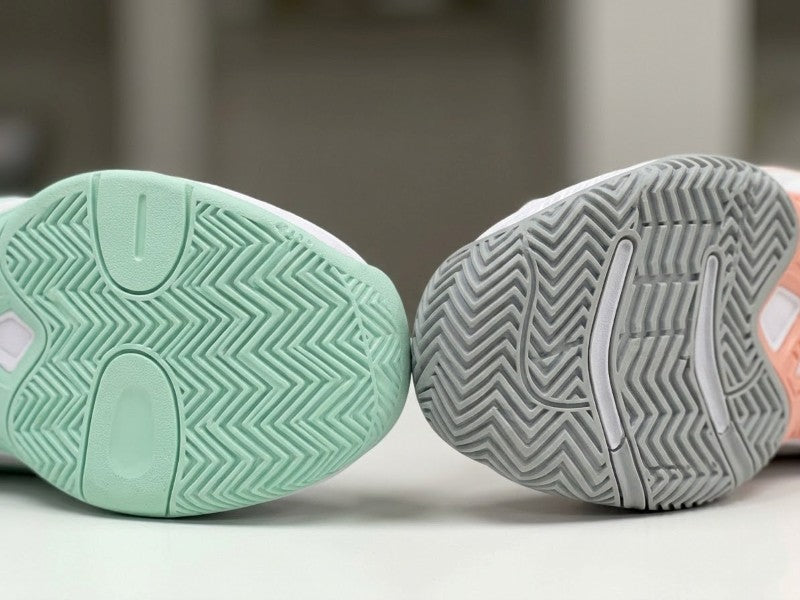
When choosing athletic shoes, many players assume any racquet-sport shoe will work for pickleball. But tennis and pickleball place very different demands on the body. To stay fast, stable, and avoid injury, it’s important to understand that dedicated pickleball shoes for women are essential—not just a marketing gimmick.
The Biomechanics: How Court Movement Differs
To understand why the shoes must be different, we must first analyze how the body moves during each sport. The tread and support structures of a shoe are engineered specifically for the athlete's primary movement patterns.
Tennis: The Baseline Marathon
Tennis involves explosive sprints, long recoveries, and high-impact movements. Players cover large distances, often sliding into shots before pushing back to position. Because of the constant impact and court coverage, tennis shoes are built for durability and cushioning, focusing on shock absorption and long-term wear.
Pickleball: The Kitchen Line Sprint
Pickleball is driven by short, quick movements rather than long runs. Most play happens near the kitchen line, where players rely on rapid lateral steps, quick reactions, and precise footwork. Shoes need to be lightweight and highly responsive—if they’re too heavy or lack grip, even a slight delay can cost you the point.
Anatomy of the Shoe: 4 Technical Differences

Because the movement patterns are so distinct, manufacturers engineer the anatomy of tennis and pickleball shoes quite differently. Here are the four critical technical variations you will find when comparing the two down to their core components.
Difference #1: Outsole Tread Patterns and Grip
The outsole (the very bottom of the shoe) is where the most significant difference lies, dictated by how the foot interacts with the court.
The Tennis Design: Tennis shoes typically feature a uniform "herringbone" (zigzag) pattern across the entire sole. This specific geometry is designed to grip the hard court when pushing off, but it also intentionally permits a controlled lateral slide when the player extends for a wide ball.
The Pickleball Design: Sliding in pickleball is rare and dangerous due to the confined space and the need for instant stops. Pickleball outsoles prioritize absolute traction. Crucially, high-quality pickleball shoes incorporate a circular "pivot point" near the ball of the foot (usually beneath the big toe). This smooth, circular area allows a player to rapidly rotate their foot 180 degrees to chase down a lob without the heavy tread catching on the grit, which prevents severe knee or ankle torque.
Difference #2: Shoe Weight and Responsiveness
The amount of armor a shoe carries directly impacts how quickly a player can react at the net.
The Tennis Design: Tennis shoes are notoriously heavy. The thick rubber outsoles and dense EVA foam midsoles required to absorb the massive shock of a jump serve and long-distance baseline sprints add significant bulk to the shoe.
The Pickleball Design: In pickleball, heavy shoes are a severe liability. When you are engaged in a rapid dink battle, your feet need to feel light and agile. Dedicated pickleball shoes are engineered to strip away excessive, bulky cushioning in favor of thinner, more responsive midsoles. This lighter profile reduces foot fatigue during long tournament days and allows for lightning-fast footwork at the Kitchen line.
Difference #3: The "Drop" and Court Feel
The "drop" of a shoe refers to the physical difference in height between the heel and the forefoot.
The Tennis Design: Tennis shoes often feature a higher heel drop. This elevated heel helps pitch the player forward, biologically aiding in explosive, straight-line sprints to the net to track down drop shots.
The Pickleball Design: Pickleball shoes generally feature a lower heel-to-toe drop. A flatter shoe keeps the player's center of gravity closer to the ground. When you are aggressively shuffling side-to-side, this lower profile provides an enhanced "court feel" and drastic improvements in lateral stability, ensuring your ankles remain balanced and reducing the risk of a rollover injury.
Difference #4: Toe Drag Protection
Both sports cause wear and tear on the front of the shoe, but the biomechanics of how players drag their feet dictate where the protection must be placed.
The Tennis Design: When a tennis player serves, they often drag the medial (inside) edge of their trailing toe across the grit of the court. Consequently, tennis shoes heavily reinforce that specific interior corner.
The Pickleball Design: In pickleball, players drag their toes during entirely different movements—such as lunging forward for a wide dink or dragging the back foot to maintain balance while reaching deep into the Non-Volley Zone. Because the lunging angles are wider and more varied, pickleball shoes feature a broader, more robust Toe Drag Guard that wraps further around the front and top of the toe box, preventing the upper material from shredding on the abrasive surface.
The Danger Zone: Wearing Running Shoes to the Courts
Perhaps the most common—and most perilous—mistake new players make is stepping onto a hard court wearing a pair of plush, expensive running shoes.
Built for Forward Motion Only
Running shoes are marvels of engineering, but they are designed for one very specific purpose: heel-to-toe, straight-line, forward motion. The thick, heavily cushioned foam soles are built to absorb the repetitive impact of jogging. They have absolutely zero lateral (side-to-side) support.
The Rolled Ankle Risk
When you wear a running shoe to play pickleball, you are standing on a tall, unstable platform of soft foam. If you attempt to shuffle quickly along the Kitchen line or abruptly change direction to chase a dink, the soft foam edge of the running shoe will compress unevenly. With no lateral reinforcements to hold your foot over the sole, your foot will slide right off the edge of the footbed, resulting in a severe rolled ankle (inversion sprain) or worse. Never play a competitive court sport in running shoes.
The 3-Step Evaluation Test for the Perfect Shoe
Now that you understand the biomechanics, how do you actually choose the right pair? When trying on a potential pair of pickleball shoes, do not just walk around the store. Perform this 3-step evaluation to ensure they are court-ready.
The Twist Test (Checking the Shank)
Hold the shoe with one hand on the heel and the other on the toe box. Try to twist the shoe in opposite directions (wringing it out like a towel). A good court shoe should be incredibly stiff through the middle and only flex easily near the ball of the foot. If you can easily twist the middle of the shoe, it lacks the torsional support needed for aggressive pivoting.
The Heel Slip Test (Checking the Fit)
Lace the shoes up tightly, using the top eyelet if necessary. Stand on your toes and simulate a forward sprint. Your heel should feel completely locked into the back of the shoe. If you feel any vertical slipping or rubbing against your Achilles tendon, the shoe is either too big or the heel cup is too wide for your specific foot shape.
The Lateral Push-Off Test (Checking Stability)
Stand with your feet shoulder-width apart. Aggressively push off the outside edge of one foot, simulating a lateral shuffle step. You should feel the stiff, reinforced edge of the shoe firmly containing your foot. Your foot should not feel like it is spilling over the side of the sole.
Frequently Asked Questions
Can I wear indoor volleyball shoes for pickleball?
It depends entirely on the surface. Volleyball shoes are fantastic for lateral movement and have incredible grip, but they are designed exclusively for indoor hardwood or polished gym floors. The gum rubber outsoles on volleyball shoes are incredibly soft. If you wear them on a gritty outdoor asphalt or concrete pickleball court, the abrasive surface will chew through the soft rubber in a matter of weeks, destroying the shoe.
How often should I replace my shoes?
As a general rule, if you play 2 to 3 times a week, a high-quality pair of court shoes will last approximately 4 to 6 months. Do not wait for holes to appear in the toe box. The EVA foam midsole that absorbs shock breaks down much faster than the exterior rubber. If your knees or lower back start aching after a session, or if the bottom tread feels completely smooth to the touch, it is time for a new pair.
Should I size up when buying pickleball shoes for women?
Yes, generally by a half-size. During a match, your feet naturally swell, and the constant sudden stops at the Kitchen line force your foot forward. If your shoes are too snug, your toes will repeatedly jam into the hard toe box, leading to painful "black" toenails. Always leave about a thumb's width of space at the front of the shoe for optimal protection.

Leave a comment
This site is protected by hCaptcha and the hCaptcha Privacy Policy and Terms of Service apply.