


If you feel stuck at your current skill level despite playing constantly, the problem isn't a lack of effort—it is the subtle, ingrained bad habits you bring onto the court every time you play. Progressing past the intermediate plateau requires more than just learning new shots; it demands that you actively unlearn the mistakes holding you back.
Habit #1: The Excessive "Tennis" Backswing
The most common—and arguably the most destructive—habit brought over from other racquet sports is the massive, looping backswing. While a huge wind-up generates tremendous power from the baseline, it is a fatal flaw when you move up to the Non-Volley Zone (NVZ).
The Problem: Being Chronically Late
When you are engaged in a fast-paced firefight at the Kitchen line, reaction time is measured in fractions of a second. If you take your paddle back past your hip:
- You Guarantee Late Contact: By the time your paddle travels forward to strike the ball, it is already past your ideal contact zone.
- You Create Pop-Ups: Hitting the ball behind your body naturally opens the paddle face, forcing you to hit an unintentional, defensive lob right into your opponent's smash zone.
- You Get Jammed: You physically will not have time to recover and reset your paddle for the next rapid-fire volley.
The Fix: The Compact Stroke
To survive and thrive at the Kitchen line, you must adopt a compact, punchy stroke.
1. Keep Elbows Forward: Your elbows should rest comfortably in front of your ribs, never tucked behind your body.
2. Never Cross the Hip: Imagine a pane of glass extending sideways from your hips. Your paddle must never break that glass. Keep the paddle head visible in your peripheral vision at all times.
3. Push, Don't Swing: Think of the motion as blocking or pushing the ball. Use your opponent's pace against them. Power at the net comes from a slight weight transfer forward, not from a long, winding arm movement.
Coach's Note: If you hear a loud "whoosh" sound from your paddle during a volley, your swing is too big. Quiet your paddle to quiet your errors.
Habit #2: The "No Man's Land" Creep

The area between the baseline and the Kitchen line is officially the transition zone, but players universally refer to it as "No Man's Land." It is the most dangerous real estate on a pickleball court, yet it is where most recreational players spend half their match.
The Problem: The Off-Balance Scoop
A common and frustrating situation: you hit a solid return and rush toward the net, but don’t reach the NVZ line before your opponents hit their third shot. Caught moving, the ball drops at your feet, leaving you off-balance. You scoop it up awkwardly, sending a high, easy ball that gets put away. You lose the point because your footwork isn’t under control.
The Fix: Master the Split Step
The goal is not just to run blindly to the net; it is to be perfectly balanced and stationary the moment your opponent strikes the ball.
1. Watch the Opponent's Paddle: As you transition forward, stop watching the ball and start watching the angle of your opponent's paddle.
2. The Small Hop: Just before they make contact, perform a small, intentional hop—the split step.
3. Land Wide and Low: Land lightly on the balls of both feet with a wide base and bent knees. This instantly halts your forward momentum.
If you execute the split step correctly, you might still be caught in No Man's Land when they hit the ball, but you are now athletic, balanced, and ready to dig out a low shot, reset it softly into the Kitchen, and then safely continue your journey to the NVZ line.
Coach's Note: Stop running through your shots. It is infinitely better to stop halfway up the court with perfect balance than to arrive at the Kitchen line completely out of control.
Habit #3: The Banger's Trap (Hitting Hard, Not Smart)
Walk by any public court, and you will hear it: the relentless, echoing thwack of players smashing the ball as hard as they can from the baseline. This strategy, affectionately known as "banging," is incredibly effective at the 3.0 level, but it is a guaranteed way to lose against intermediate and advanced players.
The Problem: Feeding the Block
Banging every ball makes your game entirely one-dimensional. The harder you hit a pickleball from the back half of the court, the easier it is for a skilled opponent standing at the NVZ line to simply block it back down at your feet.
- Giving Away Pace: You do the hard work of generating power, only to have it used against you.
- Self-Defeat: Your opponents don't need to swing; they just hold their paddle firm and let your speed create a crisp, effortless volley that puts you immediately on the defensive.
The Fix: Learn the Reset
You must learn to neutralize an attack rather than fight fire with fire. When an opponent hits a hard, deep drive, your primary objective is to take the pace off the ball.
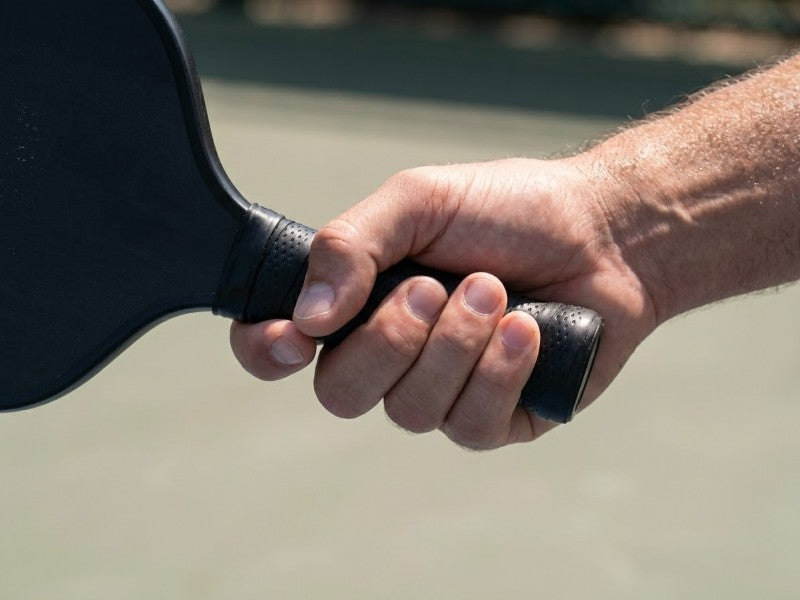
1. Loosen Your Grip: On a scale of 1 to 10, hold the paddle at a 3 or 4. A death grip acts like a trampoline; a loose grip acts like a pillow.
2. Absorb the Pace: Do not swing back. Gently push or block the ball, allowing your relaxed arm to absorb the impact.
3. Force Them to Hit Up: Arc the ball softly so it lands unattackably in their Kitchen (a dink or a drop). By forcing your opponents to hit upward from below the net tape, you instantly neutralize their offensive advantage.
Coach's Note: Stop trying to hit winners from the transition zone. A soft reset that lands in the Kitchen is a hundred times more valuable than a 60mph drive that gets blocked at your shoelaces.
Habit #4: Flat-Footed NVZ Defense
The Kitchen line is where matches are won and lost. Yet, many players arrive at the NVZ line only to stand straight up with their feet planted firmly on the ground, waiting passively for the ball to come to them.
The Problem: Reacting vs. Anticipating
When you stand flat-footed with straight legs at the NVZ, your center of gravity is dangerously high.
- The Awkward Lunge: If your opponent hits a sharp dink or a low, fast drive, you cannot bend quickly enough. You will end up bending at the waist or lunging awkwardly.
- Popped-Up Returns: This poor posture almost always results in the paddle face opening up, turning a defensive shot into a high, floating pop-up for your opponents to smash.
The Fix: The Active Ready Position
The moment you reach the Kitchen line, you must transform from a runner into an active defender.
1. Establish a Wide Base: Keep your feet slightly wider than shoulder-width apart.
2. Engage the Quads: Bend your knees significantly—you should feel your thigh muscles working. Keep your weight slightly forward on the balls of your feet, never on your heels.
3. The 10 o'clock Paddle: Keep your paddle up and out in front of your chest, favoring your backhand side (the 10 or 11 o'clock position if you are right-handed). Most speed-ups will target your body or your backhand, so this position offers the fastest reaction time.
Coach's Note: In an athletic crouch, you are no longer a spectator; you are primed to instantly track down wide dinks or punch back fast speed-ups.
Habit #5: The "Flippy" Wrist on Dinks
Dinking is the most delicate and frustrating part of pickleball. Many players struggle with consistency because they try to "flick" or "scoop" the ball over the net using only their wrist.
The Problem: Loss of Control
Your wrist is a highly unstable joint with a massive range of motion. If you flick your wrist during a dink, the angle of your paddle face changes dramatically in the fraction of a second before contact. This inconsistency causes the ball to either dive straight into the net or pop up dangerously high, giving your opponents an easy put-away.
The Fix: The Shoulder Pendulum
A reliable dink is built on stability, not snap.
1. Lock the Wrist: Establish a firm (but not tight) wrist angle and keep it locked throughout the entire motion.
2. Engage the Shoulder: The motion should come entirely from your shoulder, acting like a pendulum swinging from a fixed point.
3. Push Gently: Instead of swinging up at the ball, focus on a gentle, controlled push forward, ensuring your paddle face remains slightly open (angled upward) but completely stable through the point of contact.
Coach's Note: If your paddle tip finishes pointing at the sky after a dink, you used your wrist. Keep the tip pointing toward your target.
Habit #6: Serving Just to Start the Point
For many recreational players, the serve is simply a formality—a way to get the ball over the net so the "real" game can begin. They gently tap a high, floating ball into the middle of the opponent's service box.
The Problem: Surrendering the Advantage
By hitting a weak, shallow serve, you immediately hand the offensive advantage to the returning team. They can step forward, crush a deep return, and casually jog to the Kitchen line while you are pinned helplessly against the baseline, struggling to execute a 40-foot third-shot drop.
The Fix: Deep & Purposeful Serving
Your serve is the only shot in pickleball over which you have 100% control. Use it as a weapon.
1. Prioritize Depth: Aim for the back third of the service box. A deep serve forces the returner to back up, making their return longer and less accurate.
2. Target Weaknesses: If you know your opponent has a weak backhand, aim your serve consistently toward that side.
3. Add Margin for Error: You don't need a 90mph serve to win. A deep, high-arcing serve that lands two feet inside the baseline is far more effective than a fast serve that frequently hits the net.
Coach's Note: A deep serve delays the opponent's transition to the Kitchen line, making your all-important third shot significantly easier.

How to Drill Properly: Stop Playing Only Games
Understanding how to fix a bad habit is only 10% of the battle; the other 90% is execution. If you only ever play competitive games, you will never break your bad habits. Why? Because during a game, you only hit a specific shot—like a third-shot drop—maybe 15 times, and always under chaotic, unpredictable pressure.
The 80/20 Rule of Progression
To effectively rewire your muscle memory, you need to implement the 80/20 rule: dedicate 20% of your court time to deliberate drilling, and 80% to open play. Spending just 15 minutes before a match hitting 100 consecutive drops from the transition zone will do more for your technique than playing 10 full matches.
Two Golden Drills for Unlearning
1. The "Skinny Singles" Dink Drill: To fix flat-footed defense and flippy wrists, play a mini-game using only half the court (straight across from your partner) where all shots must land in the Kitchen. If you speed the ball up or hit it long, you lose the point. This forces total focus on compact, pendulum-swing dinks.
2. The "Drop and Freeze" Drill: To master the split step and eliminate the "No Man's Land Creep," have your partner stand at the NVZ line and feed you balls while you stand at the baseline. Hit a drop shot and take exactly two steps forward, then freeze. Do not move until your partner hits the ball back. This completely kills the urge to run wildly through your shots.
FAQ
How long does it take to break a bad pickleball habit?
It depends on how deeply ingrained the habit is, but sports psychologists generally suggest it takes anywhere from 300 to 500 perfect repetitions to overwrite an old motor pattern. This is why deliberate drilling is mandatory. In real time, if you practice specifically and consciously, expect to see a permanent change in 3 to 4 weeks.
Why do I play worse when I'm trying to fix my technique?
This is a universally recognized phase in sports learning called the "Implementation Dip." When you force your brain to consciously think about your elbow placement or your split step, you lose your natural rhythm and reaction time. You will play worse for a short period. You must push through this awkward phase; your game will emerge significantly stronger on the other side.

Leave a comment
This site is protected by hCaptcha and the hCaptcha Privacy Policy and Terms of Service apply.