


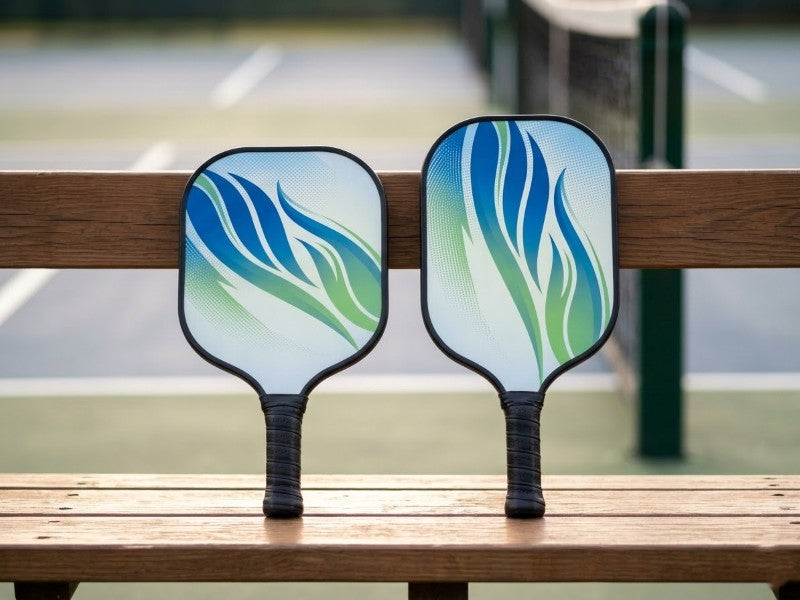
The modern paddle market is flooded with options, but the biggest debate among advancing players comes down to just a half-inch. Does that tiny extra length really matter? Absolutely. It fundamentally alters your swing physics, the location of your sweet spot, and your reaction time at the Kitchen line.
The Science of Paddle Shapes: The USAP "24-Inch Rule"
To understand why paddles are shaped the way they are, you must first understand the strict mathematical boundaries set by the sport's governing body. Paddle manufacturers cannot simply make a paddle as long and wide as they want.
USA Pickleball (USAP) enforces a strict regulation: The combined length and width of a pickleball paddle cannot exceed 24 inches. Because of this 24-inch rule, designing a paddle is a strict zero-sum game. If a manufacturer decides to add a half-inch to the length of the paddle to give you more reach, they are legally required to shave a half-inch off the width of the paddle face. You cannot have the best of both worlds. This mathematical trade-off creates the two dominant categories of paddles on the market today:
- The Standard (Widebody) Shape: Typically measures around 15.5 to 16 inches in length and roughly 8 inches in width. This is the traditional, squarer shape.
- The Elongated Shape: Typically measures 16.5 inches in length and narrows down to 7.5 inches in width.
That missing half-inch of width on an elongated paddle is the catalyst for a massive shift in how the paddle performs, behaves, and feels in your hand.

The Anatomy of Elongated Pickleball Paddles
Elongated pickleball paddles dominate the pro tours for a reason, but their extended reach comes with severe biomechanical trade-offs. Here is exactly how that shape alters your game.
Advantage 1: Maximum Reach and Leverage (Power)
The 16.5-inch length helps you dig out third-shot drops and reach wide passing shots. More importantly, it creates a longer lever. The further the paddle head is from your wrist, the faster it travels during a swing. This generates effortless, crushing power on baseline drives and overhead smashes.
Advantage 2: Two-Handed Backhand Friendly
Elongated faces are almost always paired with extended handles (5.25" to 5.5" long). This provides former tennis players the necessary real estate to comfortably stack both hands without their top hand overlapping the paddle face.
The Trade-off 1: A Narrow, Shifting Sweet Spot
A longer paddle does not mean a larger sweet spot. Because it is only 7.5 inches wide, you lose horizontal forgiveness. Off-center strikes cause the paddle to twist in your hand (torque), resulting in a dead ball. Furthermore, the physical sweet spot shifts higher up the paddle face, requiring much greater eye-hand precision.
The Trade-off 2: Higher Swing Weight (Slower Hands)
Because the paddle is longer, its mass is located further away from your hand. This drastically increases its swing weight (how heavy it feels in motion), even if the static weight on a scale is light. While a high swing weight adds baseline power, it acts as an anchor at the Kitchen line, slowing down your reaction time during rapid-fire volley battles.

The Anatomy of Standard Pickleball Paddles
If elongated pickleball paddles are the heavy artillery, standard (or widebody) paddles are the tactical shields. Measuring roughly 16 inches long and a full 8 inches wide, these paddles prioritize maneuverability and defense over raw, baseline power.
Advantage 1: A Massive, Forgiving Sweet Spot
By maximizing the 8-inch width limit, standard paddles offer a huge horizontal sweet spot. This extra width provides incredible stability. If you strike the ball off-center during a rapid volley, the paddle resists twisting (torque), making it unmatched for blocking hard drives and resetting dinks.
Advantage 2: Lightning-Fast Hand Speed
A shorter paddle keeps its mass centralized closer to your hand, drastically lowering the swing weight. At the Kitchen line, this lower swing weight makes the paddle feel weightless and agile, allowing you to react to fast speed-ups instantly and win rapid-fire hand battles.
The Trade-off: Reduced Power and Crowded Handles
Without the extended lever arm of an elongated paddle, generating baseline power requires much more physical effort and core rotation. Additionally, to maximize the 16x8 paddle face, handles are often restricted to 4.75 or 5.0 inches. This can feel incredibly cramped if you have large hands or rely on a two-handed backhand.
Head-to-Head: Which Playstyle Matches Which Shape?
Now that the biomechanics are clear, it is time to look in the mirror. You should never buy a paddle simply because a touring pro uses it; you must buy the shape that supplements your specific weaknesses and amplifies your strengths.
The Tennis Transitioner -> Winner: Elongated
If you are coming to pickleball from a tennis background, you are already accustomed to swinging a 27-inch racquet with a long handle. A standard pickleball paddle will feel completely alien, like playing with a ping-pong paddle. Elongated pickleball paddles offer the longer grip necessary for your two-handed backhand and provide the extended leverage you need to hit the heavy, topspin baseline drives that tennis players naturally favor.
The Doubles Specialist / Control Player -> Winner: Standard
If you pride yourself on your "soft game"—executing flawless third-shot drops, engaging in 20-shot dink rallies, and blocking overhead smashes back into the Kitchen—you need a standard widebody paddle. The massive sweet spot ensures your delicate drops do not pop up due to off-center hits, and the low swing weight guarantees you will never be late to block a sudden speed-up.
The Singles Aggressor -> Winner: Elongated
Singles pickleball is an entirely different sport than doubles. It is a game of court coverage, passing shots, and brute force. You need every fraction of an inch of reach to run down wide angles, and you need the massive leverage to hit groundstrokes that penetrate the court. In singles, the elongated shape is the undisputed king.
The True Beginner -> Winner: Standard
When you are first learning the mechanics of pickleball, your hand-eye coordination is still developing. You will frequently hit the ball off-center. An elongated paddle will punish those mistakes, twisting in your hand and killing the shot. A standard paddle acts as a set of training wheels, offering maximum forgiveness and a giant sweet spot while you build your confidence and perfect your stroke mechanics.
FAQ
Do elongated pickleball paddles cause tennis elbow?
They absolutely can if you are not careful. Because elongated paddles have a higher swing weight, they require more force to maneuver. If you have a tendency to "arm" the ball (swinging entirely from the elbow and wrist rather than rotating your core and shoulders), the increased leverage of the longer paddle head will put significantly more strain on your elbow tendons. If you suffer from tennis or golfer's elbow, dropping down to a standard shape with a lower swing weight is highly recommended.
Can I use an elongated paddle for doubles?
Yes, and many professionals do. However, you must be honest about your own reaction time. Using an elongated paddle in doubles means you are trading hand-speed at the net for power and reach. If you already have incredibly fast reflexes, you can overcome the sluggish swing weight. If you frequently find yourself getting "jammed" by fast balls at the net, an elongated paddle will only make that problem worse.
What is a "hybrid" pickleball paddle shape?
If you cannot decide between the reach of an elongated pickleball paddle and the wide sweet spot of a standard shape, manufacturers now offer "hybrid" models. These typically measure around 16.25 to 16.4 inches in length and roughly 7.6 to 7.8 inches in width. They often feature a slightly curved or aerodynamic top edge to reduce drag. Hybrids are designed as a middle-ground compromise, offering slightly more leverage and reach than a standard paddle, but with a faster, more manageable swing weight than a fully 16.5-inch elongated paddle.

Leave a comment
This site is protected by hCaptcha and the hCaptcha Privacy Policy and Terms of Service apply.