


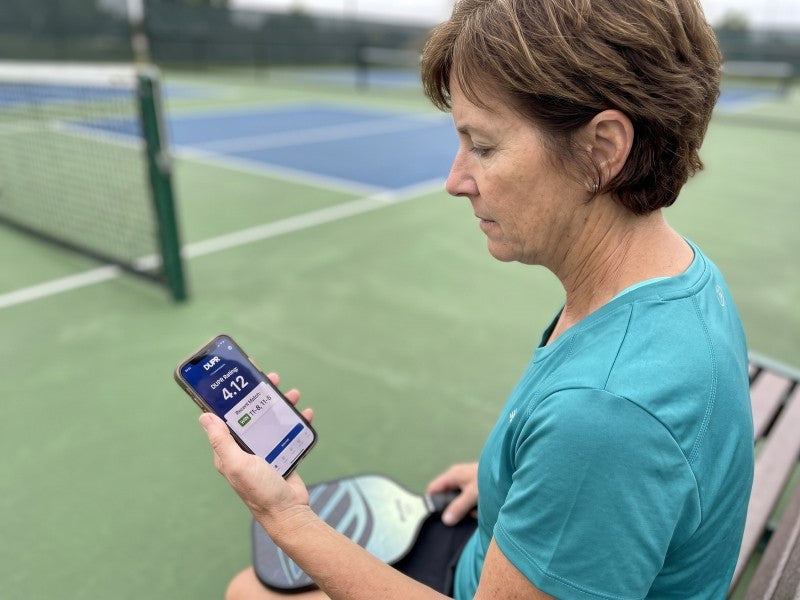
Imagine walking onto your local courts on a busy Saturday morning, feeling confident about your game. You ask to mix in with a group of four, and the first question they ask you is, "What's your DUPR?" If you respond with a blank stare, you are missing out on the single most important metric in modern pickleball.
If you are new to the sport, you are probably asking: what is DUPR? DUPR stands for Dynamic Universal Pickleball Rating. It is the most accurate global rating system used to evaluate a player's skill level, ranking everyone from beginners to touring professionals on a single, continuous scale of 2.00 to 8.00.
The Short Answer: The Definition of DUPR
To fully understand why DUPR has completely taken over the pickleball ecosystem, we first need to unpack the acronym and the mathematics behind the numbers.
The Acronym Explained
- Dynamic: Your rating is never frozen. It is a living, breathing number that fluctuates weekly (or even daily) based on your most recent match results. If you improve, your number goes up.
- Universal: This is DUPR's greatest triumph. In the past, ratings were separated by age and gender. DUPR merges everyone into a single, universal system. A 4.0 rating means the exact same thing whether you are a 22-year-old male college athlete or a 65-year-old female retired teacher. It evaluates pure skill, completely blind to demographics.
- Pickleball Rating: It is an algorithm built from the ground up specifically for the unique scoring mechanics, side-outs, and rally data of pickleball.
The 2.00 to 8.00 Scale
Before DUPR, players used broad, clunky categories like "I am a 3.5" or "I play at a 4.0 level." DUPR brought mathematical precision to the sport by using a three-digit system with two decimal places (for example, 3.45 or 4.12).
- 2.00 to 2.99: Absolute beginners to early novices.
- 3.00 to 3.99: The massive "intermediate" middle class of pickleball where most recreational players sit.
- 4.00 to 4.99: Advanced players who have mastered the "soft game" (dinking) and strategic positioning.
- 5.00+: Elite amateurs, sponsored players, and touring professionals. (For context, generational talents like Ben Johns and Anna Leigh Waters hover in the elite 6.50 to 7.00+ stratosphere).
This extreme decimal precision eliminates the "grey area" of skill gaps, ensuring that when two 3.75 players step onto the court, the match will be a nail-biter.
The Old Way vs. The DUPR Way: Why Did Pickleball Change?
To appreciate DUPR, you have to understand the chaotic "dark ages" of pickleball ratings that existed before it.
The Problem with Self-Rating
For years, the sport relied heavily on traditional self-rating systems and the early UTPR (USA Pickleball Tournament Player Rating). Players essentially guessed their own skill level based on an arbitrary checklist of abilities. This created two massive problems:
- Sandbagging: This is the most infamous plague in amateur sports. A highly skilled 4.5 player would purposefully register themselves as a 3.5 in a local tournament just to easily win a gold medal. It completely ruined the competitive integrity of amateur events.
- Ego and Delusion: Conversely, many players suffered from the Dunning-Kruger effect. They believed they were legitimate 4.0 players because they could hit the ball hard, completely ignoring their lack of strategy or unforced errors. This resulted in incredibly lopsided, frustrating recreational games.
The Algorithm Revolution
DUPR stepped in to fix this chaos. Backed by Major League Pickleball (MLP) and adopted globally, DUPR acts very much like the famous Elo rating system used in international chess. It is cold, objective mathematics.
DUPR removed human emotion, guesswork, and ego from the equation, forcing everyone to let their paddle do the talking. By 2026, almost all serious tournament directors and private pickleball clubs have abandoned self-rating entirely, requiring a verified DUPR score just to step foot on the court.

How Does the DUPR Algorithm Actually Work?
This is where DUPR separates itself from traditional "win/loss" sports rankings. DUPR is an advanced, AI-driven algorithm. In this system, you do not simply get points for winning. How you win and who you beat dictate absolutely everything.
Here are the three core pillars of the DUPR algorithm:
1. Margin of Victory (Points Matter)
In a traditional sport like tennis or basketball, a win is a win, regardless of the score. DUPR completely rejects this philosophy. Every single point matters.
If your team beats an opponent 11-0, the algorithm recognizes total dominance and will reward you with a significant rating boost. However, if you beat that exact same team 11-9, the algorithm recognizes that the teams are actually very evenly matched. You will still get a slight bump for the victory, but it will be a fraction of the reward of an 11-0 blowout.
The Tactical Takeaway: Never take your foot off the gas. Giving your opponents "pity points" when you are up 10-1 actively damages your own DUPR rating.
2. Expected vs. Actual Outcome (The Upset Mechanic)
Before you even serve the first ball, the DUPR algorithm calculates the mathematical probability of who will win based on everyone's current rating. It generates an "Expected Outcome." Your rating changes based on how your real-world performance compared to that expectation.
- The Miracle Loss: Let's say you (a 3.00 player) play against a certified 4.50 pro. The system expects you to lose violently, perhaps 11-1. If you play the match of your life and lose 11-9, your DUPR rating will actually go up, even though you lost the game! You vastly outperformed the algorithm's expectations.
- The Disappointing Win: Conversely, if that 4.50 player struggles and only beats you 11-9, their rating will actually drop despite securing the victory. They performed well below their statistical expectation.
3. Recency and Half-Life (The Freshness Factor)
Your DUPR rating is an accurate snapshot of how good you are right now, not how good you were two years ago.
The algorithm uses a half-life mechanic for historical data. A match you played yesterday carries 100% of its mathematical weight. A match you played six months ago carries significantly less weight, and a match from two years ago is almost entirely phased out of your current score. This prevents legacy players from sitting on a high rating without defending it, and it allows rapidly improving beginners to see their score shoot up without being forever dragged down by the terrible matches they played when they first bought a paddle.
The DUPR Scale Explained: Where Do You Actually Fit?
Now that we know how the algorithm calculates the math, what do these numbers actually look like on the court? If you are trying to estimate your current level before logging your first match, here is a breakdown of the four major DUPR brackets and the specific skills associated with them.
2.00 - 2.99: The Beginner Phase
If you score in the 2.00s, you are likely in your first few months of playing pickleball.
- Characteristics: Players in this bracket are primarily focused on just getting the ball over the net and keeping it inside the baseline. Rallies are incredibly short, often ending in one or two shots.
- Weaknesses: There is virtually no strategy. "Dinking" at the Kitchen line is non-existent, and points are usually given away by unforced errors, such as serving directly into the net or popping the ball up too high.
3.00 - 3.99: The Intermediate Grinder
This is the massive "middle class" of the pickleball world. The vast majority of recreational players who play on weekends sit comfortably somewhere in the 3.00s.
- Characteristics: You understand the rules perfectly and can sustain a medium-paced rally. You know that you should move up to the Non-Volley Zone (the Kitchen) and you attempt to hit soft, strategic shots.
- Weaknesses: Inconsistency is the defining trait of the 3.00s. A 3.50 player might hit a beautiful, professional-looking Third Shot Drop, but then immediately hit the next three shots straight into the fence. They lack the defensive resets required to survive a fast-paced "firefight" at the net.
4.00 - 4.99: The Advanced Strategist
When you cross the 4.00 threshold, you transition from playing "ping-pong on a tennis court" to playing true, tactical pickleball.
- Characteristics: 4.00+ players have extremely high consistency. They dictate the pace of the game, intentionally slowing it down with precise, unattackable dinks, and violently speeding it up when their opponent makes a mistake. They utilize advanced strategies like "stacking" and aggressively target their opponents' weaknesses.
- Weaknesses: The only thing separating a 4.50 player from a 5.00+ player is microscopic margin for error and the ability to handle extreme, elite-level power.
5.00+: The Elite & Pro Tier
This is the pinnacle of the sport.
Characteristics: Players with a DUPR of 5.00 or higher are local club champions, sponsored athletes, and touring professionals. Their mechanics are flawless. They can seamlessly transition from brutal, high-speed drives to feather-light drops in the blink of an eye.
Step-by-Step Guide: How to Get Your Initial DUPR Rating
If you are tired of guessing your skill level and want to join the global leaderboard, getting your initial DUPR rating is incredibly straightforward. Here is the exact process:
Step 1: Create a Free Account
Download the official DUPR mobile app or visit their website. Creating a player profile is 100% free. You will be assigned a unique DUPR ID, which will act as your digital passport for all future pickleball events.
Step 2: Log Your Recreational Matches
You do not need to wait for a tournament to get a rating. You can log standard recreational games at your local park. After a match, open the app, enter the final score, and tag the three other players involved. The app will send them a notification to "validate" the score. Once they hit accept, the data is fed into the algorithm.
Step 3: Play in DUPR Sanctioned Events
While self-logged recreational matches are great, "Verified" match data is king. To get the most accurate rating possible, sign up for a local DUPR Sanctioned Tournament or a club "Waterfall" event. In these events, the club director uploads the official scores, which carry a much higher trust weight in the algorithm.
Understanding Your Reliability Score
When you first start logging matches, you will notice an asterisk (*) next to your rating, or a low "Reliability Percentage." This means your rating is still provisional. The algorithm needs a sufficient sample size of data to trust its own math. Usually, it takes between 10 to 15 recent matches against a variety of different opponents for your rating to stabilize, shed the asterisk, and become a fully reliable DUPR.

Pro Tips: How to Increase Your DUPR Score Faster
Everyone wants their number to go up. While the most obvious answer is "get better at pickleball," there are distinct ways to optimize your match selection to feed the algorithm exactly what it wants to see.
"Win by More, Lose by Less"
Because DUPR weighs every single point heavily, you must adopt a ruthless mindset on the court. If you are destroying an opponent 10-1, do not start attempting flashy trick shots; close the game out at 11-1 to maximize your points gained. Conversely, if you are losing 10-2, do not give up. Fighting tooth and nail to make the final score 11-6 will significantly cushion the blow to your rating.
Seek Out Higher-Rated Opponents
The algorithm heavily punishes you for losing to lower-rated players, but it generously rewards you for challenging higher-rated players. Playing against people with a higher DUPR is a "low-risk, high-reward" scenario. If you lose, the system expected you to lose anyway, so your rating barely moves. But if you manage to keep the game incredibly close—or pull off a miracle upset—your rating will skyrocket.
Consistency in Partnerships
In doubles, DUPR calculates the "Expected Outcome" by averaging your rating with your partner's rating. If you constantly play with wildly erratic partners, you introduce massive variance into the algorithm. Finding a steady, consistent partner whose playstyle complements your own will lead to far more predictable match outcomes, allowing your DUPR to climb steadily without violent drops.
Frequently Asked Questions (FAQs) About DUPR
Can my DUPR score go down even if I win the match?
Yes, absolutely! This is the most shocking realization for new players. If you are a 4.50 and you play against a 3.00, the algorithm expects you to win 11-0. If you play lazily and only win 11-9, the algorithm views this as a massive underperformance. You won the game, but your rating will drop because you failed to meet the mathematical expectation.
Does my bad partner drag my DUPR down?
Not inherently. The algorithm is smart enough to average your team's rating. If a 4.50 pairs with a 2.50, the team average is 3.50. The system expects you to perform like a 3.50 team. However, if your opponents ruthlessly target your weaker partner and you lose the match badly, your individual rating will suffer because you are sharing the team's defeat.
Is the DUPR app free to use?
Yes. The core functionality—creating a profile, searching for other players, logging recreational matches, and tracking your rating—is completely free. While there are premium tools and club-management features that cost money, the individual player experience costs nothing.


Leave a comment
This site is protected by hCaptcha and the hCaptcha Privacy Policy and Terms of Service apply.