


For years, the pickleball equipment industry was obsessed with a single metric: raw power. Manufacturers chased stiffer faces, thicker honeycombs, and aggressive aerodynamic shapes, all designed to help players hit the plastic ball harder and faster. But as the sport has matured through 2026, a massive shift has occurred. Players are realizing that power means nothing if you cannot control the ball—and it means even less if your elbow is in too much pain to swing the paddle.
Enter the greatest technological leap in modern racket sports: the foam core pickleball paddle.
Phase 1: The Physics & Material Science of Foam Cores
To understand why a foam core feels so radically different on the court, we have to understand the fundamental flaws of traditional paddle engineering. A paddle is not just a piece of sporting equipment; it is a complex acoustic and kinetic instrument.
The Engineering Evolution: Beyond the Honeycomb
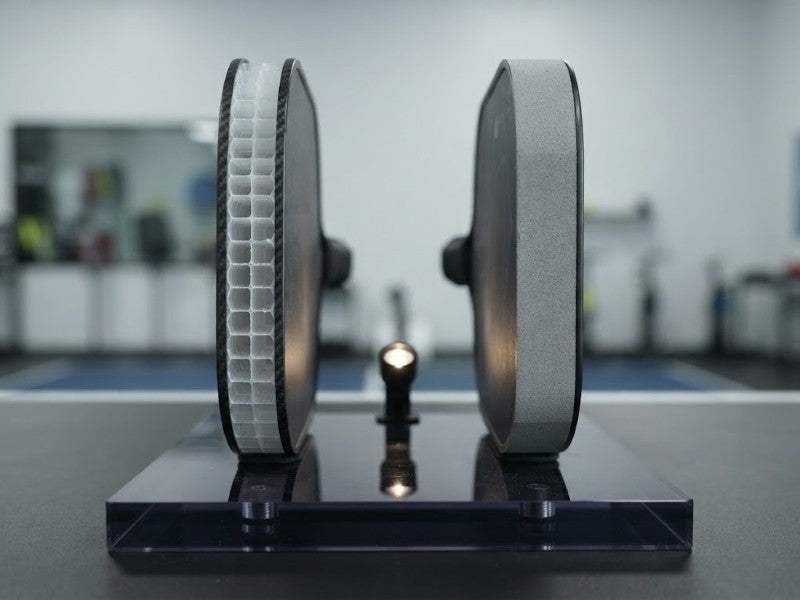
Historically, 95% of pickleball paddles were manufactured using a polymer honeycomb core. If you were to cut one of these traditional paddles in half, it would look like a plastic beehive—thousands of hollow, hexagonal cells glued between two sheets of fiberglass or carbon fiber. While this design is incredibly lightweight and rigid, it is still fundamentally hollow. When the ball strikes a hollow structure, the energy creates a sharp, high-frequency vibration.
A foam core pickleball paddle abandons the hollow honeycomb grid in favor of a solid, continuous cellular structure. Modern iterations utilize high-density EVA (Ethylene-Vinyl Acetate) foam or proprietary aerospace-grade structural foams.
- Thermoformed Foam Walls: Many high-end modern paddles use a hybrid approach, injecting dense foam around the entire perimeter of a honeycomb grid, sealing it shut under immense heat and pressure.
- Solid Foam Cores: Other specialized paddles use a 100% solid foam slab.
Because foam is a viscoelastic material, it possesses both fluid-like and solid-like properties. It can compress under pressure and immediately snap back to its original shape, entirely changing the physics of how the paddle interacts with the ball.
Dwell Time Mechanics
In racket sports, control and spin are largely dictated by a metric called "dwell time." Dwell time is the microscopic fraction of a second that the ball remains physically compressed against the paddle's face before rebounding over the net.
When a pickleball hits a stiff, traditional honeycomb paddle, the impact is violent and instantaneous. The ball aggressively bounces off the rigid face, resulting in a low dwell time. This is great for a fast-paced drive, but terrible for control.
Because a foam core is inherently compressible, it acts like a microscopic mattress. When the ball strikes the face, the foam core slightly gives way, "cradling" the plastic ball for a few milliseconds longer.
- Increased Friction: This extended dwell time allows the raw grit of your carbon fiber face to bite deeply into the plastic of the ball.
- Maximum RPMs: By holding the ball just a fraction of a second longer as you brush up on your swing, a foam core allows you to generate massive amounts of topspin (Revolutions Per Minute) that simply are not possible on a rigid board.
Eradicating the Dead Zones
Every pickleball player knows the frustration of a "dead spot." You swing perfectly, but the ball strikes the paddle near the edge guard. Instead of flying over the net, it makes a dull thunk and plummets straight into the ground.
Dead spots occur in traditional paddles because the honeycomb core loses its structural integrity near the edges where it meets the plastic guard. The energy simply dissipates into the frame.
Foam core technology completely eradicates this issue. By injecting high-density foam around the entire perimeter of the paddle (often called Edge Foam Injection), engineers create a uniform density from the absolute center to the outer rim.
- Increased Moment of Inertia (MOI): The added weight of the foam around the edges acts as perimeter weighting. This prevents the paddle from twisting in your hand on off-center hits.
- Edge-to-Edge Consistency: Whether you hit the ball dead center or an inch from the edge guard, the foam core compresses and returns energy uniformly, effectively expanding the sweet spot to encompass nearly the entire face of the paddle.
Phase 2: Solving the Tennis Elbow Epidemic (Biomechanics)
While the performance benefits of foam are incredible, they are secondary to the primary reason this technology is taking over the market: injury prevention. The pickleball community is currently facing an epidemic of upper extremity injuries. If you are wearing a compression brace on your forearm just to survive a weekend tournament, you are the victim of bad material science.
Why Pickleball Hurts
To solve the pain, we must understand the biomechanics of lateral epicondylitis, commonly known as tennis elbow.
A standard outdoor pickleball is essentially a hard, 26-gram piece of rigid plastic. When that ball impacts a stiff carbon fiber and hollow honeycomb paddle at 40 miles per hour, it generates a massive shockwave of kinetic energy.
Because the traditional paddle is rigid, it cannot absorb this energy. Instead, the shockwave travels:
1. Through the paddle face.
2. Down the paddle shaft.
3. Into the handle.
4. Directly into the flexor and extensor tendons of your forearm.
When you repeat this violent kinetic transfer 1,000 times during a three-hour playing session, you cause micro-tears in the tendons attaching your forearm muscles to the outside of your elbow. The result is chronic, agonizing inflammation.
The Ultimate Shock Absorber
This is exactly where the foam core pickleball paddle transitions from a piece of sports gear into an orthopedic tool.
Foam is naturally dampening. Think of the shock absorbers on a car, or the thick foam midsoles of premium running shoes. When the hard plastic ball strikes a foam core paddle, the cellular structure of the foam forces the kinetic energy to navigate through millions of microscopic air pockets and rubberized barriers.
By the time the impact wave reaches the paddle's handle, the foam has absorbed, scattered, and dissipated up to 40% of the harsh, high-frequency vibrations. You still feel a solid, connected "thud" when you hit the ball, but the violent, tendon-rattling "buzz" is completely neutralized. For players suffering from joint pain, switching to a foam core feels like taking off heavy work boots and stepping into a pair of plush, memory-foam slippers.
Equipment Meets Physiology
It is important to note that while a foam core paddle is the ultimate preventative measure, it is not a magical medical cure for a fully ruptured tendon. If you are actively suffering from severe tennis elbow, upgrading your equipment must be paired with active physical rehabilitation.
As we covered in our previous guides on racket sport fitness, equipment upgrades work best when combined with anatomical strengthening. To fully eradicate elbow pain, pair your new foam core paddle with:
- Eccentric Forearm Exercises: Utilizing tools like a FlexBar to perform the "Tyler Twist," which strengthens the extensor tendons under tension.
- Shoulder Stabilization: Strengthening your rotator cuff and scapula so that your larger muscle groups absorb the force of your swing, rather than isolating the stress onto your fragile elbow joint.
- Grip Size Optimization: Ensuring the handle of your new foam paddle is thick enough. A grip that is too small forces you to squeeze the paddle with a "death grip," which immediately inflames the forearm tendons.
By combining the kinetic absorption of a foam core paddle with a stronger, healthier arm, you ensure that you can stay on the court for decades to come, playing completely pain-free.

Phase 3: Foam Core vs. Traditional Honeycomb
Understanding the science is one thing, but how does that translate when you are tied 10-10 in a gold medal match? If you are standing in a pro shop holding a traditional polymer honeycomb paddle in one hand and a modern foam core pickleball paddle in the other, here is exactly how they compare in real-world conditions.
Acoustic Profiling: The HOA Savior
Beyond performance, the most controversial aspect of pickleball in 2026 is the noise. The sharp, high-pitched "pop" of traditional hollow honeycomb paddles has led to countless community noise complaints, HOA bans, and even lawsuits.
This acoustic signature is caused by the high-frequency reverberation of the hollow plastic cells upon impact. Because foam is dense and continuous, it acts as acoustic insulation. When a ball strikes a foam core paddle, it produces a muted, low-decibel "thud" rather than a piercing "crack."
· The Verdict: If you play in a noise-restricted neighborhood, a country club with strict acoustic rules, or simply prefer a quieter game that allows you to hear your partner communicate, foam core technology is an absolute necessity.
Performance Tradeoffs: Power vs. Plush Control
There is a give-and-take in material science. While foam cores excel in almost every category, they do require a slight adjustment in your swing mechanics.
· Traditional Honeycomb: Acts like a stiff trampoline. The ball leaves the paddle face almost instantly, rewarding players with explosive, effortless power on drives and overhead smashes. However, this makes resetting hard-hit balls at the Kitchen line incredibly difficult, as the ball naturally wants to pop up.
· Foam Core: Acts like a catcher's mitt. Because of the prolonged dwell time, the paddle naturally absorbs the pace of incoming attacks. This makes hitting third-shot drops and defensive resets vastly easier. You will have unparalleled control, but you may need to rely a bit more on your own body rotation and core strength to generate maximum power from the baseline.
2026 Buyer’s Guide: Is a Foam Core Right for You?
Not every paddle fits every player. Upgrading to a foam core is a significant investment (often ranging from $150 to $250). Here is how to determine if it is the right fit for your game, and how to navigate the complex world of paddle certifications.
Playstyle Matching: Who Needs Foam the Most?
You should immediately upgrade to a foam core if you fit any of the following profiles:
1. The "Tennis Elbow" Sufferer: If you experience any joint, forearm, or shoulder pain after playing, the vibration-dampening properties of foam are non-negotiable.
2. The Strategic Dinker: If your game relies on patience, moving your opponents around the court, and outlasting them in soft dink rallies, the plush feel of foam will elevate your consistency.
3. The Reset Specialist: If you frequently play against "bangers" (players who hit the ball as hard as possible), a foam core acts as a shield, effortlessly absorbing their power and dropping the ball softly into the Kitchen.
Navigating USAP Compliance in 2026
You must be extremely careful when purchasing a foam paddle. In recent years, USA Pickleball (USAP) has cracked down heavily on paddle technology, specifically targeting "deflection" (how bouncy the paddle is).
Early iterations of 100% pure EVA foam paddles (like the infamous Diadem Vice) were incredibly quiet and plush, but they were banned from official tournament play because they functioned too much like a trampoline, giving players an unfair advantage.
· The Solution: When shopping in 2026, look for Thermoformed Paddles with Edge Foam Injection. These paddles utilize a USAP-approved polymer core in the center but inject dense foam around the entire perimeter and under the edges. This gives you the expanded sweet spot, the vibration dampening, and the plush feel of foam, while still strictly retaining the "USA Pickleball Approved" seal required for tournament play.
Frequently Asked Questions (FAQs)
Are foam core paddles heavier than traditional paddles?
Generally, yes, but only by a fraction of an ounce. The injection of perimeter foam slightly increases the paddle's static weight (usually pushing it into the 8.0 to 8.4 oz range). However, because this weight is distributed around the edges, it increases the paddle's stability and prevents it from twisting in your hand, making the extra weight feel completely balanced.
How long does a foam core pickleball paddle last?
For the average recreational player hitting the courts three times a week, a high-quality thermoformed foam paddle will retain its optimal structural integrity for 6 to 8 months. Competitive tournament players who hit with extreme force may need to replace their paddles every 3 to 4 months as the foam inevitably begins to compress and lose its "pop."
Can I use a foam paddle if I am a beginner?
Absolutely. While advanced players love the spin, beginners benefit immensely from the expanded sweet spot. A foam core paddle is far more forgiving on mishits, helping new players keep the ball in play while developing their technique.


Leave a comment
This site is protected by hCaptcha and the hCaptcha Privacy Policy and Terms of Service apply.