


You have officially caught the pickleball bug. But as you walk past the dusty dumbbells sitting in the corner of your garage, a nagging question creeps into your mind: Is swinging a paddle enough to maintain muscle mass?
If you are trading your gym membership for a paddle and wondering, does pickleball do any strength training at all? The honest answer is: Yes and No.
While pickleball provides excellent muscular endurance and bodyweight toning for your legs and core, it lacks the progressive overload required to build true muscle mass or completely replace traditional strength training.
The Science of the Swing: Muscular Endurance vs. True Strength
To answer whether pickleball counts as strength training, we first need to define what "strength" actually means in the fitness world. Most players confuse muscular endurance with hypertrophy (muscle growth). Pickleball is a masterclass in the former, but it structurally fails at the latter.
What Pickleball Actually Does (Muscular Endurance)
Pickleball is a high-intensity, bodyweight-driven aerobic activity. When you are on the court, you are constantly starting, abruptly stopping, changing directions, and holding low athletic stances.
This repetitive action trains your muscles to process oxygen more efficiently and sustain contractions over a long period without fatiguing. This is called muscular endurance. It is the reason your legs feel "tighter" and your overall physique looks more toned. You are burning fat and conditioning your muscle fibers to last through a two-hour session, but you are not necessarily making those muscles larger or fundamentally stronger.
The Missing Element: Progressive Overload
Here is why pickleball cannot replace the weight room: the biological law of progressive overload.
For a muscle to grow in size and raw strength, it must be subjected to a stress it has never experienced before, which causes microscopic tears in the muscle fibers. As they heal, they grow back thicker. To keep growing, you have to continually lift heavier weights.
A standard pickleball paddle weighs roughly 8 ounces. Your body weight remains relatively fixed. No matter how hard you swing or how many hours you play, you are never increasing the physical load on your muscles. You are simply asking them to move the exact same lightweight resistance thousands of times. It is a phenomenal workout, but it is not true strength training.

The Anatomy of a Match: Which Muscles Does Pickleball Work?
Even though you are not going to look like a bodybuilder from playing pickleball, the sport does force your body to engage specific, highly targeted muscle groups. If you wake up incredibly sore after a long tournament, here is the anatomical breakdown of where that effort went.
The Lower Body: Quads, Calves, and Glutes
Pickleball is undeniably a lower-body workout. While the court is small, the sheer volume of micro-movements is staggering.
- The "Dinking" Stance: When you are pulled up to the Non-Volley Zone (the Kitchen), you must stay low to handle soft shots. This requires a sustained, isometric hold in a half-squat position, which sets your quadriceps and glutes on fire.
- Lateral Lunges: Because you are constantly covering the 20-foot width of the court, your body relies on aggressive side-shuffles and lateral lunges. This heavily recruits your abductors and adductors (outer and inner thighs)—muscle groups that are entirely ignored during linear exercises like running or cycling.
- Calves: Staying on the balls of your feet in the "ready position" acts as a continuous calf raise, building dense, springy lower leg muscles.
The Core & Obliques: The Power Engine
One of the biggest misconceptions among beginners is that you hit the ball with your arm. In reality, a high-level pickleball drive is generated from the ground up and transferred through your core.
- Torso Rotation: Every time you wind up for a powerful forehand or backhand drive, you are violently twisting your torso. Your obliques (the muscles on the sides of your abdomen) act as the engine for this rotational torque.
- Core Stabilization: When you are reaching out of bounds to execute an emergency reset, your deep abdominal muscles must contract intensely to keep your spine stable and prevent you from falling over.
The Upper Body: Shoulders and Forearms
While your lower body acts as the engine, your upper body acts as the steering wheel.
- Forearms and Grip: Squeezing the paddle during rapid-fire net volleys, combined with the vibration of the ball striking the face, provides an excellent workout for your forearm flexors and grip strength.
- The Anterior Deltoids: Constantly keeping your paddle raised in the "ready position" at your chest, combined with the explosive upward motion of hitting an overhead smash, thoroughly works the front of your shoulders.
The Danger Zone: Why You STILL Need to Hit the Gym
While pickleball is phenomenal for cardiovascular health and muscular endurance, relying on it as your only form of exercise is a recipe for orthopedic disaster. If you completely abandon the weight room, you expose yourself to two major physical risks.
The Asymmetry Problem
Pickleball is an extreme unilateral sport. You hold the paddle in one hand, you lunge predominately with your dominant leg, and your torso forcefully rotates in one specific direction thousands of times a week.
If you play for months without corrective strength training, your dominant side will become significantly stronger and tighter than your non-dominant side. This muscular imbalance pulls on your skeletal structure, often leading to uneven hips, spinal misalignment, and severe lower back pain. You must hit the gym to train your non-dominant side and pull your body back into perfect anatomical alignment.
Joint Protection & Injury Prevention
As we discussed in our comprehensive breakdown of Tennis vs. Pickleball Calories Burned, pickleball is highly celebrated as a "low-impact" sport. However, low-impact does not mean zero trauma.
The sport requires violent stops, explosive starts, and rapid changes of direction. This puts immense shearing force on your knees (specifically the meniscus) and extreme tension on your Achilles tendons. Muscles adapt to stress quickly, but tendons and ligaments take much longer. Traditional strength training (lifting heavy weights) is the only proven way to increase the density and resilience of your connective tissues. Lifting weights builds the armor around your joints so they do not snap when you lunge for a ball.
The "Pickleball Strong" Routine: 3 Essential Gym Exercises
You do not need to become a bodybuilder to protect yourself on the court. Adding just two days a week of targeted resistance training is enough to bulletproof your joints and fix your imbalances.
Next time you are at the gym, skip the complicated machines and focus on these three essential, pickleball-specific movements:
1. Goblet Squats (The Knee Bulletproofer)
Hold a heavy kettlebell or dumbbell vertically against your chest and squat down until your hips drop below your knees.
Why it works: Because the weight is front-loaded, it forces your core to stay perfectly upright. This exercise builds massive raw strength in your quadriceps and glutes, directly reinforcing your knee joints so you can hold that low "dinking" stance for hours without joint pain.
2. Cable Woodchoppers (The Core Rotator)
Using a cable machine, pull a D-handle diagonally across your body from high to low (and then low to high), mimicking a violent swinging motion.
Why it works: Pickleball power comes from rotation. Woodchoppers train your obliques and transverse abdominis under heavy resistance. Most importantly, you can train your non-dominant side to swing just as hard, fixing the asymmetrical core imbalances that cause lower back pain.
3. Single-Arm Dumbbell Rows (The Posture Fixer)
Place one knee on a bench and pull a heavy dumbbell up to your hip, squeezing your shoulder blades together.
Why it works: Pickleball forces you into a hunched, forward-leaning "ready position" for hours, which ruins your posture and rounds your shoulders. Heavy rowing strengthens your upper back and rear deltoids, pulling your shoulders back into a healthy, upright posture and preventing rotator cuff injuries.

Frequently Asked Questions (FAQs)
Is pickleball considered a weight-bearing exercise for bone health?
Yes! Because you are constantly on your feet, running, and absorbing the impact of your own body weight against the hard court, pickleball is an excellent weight-bearing exercise. It actively stimulates bone regeneration and is highly recommended for older adults looking to maintain bone density and ward off osteoporosis.
Can I skip "leg day" at the gym if I play pickleball 4 times a week?
Absolutely not. This is the most common mistake amateur players make. Playing pickleball conditions your legs for stamina (aerobic endurance), but it does not make the muscle fibers significantly stronger. You still need traditional "leg days" (squats, deadlifts, and lunges) to build the raw explosive power and joint stability required to prevent knee and ankle injuries on the court.
Does pickleball build arm muscle?
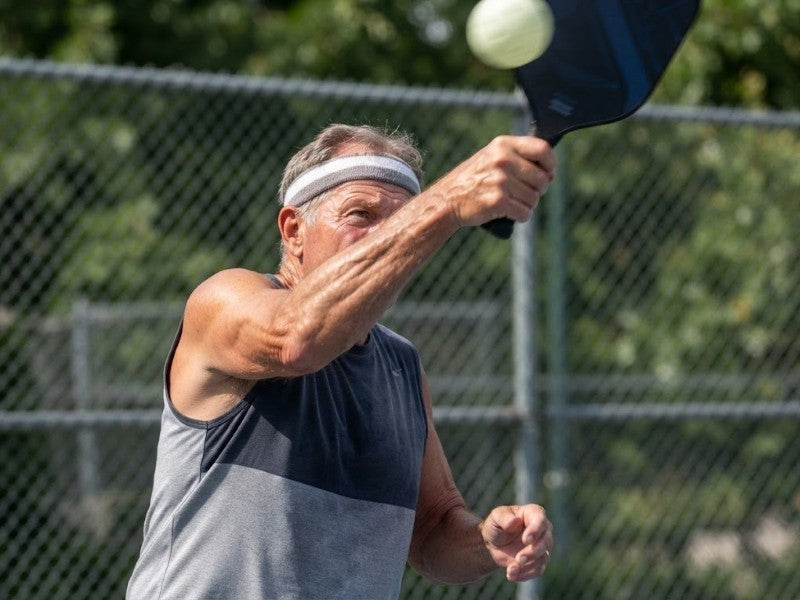
Playing frequently will certainly increase the vascularity (vein visibility) and muscle tone in your dominant forearm due to the constant gripping of the paddle. However, because the paddle only weighs about 8 ounces, it does not provide enough heavy resistance to trigger hypertrophy. It will not build large, bulging biceps or triceps.
Conclusion
So, does pickleball do any strength training at all? It provides a world-class workout for your cardiovascular system, tones your lower body, and builds incredible muscular endurance. But it is not a complete fitness program.
Do not let your gym membership gather dust. Think of the weight room as your shield, and the pickleball court as your battlefield. By dedicating just a couple of hours a week to heavy squats, rows, and core rotations, you will fix your bodily imbalances, protect your joints from injury, and ensure you can keep stepping onto the court for decades to come.
Go hit the gym today—your split-step on the court tomorrow will feel lighter, faster, and more explosive than ever before.

Leave a comment
This site is protected by hCaptcha and the hCaptcha Privacy Policy and Terms of Service apply.