


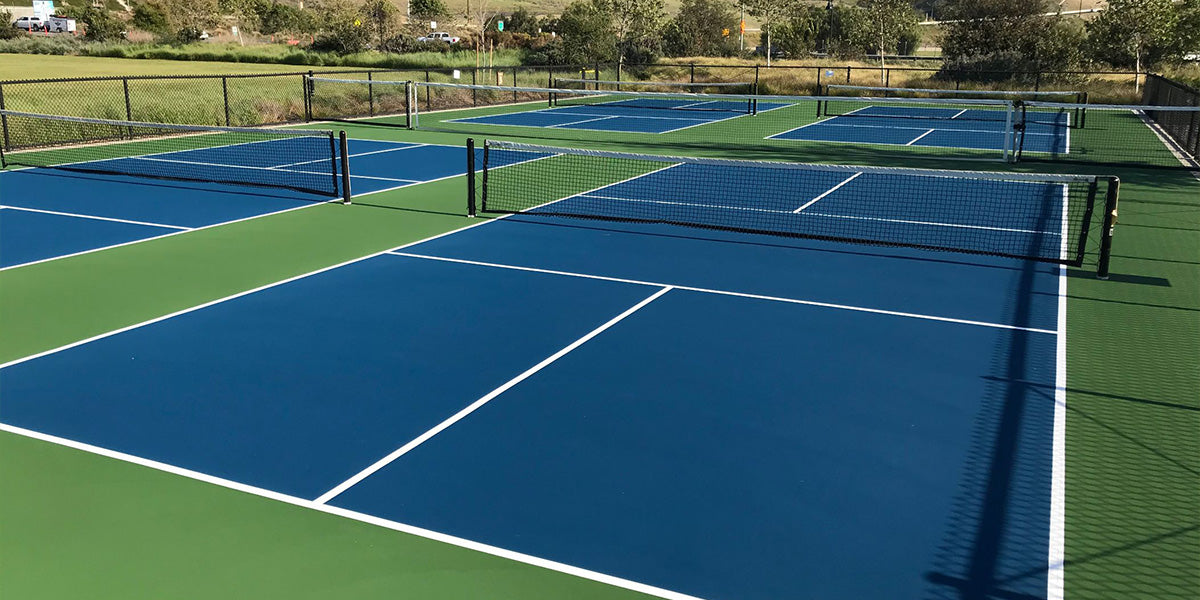
Let’s get straight to the measurements. According to USA Pickleball standards, a regulation court is exactly 20 feet wide by 44 feet long (6.10 meters by 13.41 meters). That gives you a total playing area of 880 square feet (about 81.7 square meters).
A common point of confusion is whether singles and doubles use different sizes. They don't. Singles and doubles share the exact same court dimensions. There is no extra alley to worry about.
When laying out lines, remember that all lines are 2 inches wide and count as part of the court. Measurements should be taken to the outside edge of the boundary. To check that your layout is square, the diagonal distance between opposite corners should be 48 feet 4 inches.
For quick reference, a pickleball court fits perfectly within the lines of a standard badminton doubles court. If you're converting a gym floor or a multi-use pad, this is a useful visual shortcut.
Finally, don't forget the safety buffer. While the court itself is 20x44, USA Pickleball recommends a minimum total playing space of 30 feet wide by 60 feet long. That extra room outside the lines is essential for chasing down wide shots without hitting a fence or wall.
Court Layout: Breaking Down Each Zone
A pickleball court might look like a simple rectangle, but every inch of it is there for a reason. Whether you're setting up a permanent court or rolling out a temporary one on a driveway, understanding how the space is divided will save you time and prevent arguments over line calls. Let's walk through each section.
The Kitchen (Non-Volley Zone)
This is the defining feature of pickleball. The Kitchen is the area that extends 7 feet back from the net on both sides and spans the entire 20-foot width of the court. The line at the front edge is officially called the Non-Volley Line, but everyone just calls it the kitchen line.
The rule is straightforward and strictly enforced: you cannot volley the ball while standing in the kitchen. A volley means hitting the ball out of the air before it bounces. If any part of your foot is touching the kitchen line during a volley, it is a fault. If your momentum carries you into the kitchen after a volley, it is also a fault. This is why you see players dinking just outside that 7-foot boundary and why footwork matters so much.
One measurement detail worth remembering: the 7-foot depth is measured from the net to the outside edge of the kitchen line. The line itself is 2 inches wide and is considered part of the kitchen. Touch it, and you're in.

The Service Courts
Behind the kitchen, the court is split down the middle by the centerline. This creates two equal service boxes on each side of the net: a left service court and a right service court. Each box measures 10 feet deep by 15 feet wide.
When you serve, you must stand behind the baseline and hit the ball diagonally into the opponent's corresponding service court. The ball must clear the kitchen line completely. If it lands on the kitchen line or anywhere inside the kitchen, the serve is a fault. This is one of the few times in pickleball where a line does not count as "in."
The Lines: What They Are and How to Measure Them
Every line on a regulation court is 2 inches wide, and measurements are always taken to the outside edge of the line. This is the detail that trips up most DIY builders. The full 20-foot width and 44-foot length include the lines themselves. If you measure to the inside edge, your court will be 4 inches too small in both directions.
Here is what each line is called and what it does:
- Baseline: The back boundary line. Runs parallel to the net at both ends.
- Sidelines: The side boundaries. Run perpendicular to the net.
- Centerline: Splits the two service courts on each side. It runs from the kitchen line straight back to the baseline.
- Non-Volley Line (Kitchen Line): Marks the 7-foot kitchen boundary. Touching this line during a volley is a fault.During regular play, any ball that touches the baseline, sideline, or centerline is considered in. The exception, as noted, is the serve and the kitchen line.
Quick Square Check: Once your lines are down, check your corners. The diagonal distance between opposite corners of the full 20x44 rectangle should be 48 feet 4 inches. If that measurement is off, your court is not square, and all your line calls will be slightly suspect.
The Net
The net sits at 36 inches high at the sidelines and dips slightly to 34 inches at the center. This subtle sag is part of the official specification and affects how shots travel—especially drives aimed just over the tape. If you're using a portable system, take an extra minute to check the center height and tension. A net that sags too low or sits too high changes the game more than most players realize.
For players and clubs who don't have a permanent court, portable net systems have become the go-to solution. A system like the Srikel FlashCourt is designed to meet these exact height standards without requiring permanent posts or ground sleeves. It sets up on any hard surface in a couple of minutes and gives you a regulation-quality net that won't shift mid-game. If you're converting a driveway, a gym floor, or a tennis court for pickleball use, having a net you can trust to stay at 34 inches in the center makes all the difference.
Minimum Space Beyond the Lines
One final number to keep in mind: the court itself is 20x44, but USA Pickleball recommends a minimum total playing area of 30 feet wide by 60 feet long. For tournament play or comfortable recreational use, 34 feet by 64 feet is even better. That extra space outside the lines gives players room to chase down wide shots without running into fences, walls, or the next court over. If you're planning a backyard build or laying out multiple courts, factor in that buffer from day one.
Indoor vs. Outdoor Court Considerations
The official dimensions do not change whether you are inside or outside—a court is always 20 feet wide by 44 feet long. However, the playing environment does change a few practical details.
Surface. Outdoor courts are typically asphalt or concrete, which plays faster and wears down balls and paddles more quickly. Indoor courts are often wood or sport tile, offering more grip and a slightly slower bounce.
Wind and Sun. Outdoors, you have to account for wind affecting ball flight and sun affecting visibility. There is no rulebook fix for either—just something to factor in when you choose which side to start on.
Clearance. Indoors, ceiling height becomes the main concern. USA Pickleball recommends a minimum overhead clearance of 18 to 20 feet for official play. If your local gym has a lower ceiling, lobs become a much bigger weapon.
Lighting. Indoors, consistent, shadow-free lighting matters more than most players realize. Outdoors, you are at the mercy of the time of day.
No matter where you play, the court itself stays the same. The adjustments are all in the setup around it.

Court Orientation and Windbreaks
If you are building a permanent outdoor court, orientation matters more than you might expect. The standard recommendation is to align the court north-south. This keeps the sun out of players' eyes during morning and afternoon games. An east-west alignment almost guarantees one side will be staring directly into the sun for a significant portion of the day.
Wind is the other outdoor variable no one fully prepares for. A steady breeze can push a soft dink several inches off course. If your court sits in an open area, consider adding a windbreak along the ends or sides. This does not need to be permanent fencing—simple windscreens, dense hedges, or even temporary netting can cut down enough wind to make play noticeably more consistent.
If permanent installation is not an option, position your portable setup so any prevailing wind crosses the court sideways rather than straight down the length. A crosswind is easier to adjust to than a headwind or tailwind that changes every shot's depth.
Fencing, Gates, and Safety Clearance
If you are building a dedicated court, fencing serves two purposes: keeping balls contained and giving players a safe boundary to stop against. The recommended fence height is 10 feet behind the baselines and 6 to 8 feet along the sidelines. Anything shorter behind the baseline, and you will spend half your session chasing balls into neighboring yards or courts.
Gate placement matters. Position gates in the corners or at the center of the sideline, not directly behind the baseline. Players sprinting back for a lob should not have to worry about colliding with a gate post or an incoming player.
Safety clearance is non-negotiable. Between the sideline and any fence or wall, leave at least 6 feet of run-off space. Between the baseline and a back fence, 8 to 10 feet is the comfortable minimum. If you try to squeeze a court into a tighter footprint, someone will eventually run into something hard. The dimensions inside the lines are fixed. The space outside them keeps everyone on the court and out of the emergency room.
How a Pickleball Court Compares to Other Sports
If you are a facility owner or a sports enthusiast, understanding the space requirements relative to other racket sports is key to maximizing your property’s potential. Pickleball is famously space-efficient, which is a major reason for its rapid global growth.
1.Pickleball vs. Tennis
The most common comparison is with tennis. A standard tennis court is much larger, measuring 36' x 78' for doubles. In fact, the footprint of one tennis court is large enough to fit four pickleball courts if you factor in the required safety buffers. This makes converting underutilized tennis courts into multiple pickleball hubs a high-ROI strategy for sports clubs.
2.Pickleball vs. Badminton & Padel
When it comes to Badminton, the dimensions are a perfect match—a standard doubles badminton court is exactly 20' x 44', making it the easiest transition for indoor gymnasiums. On the other hand, Padel courts are significantly larger (66' x 33') and require expensive glass walls and steel structures, whereas pickleball can be set up on almost any flat, hard surface with a portable net.
3.2026 Pro Update: The 17-Foot Experiment
It is worth noting that as the sport evolves, so do the rules. As of 2026, professional organizations like the PPA are testing a narrower 17-foot width for singles matches (pulling each sideline in by 1.5 feet). While the standard 20' x 44' remains the rule for 99% of players, these experiments show how the sport is constantly optimizing for more athletic, fast-paced competition.


Leave a comment
This site is protected by hCaptcha and the hCaptcha Privacy Policy and Terms of Service apply.