


Pickleball is undeniably the most social sport in America right now. Half the fun of a busy open-play session happens off the court—waiting in line with your paddle stacked, catching your breath between grueling matches, and chatting with strangers who instantly become your weekend friends.
Want to instantly become the most interesting person on the sidelines? You need more than just a good dink; you need good trivia.
Fact #1: It Wasn’t Named After a Dog
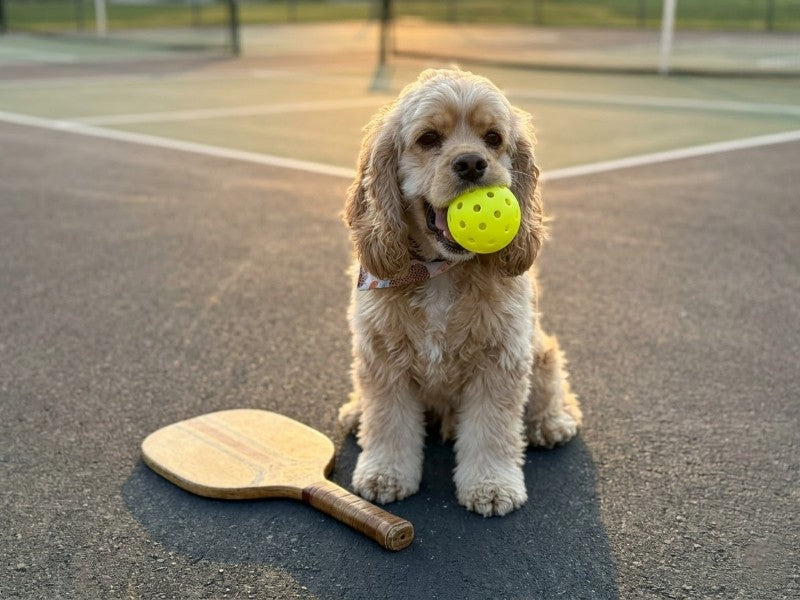
This is the most pervasive myth in the sport. If you ask a casual player how the game got its name, 90% of them will confidently tell you: "Oh, the inventors had a dog named Pickles who kept chasing the ball." False. It is a charming story, but the timeline doesn't match up. The official archives of USA Pickleball—and the founders' own family members—have confirmed that the Pritchard family did eventually get a Cocker Spaniel/Cockapoo mix named Pickles, but that dog joined the family a few years after the game was already invented and named. The dog was named after the sport, not the other way around!
Fact #2: The True Meaning of the "Pickle Boat"
So, if not the dog, then what? The true namesake of the sport is actually rooted in collegiate rowing.
Joan Pritchard, the wife of one of the inventors, was a fan of crew races. In rowing, a "pickle boat" is a term used to describe a makeshift crew thrown together from the leftover oarsmen who didn't make the primary varsity boats. Joan observed her husband and his friends cobbling together a game using leftover equipment from badminton, ping-pong, and baseball. Because the game was a "mixed crew" of other sports, she smiled and called it "Pickleball." The name perfectly captured the scrappy, makeshift spirit of the game.
Fact #3: Invented Out of Pure Boredom in 1965
You can thank teenage boredom for the fastest-growing sport in the world. In the summer of 1965, on Bainbridge Island, Washington (just a ferry ride away from Seattle), Congressman Joel Pritchard and successful businessman Bill Bell returned home from playing golf to find their families sitting around, complaining that they had nothing to do.
Accepting the challenge to cure their kids' boredom, Pritchard and Bell, soon joined by their friend Barney McCallum, decided to invent a game on an old asphalt badminton court in the Pritchards' backyard. They didn't have a grand vision of a global sport; they just wanted their kids to stop complaining.
Fact #4: The Original "Paddles" Were Ping-Pong Bats
When the three dads first set up the badminton net on that fateful summer day, they couldn't find enough badminton rackets. Desperate to keep the game going, they rummaged through the garage and grabbed a set of table tennis (ping-pong) paddles.
They quickly realized two things: First, the plastic ball they were using bounced surprisingly well on the asphalt. Second, the thin ping-pong paddles kept breaking when hitting the heavier plastic ball. To solve this, Barney McCallum went into his basement workshop, grabbed some marine plywood and a jigsaw, and hand-cut larger, sturdier wooden paddles. Those crude, splintery pieces of plywood were the direct ancestors of the high-tech, $200 paddles we use today.

Fact #5: The "Kitchen" Actually Has Roots in Shuffleboard
The most iconic feature of a pickleball court is the 7-foot Non-Volley Zone (NVZ), universally and affectionately known as "The Kitchen."
But why call it a kitchen? The inventors didn't name it that because things get "heated" up front (though they certainly do). The term was actually borrowed from shuffleboard. In shuffleboard, the penalty area at the back of the scoring triangle is traditionally called the "kitchen"—if your puck lands there, you lose points. Because stepping into the NVZ to volley a ball is a fault in pickleball, the founders adopted the punitive terminology. It’s a penalty zone, hence, the Kitchen.
Fact #6: A Court is Exactly the Size of a Doubles Badminton Court
Ever notice how perfectly a pickleball court fits inside a gym? That’s because its dimensions—20 feet wide by 44 feet long—are identical to a standard doubles badminton court.
When Joel Pritchard and Bill Bell first tried to set up a game in 1965, the only level surface they had was an old asphalt badminton court in Pritchard’s backyard. They simply used the existing lines painted on the ground. Had they been standing on a tennis court that day, the entire sport might look drastically different, and you might be running twice as far for a dink.
Fact #7: The Net is Designed with a Two-Inch Drop
A regulation pickleball net is 36 inches high at the sidelines but exactly 34 inches high in the dead center. That two-inch drop is not a manufacturing defect; it is a critical piece of physics.
The inventors quickly realized that if the net was uniformly 36 inches high (like tennis), the lightweight plastic ball would be incredibly difficult to hit back and forth, especially on low, defensive shots. Dropping the center by two inches encourages players to hit toward the middle of the court, resulting in longer, more strategic rallies rather than constant, frustrating faults into the tape.
Fact #8: The "Two-Bounce Rule" Was Created to Save Friendships
In the early days of the sport, older players and younger kids were getting crushed by aggressive, athletic adults who would serve the ball and immediately sprint to the net to smash the return (a classic "serve-and-volley" tennis tactic).
To level the playing field, the inventors instituted the "Two-Bounce Rule." The ball must bounce once on the serve, and the receiving team's return must also bounce once before anyone can volley the ball out of the air. This brilliant piece of rule-making effectively killed the serve-and-volley advantage, forcing players to earn their way to the Kitchen line and ensuring that strategy always triumphs over raw speed.
Fact #9: The Ball Has Specific Hole Counts for Aerodynamics
Not all pickleballs are created equal. An outdoor ball typically has 40 small holes, while an indoor ball has 26 larger holes.
This isn't arbitrary. Outdoor balls are exposed to wind. The 40 smaller holes, combined with heavier, harder plastic, make the ball more aerodynamic and less susceptible to being blown off course by a breeze. Indoor balls, played in controlled gym environments, use 26 larger holes and softer plastic to provide a more forgiving bounce on hardwood floors.
Fact #10: The Very First Ball Was a Plastic Wiffle Ball
Before the specialized 40-hole neon green orbs we use today, the very first pickleball games were played using a standard Wiffle ball—the kind used for backyard baseball practice.
However, as players got stronger and paddles got better, the thin plastic of a Wiffle ball couldn't withstand the impact and would frequently crack or warp. Today's pickleballs are specifically engineered with seamless rotational molding to ensure they maintain their perfectly spherical shape after taking thousands of massive overhead smashes.

Fact #11: Modern Paddle Cores Borrow from Aerospace Engineering
If you slice open a high-end, $250 pickleball paddle today, you won't find wood. You will find a "polymer honeycomb core."
This hexagonal honeycomb structure is incredibly lightweight yet remarkably strong. Where did paddle manufacturers get this idea? The aerospace industry. This identical honeycomb architecture is used in the construction of airplane wings and spacecraft panels to provide maximum structural integrity without adding unnecessary weight. When you hit a third-shot drop, you are literally utilizing rocket science.
Fact #12: It Is America’s Fastest-Growing Sport (Multiple Years Running)
This isn't just a marketing slogan; it's a statistical reality verified by the Sports & Fitness Industry Association (SFIA). For several consecutive years, pickleball has held the title of the fastest-growing sport in the United States, with participation numbers surging past 36 million players annually. What started as a niche hobby for retirees has exploded across all 50 states.
Fact #13: The Average Age of a Player is Dropping Rapidly
The stereotype that pickleball is only for the retirement community is officially dead. While seniors certainly built the foundation of the sport, the demographics have radically shifted. According to recent data, the largest demographic of pickleball players is now the 18-to-34 age group. The sport is getting younger, faster, and significantly more athletic.
Fact #14: Professional Pickleball is a Multi-Million Dollar Industry
In 1965, the prize for winning a pickleball match was bragging rights. Today, professional tours like the PPA (Professional Pickleball Association) and MLP (Major League Pickleball) offer millions of dollars in prize money. Furthermore, the sport has attracted massive celebrity investment. Icons like LeBron James, Tom Brady, Kevin Durant, and Mark Cuban have all purchased ownership stakes in professional pickleball teams, cementing its status as a major league business.
Fact #15: The "Pickleball Pop" Has Sparked Real Estate Turf Wars
The exponential growth of the sport has brought a unique problem: the noise. The acoustic profile of a hard paddle striking a plastic ball creates a sharp "pop" with a specific pitch that travels significantly further than the muted thud of a tennis ball.
This has led to widespread turf wars across the country. High-end neighborhoods and country clubs are dealing with noise complaints, petitions, and even lawsuits from homeowners living adjacent to newly built courts. The issue has become so prevalent that manufacturers are now racing to develop "quiet paddles" to keep the peace in suburban America.


Leave a comment
This site is protected by hCaptcha and the hCaptcha Privacy Policy and Terms of Service apply.