


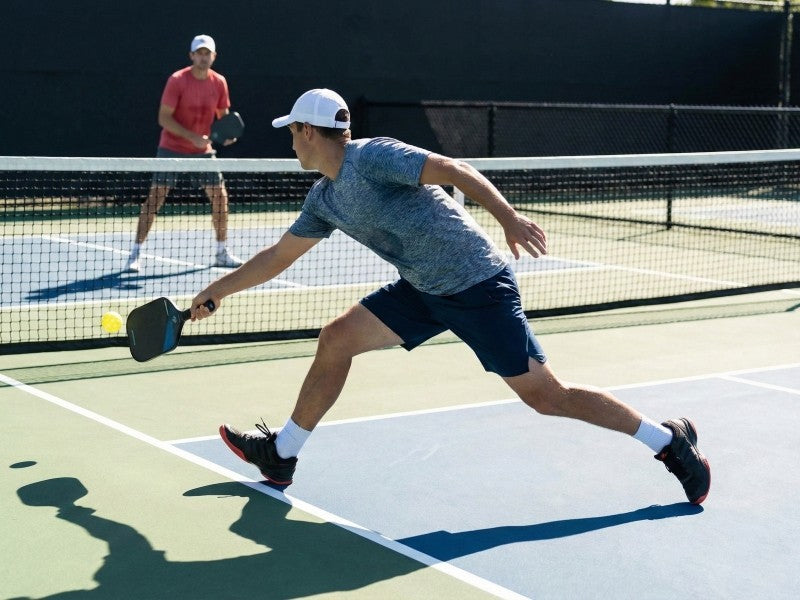
Pickleball is widely celebrated as a highly social, community-driven sport, which is why the vast majority of players are introduced to the game through doubles play. However, beneath the friendly banter and the four-player kitchen-line rallies lies a completely different beast: singles pickleball. Playing 1v1 is the ultimate crucible. It is a rigorous test of your absolute cardiovascular fitness, your baseline groundstroke precision, and your unassisted tactical execution.
Understanding the 1v1 pickleball rules is not inherently complicated, but it requires unlearning a few ingrained habits developed during doubles play.
The Core Framework: What Stays Exactly the Same?
When learning the 1v1 pickleball rules, the best place to start is with what you already know.
The Court Dimensions: The Truth About the Boundaries
The single most common misconception among transitioning players is the belief that a singles match uses "singles lines" or "alleys" to narrow the playing field, much like in traditional tennis.
This is entirely false. In pickleball, the 1v1 court dimensions are exactly the same as the doubles court: 20 feet wide by 44 feet long. There are no inner sidelines to utilize.
From a physiological standpoint, this rule is what makes singles pickleball so exhausting. In doubles, you are responsible for covering roughly 10 feet of width. In singles, you are solely responsible for covering the entire 20-foot width of the baseline and the kitchen line. This demands explosive lateral agility, exceptional stamina, and the ability to hit high-quality shots while on a full sprint.

The Kitchen / Non-Volley Zone Rules
The sacred geometry of the pickleball court remains untouched in a 1v1 scenario. The Non-Volley Zone (NVZ), universally known as the Kitchen, extends 7 feet from the net on both sides.
The rules governing this area are identical to doubles:
- You absolutely cannot hit a ball out of the air (a volley) while any part of your body is touching the Kitchen zone or the Kitchen line.
- Your momentum from hitting a volley outside the Kitchen cannot carry you into the Kitchen after the strike.
- You may enter the Kitchen at any time to hit a ball that has already bounced.
The Two-Bounce Rule (Double Bounce Rule)
The rhythmic cadence of a pickleball point is dictated by the Two-Bounce Rule, and it is strictly enforced in 1v1 play.
When the server hits the ball over the net, the receiver must allow the ball to bounce once before returning it. Subsequently, when the receiver hits the ball back, the server must also allow the ball to bounce once before making contact.
Only after these two initial bounces (one on each side of the net) have occurred is the ball considered "live" for airborne volleys. In singles, this rule is strategically massive. It prevents the serving player from employing a tennis-style "serve-and-volley" tactic where they hit a massive serve and instantly rush the net to smash the return out of the air.

Demystifying 1v1 Pickleball Rules: Serving and Scoring
Now that we have established the foundational similarities, we must address the radical differences. The complexity of doubles scoring (which requires tracking the serving team's score, the receiving team's score, and whether it is server one or server two) is completely stripped away in singles.
The Two-Number Scoring System
If you have played doubles, you are used to calling out three numbers before every serve (e.g., "0-0-2"). When playing 1v1, the third number is entirely eliminated. Because you do not have a partner, there is no "Server 1" and "Server 2".
In singles pickleball, the score consists of only two numbers, called in a specific order:
The Server's Score
The Receiver's Score
For example, if you have 4 points and your opponent has 2 points, and it is your turn to serve, you simply announce clearly: "4-2". If your opponent wins the serve back, they will announce: "2-4". It is a clean, binary system.
Positioning: The Even/Odd Rule
Because there is no "Server 1" or "Server 2" to dictate who stands where, the 1v1 pickleball rules rely on a mathematical positioning system. Where you stand to serve, and where you stand to receive, is dictated entirely by your own score. This is known as the Even/Odd Rule, and committing it to memory is the most important step in mastering singles play.
- The Even Rule (Right Side): If your current score is an even number (0, 2, 4, 6, 8, 10), you must serve from the right-hand side of the center line (the even court). Similarly, if you are receiving the serve and your score is an even number, you must stand on the right-hand side of your court to receive.
- The Odd Rule (Left Side): If your current score is an odd number (1, 3, 5, 7, 9), you must serve from the left-hand side of the center line (the odd court). If you are receiving the serve and your score is an odd number, you must stand on the left-hand side to receive.
The "Fault = Side Out" Mechanic
In a standard doubles match, when the first server faults (hits the ball into the net or out of bounds), the serving team gets a second chance; the ball goes to Server 2.
Singles pickleball offers no such luxury. The 1v1 format is brutal and unforgiving. If you are serving and you commit a fault, or if you lose the rally, the result is an immediate "Side Out." You lose the right to serve, and the ball is immediately handed over to your opponent.
Just like in traditional doubles, you can only score points when you are the serving player. If you are the receiving player and you win the rally, you do not gain a point; you simply win the right to serve (the Side Out).
Step-by-Step: Walking Through a 1v1 Match
Reading the rules is one thing, but visualizing how they flow in real-time is how you truly internalize them. Let us walk through the opening sequences of a hypothetical singles match to see how the scoring, positioning, and side-outs interact flawlessly.
The Setup:
Player A is serving. Player B is receiving. The game is played to 11 points (win by 2).
Calling the Score and The First Serve
The match begins at zero. Since zero is an even number, Player A starts on the right side (even court) of the center line.
Because Player B's score is also zero (even), Player B stands on their respective right side to receive the diagonal serve.
Player A loudly announces the two-number score: "0-0" (Zero to Zero).
Player A executes the serve diagonally into Player B's right service box.
Winning a Point on the Serve
Let us assume Player A hits a brilliant passing shot and wins the rally.
Because Player A was serving, they win a point.
The score is now 1-0 in favor of Player A.
Because Player A's score is now 1 (an odd number), the 1v1 pickleball rules dictate that Player A must physically move to the left side of their court to serve the next point.
Player B's score remains 0 (even). Therefore, Player B must stay on their right side to receive the serve. (Notice how the serve is always diagonal).
Player A announces the new score: "1-0".
Losing a Rally (The Side Out)
Player A serves from the left side. A fierce rally ensues, but this time, Player A hits the ball into the net.
Because Player A was serving and lost the rally, they do not lose a point, but they do suffer a Side Out. The ball immediately goes to Player B.
Now, where does Player B serve from? This is where most beginners freeze.
To figure out the positioning, Player B only looks at their own score. Player B's score is currently 0. Since 0 is an even number, Player B will serve from the right side of their court.
Player B announces the score (Server's score first): "0-1".
Player B serves diagonally to Player A (who is standing on the left side, because Player A's score is 1, which is odd).
This logical loop repeats continuously until one player reaches 11 points and wins by a margin of at least two points.
Here is the second half of the definitive guide. We will now elevate this from a simple rulebook explanation into a masterclass on singles strategy, introducing the most valuable practice variation and the tactical shifts required to dominate the full court.
Adapting Your Game to 1v1
Knowing the 1v1 pickleball rules is only the baseline; knowing how to exploit them is how you win. You cannot take a successful doubles strategy and apply it to a singles match. The physics of the empty court demand a complete tactical rewrite.
The Death of the 3rd Shot Drop?
In doubles, the "3rd shot drop" is the holy grail of strategy. The serving team hits a soft, arcing shot into the Kitchen to neutralize the receiving team's net advantage, allowing the servers to move forward.
In singles, relying exclusively on the 3rd shot drop is often a fatal mistake. Because you are covering the entire court alone, a slow, looping drop shot gives your opponent entirely too much time to sprint forward, set their feet, and hit an aggressive angled volley past you.
Instead, singles pickleball heavily favors the 3rd Shot Drive. Hitting a deep, fast, and powerful groundstroke forces your opponent to remain pinned at the baseline, allowing you to dictate the pace and look for a shorter ball to attack on your 5th shot.
Serving Deep and Wide
In doubles, a deep serve to the middle of the court is perfectly acceptable, as it limits the angles of the return. In singles, your serve is your primary offensive weapon.
Your goal on every serve is to hit the ball as deep into the baseline as possible, pushing the receiver backward. Furthermore, you want to utilize the width of the court. Serving sharply out wide forces the receiver to scramble horizontally. By the time they hit their return, you have opened up a massive, empty gap on the opposite side of the court to hit your next shot into.
Master the Center-Line Recovery
The most critical movement pattern in singles is the concept of "bisecting the angle."
When you hit a shot to the far right corner of your opponent's court, you cannot simply stand still and watch the ball. You must immediately physically recover toward the center line, slightly shading toward the side where you hit the ball. This places you in the optimal geometric position to intercept their return, whether they hit it straight down the line or cross-court. If you hit out wide and fail to recover to the center, a competent singles player will effortlessly pass you on the open side every single time.


Leave a comment
This site is protected by hCaptcha and the hCaptcha Privacy Policy and Terms of Service apply.