


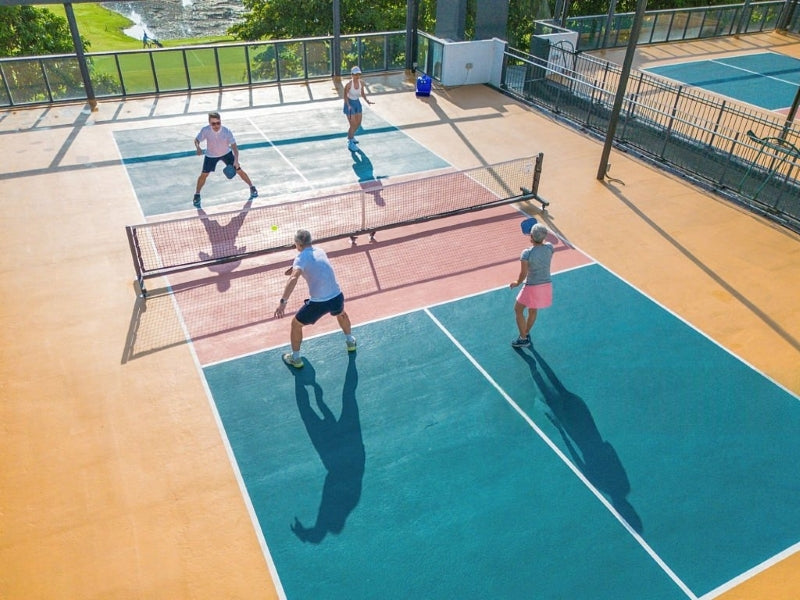
Most pickleball players do not stop improving because they lack athletic ability or commitment. In fact, many players practice regularly, play multiple times per week, and still find themselves stuck at the same level for months or even years.
The real issue is not effort, but repeated strategic and technical mistakes that compound over time.
Pickleball is a game that rewards efficiency, decision-making, and discipline far more than raw power or flashy shots. Players who fail to recognize this often reinforce bad habits, making progress increasingly difficult as competition improves.
Mistake #1: Prioritizing Power Over Placement
One of the most widespread errors among pickleball players is the belief that hitting harder will win more points.
Why This Mistake Happens
Many players come from tennis or other racket sports, where pace and spin are major weapons. In pickleball, however, the shorter court, lower net, and presence of the non-volley zone significantly reduce the effectiveness of pure power.
As a result, hard-hit balls often:
- Fly long due to limited court depth
- Sit up for easy counters
- Increase unforced error rates
Why It Hurts Your Game
Overreliance on power leads to:
- Loss of consistency
- Shorter rallies that favor opponents who defend well
- Fewer opportunities to control point structure
At higher levels, opponents are not intimidated by pace—they are prepared for it.
How Pickleball Players Can Avoid This Mistake
Effective pickleball players shift their focus to:
- Placement over pace
- Depth and margin instead of speed
- Forcing opponents to hit difficult balls rather than ending points quickly
Power becomes a tool, not a default strategy.

Mistake #2: Poor Shot Selection and Directional Discipline
Shot selection is one of the most underdeveloped skills among pickleball players, yet it has a direct impact on consistency and win rate.
Common Shot Selection Errors
Many players:
- Change direction under pressure
- Hit down-the-line without positional advantage
- Aim for low-percentage targets too early in rallies
These choices often feel aggressive but are strategically unsound.
Why Directional Discipline Matters
In doubles especially, maintaining directional discipline:
- Reduces interception risk
- Preserves team positioning
- Forces opponents into predictable responses
High-level pickleball players rely heavily on crosscourt patterns and only change direction when conditions clearly justify the risk.
How to Improve Shot Selection
Pickleball players should adopt a simple rule:
Direction changes should be intentional, not reactive.
Before changing direction, ask:
- Am I balanced?
- Is my opponent out of position?
- Does this shot reduce risk or increase it?
If the answer is unclear, the safer option is usually correct.
Mistake #3: Rushing the Net Without a Plan
Reaching the non-volley zone is essential in pickleball, but how you get there matters as much as when.
The Problem With Blind Net Rushing
Many pickleball players sprint to the kitchen line after the serve or return, regardless of shot quality. This often leaves them:
- Vulnerable to low passing shots
- Forced into defensive volleys
- Out of balance during key exchanges
The transition zone—the area between baseline and kitchen—is where many points are lost, not won.
Why This Mistake Persists
Players are often told, “Get to the net as fast as possible,” without understanding that timing and shot quality must dictate movement.
How to Fix It
Smart pickleball players:
- Move forward behind quality drops or deep shots
- Pause and reset if the ball sits up
- Prioritize balance over speed
Controlled progression to the net is far more effective than rushing.
Mistake #4: Weak or Inconsistent Dinking Fundamentals
Dinking is not optional in pickleball—it is foundational. Yet many pickleball players treat it as a temporary phase rather than a core skill.
Common Dinking Problems
Typical issues include:
- Hitting dinks too high
- Speeding up balls unnecessarily
- Losing patience during extended exchanges
These mistakes usually result from discomfort rather than poor mechanics.
Why Dinking Decides Matches
At competitive levels, most points are decided at the kitchen line. Players who lack reliable dinking:
- Give opponents easy attack opportunities
- Lose control of rally tempo
- Struggle against disciplined teams
Strong dinking creates pressure without risk.
How Pickleball Players Can Improve Dinking
Effective dinking focuses on:
- Net clearance consistency
- Soft hands and relaxed grip
- Intentional placement rather than pace
Patience is not passive—it is strategic.
Mistake #5: Poor Positioning at the Kitchen Line
Even players with solid strokes often struggle due to incorrect spacing and footwork at the non-volley zone.
Positioning Errors to Watch For
Many pickleball players:
- Stand too close to the kitchen line, limiting reaction time
- Drift too far back, giving opponents attack angles
- Fail to adjust laterally with their partner
These positioning errors create openings that opponents exploit easily.
Why Positioning Is a Skill, Not a Static Spot
Kitchen positioning is dynamic. Players must constantly:
- Adjust distance based on ball height
- Stay balanced and ready
- Maintain proper spacing with their partner
How to Improve Kitchen Positioning
Better positioning comes from:
- Staying athletic and slightly off the line
- Matching partner movement
- Resetting posture after each shot
Good positioning reduces the need for heroic shots.

Mistake #6: Ignoring Partner Positioning and Team Responsibility in Doubles
One of the clearest differences between developing and advanced pickleball players is how well they understand doubles responsibility.
Why This Mistake Is So Common
Many players unconsciously play doubles as if it were singles. They focus only on the ball in front of them and fail to account for:
- Their partner’s position
- Middle-court responsibility
- Coverage gaps created by movement
This often leads to confusion, hesitation, and easy points for opponents.
How It Hurts Your Game
Ignoring partner positioning results in:
- Exposed middle shots
- Late reactions on poaches
- Miscommunication on lobs and speed-ups
Doubles is not about hitting better shots—it is about moving and thinking as a unit.
How Pickleball Players Can Fix This
Effective teams:
- Treat the middle as a shared responsibility
- Move laterally together
- Anticipate likely returns based on shot direction
Clear role awareness reduces pressure and improves consistency.
Mistake #7: Treating the Serve and Return as Unimportant
Many pickleball players view the serve as a formality and the return as a simple way to start the rally. This mindset costs points before rallies even develop.
Why the First Two Shots Matter
The serve and return determine:
- Who controls court position
- Whether the serving team can advance safely
- How much pressure exists on the third shot
A weak serve or short return immediately puts one team on defense.
Common Errors
- Serving with no depth or variation
- Returning short and allowing easy third-shot attacks
- Rushing forward after a poor return
How to Improve Serve and Return Strategy
Smarter pickleball players focus on:
- Consistent, deep serves
- Returns that land near the baseline
- Staying back long enough to handle the third shot
The goal is not to win the point, but to avoid starting it at a disadvantage.
Mistake #8: Letting Emotions Drive Decision-Making
Pickleball is fast-paced, and emotional reactions can quickly override sound strategy.
How Emotions Create Tactical Errors
After a few mistakes, players often:
- Force aggressive shots to “make up” for errors
- Abandon patient rally patterns
- Rush points unnecessarily
These decisions rarely improve outcomes.
Why Emotional Control Matters
Matches are often decided by:
- Who stays disciplined under pressure
- Who continues making high-percentage choices
- Who resists the urge to chase quick points
Emotionally stable pickleball players are more consistent and harder to beat.
How to Regain Control
Practical methods include:
- Slowing down between points
- Refocusing on simple tactical goals
- Accepting errors without immediate correction attempts
Calm decision-making leads to better execution.
Mistake #9: Practicing Without Structure or Purpose
Playing often does not guarantee improvement. Many pickleball players plateau because their practice lacks direction.
Why Casual Play Isn’t Enough
Unstructured play reinforces existing habits—good or bad. Without feedback or focus, mistakes remain uncorrected.
Common Practice Problems
- Repeating games without targeted goals
- Avoiding uncomfortable shots or situations
- Failing to track progress over time
How to Practice More Effectively
Productive practice includes:
- Isolating specific skills (drops, dinks, returns)
- Practicing under controlled pressure
- Reflecting on what breaks down during matches
Purposeful repetition accelerates learning.
Mistake #10: Copying Advanced Players Without Matching Skill Level
Watching high-level pickleball is educational, but imitation without context can be harmful.
Why This Backfires
Advanced players:
- Have superior control and anticipation
- Understand when to take risks
- Recover faster from poor positions
Recreational pickleball players often attempt the same shots without the foundation to support them.
A Better Approach
Progress should be staged:
- First build consistency and control
- Then add variation and aggression
- Finally, introduce advanced tactics selectively
Development is sequential, not instantaneous.
Common Mistakes by Pickleball Player Skill Level
Beginner Pickleball Player
- Overhitting
- Poor positioning
- Limited dinking confidence
Priority: Consistency and basic court awareness
Intermediate Pickleball Player
- Inconsistent shot selection
- Rushing the net
- Emotional swings
Priority: Decision-making and discipline
Advanced Pickleball Player
- Forcing winners
- Overusing speed-ups
- Underestimating patient opponents
Priority: Tactical refinement and adaptability
FAQ: Real Questions Pickleball Players Ask
Why do I feel stuck at the same pickleball level even though I play often?
This is one of the most common frustrations among pickleball players.
In most cases, the issue is not a lack of playing time, but repeating the same mistakes without feedback or correction. Casual games tend to reinforce habits—good and bad—rather than fix them.
What to do instead:
- Identify one recurring problem per week (e.g., high dinks, rushed net approaches)
- Practice that skill intentionally outside of match play
- Measure improvement by reduced errors, not just wins
Progress comes from targeted correction, not volume alone.
I’m consistent but still lose matches—what am I doing wrong?
Consistency is necessary, but not sufficient.
Many pickleball players are consistent to the wrong locations or at the wrong times. Safe shots that land short, sit up, or invite attacks still put you at a disadvantage.
How to fix this:
- Aim for depth on serves and returns
- Keep neutral shots crosscourt instead of straight ahead
- Avoid speeding up the ball unless you are balanced and attacking a weakness
Consistency must be paired with strategic intent.
Why do I keep losing points at the kitchen line?
Most kitchen-line losses are caused by one of three issues:
1. Standing too close to the line
2. Dinking too high
3. Speeding up balls without advantage
Actionable correction:
- Stand slightly off the line unless attacking
- Prioritize low, unattackable dinks over placement
- Only speed up balls above net height
The kitchen is about patience and pressure, not quick winners.
How do I stop making careless mistakes under pressure?
Pressure does not create mistakes—it reveals habits.
When rallies get tense, many pickleball players abandon structure and attempt low-percentage shots.
Practical solution:
- Simplify your decision-making on big points
- Commit to one safe pattern (usually crosscourt)
- Accept longer rallies instead of forcing endings
Reducing choices under pressure improves execution.
Should I focus more on drills or playing games to improve?
Both matter, but they serve different purposes.
- Games test decision-making
- Drills build reliability
If you only play games, improvement slows.
If you only drill, match performance suffers.
Best approach:
- 70% play, 30% targeted drills
- Drills should address mistakes seen in real matches

Leave a comment
This site is protected by hCaptcha and the hCaptcha Privacy Policy and Terms of Service apply.