


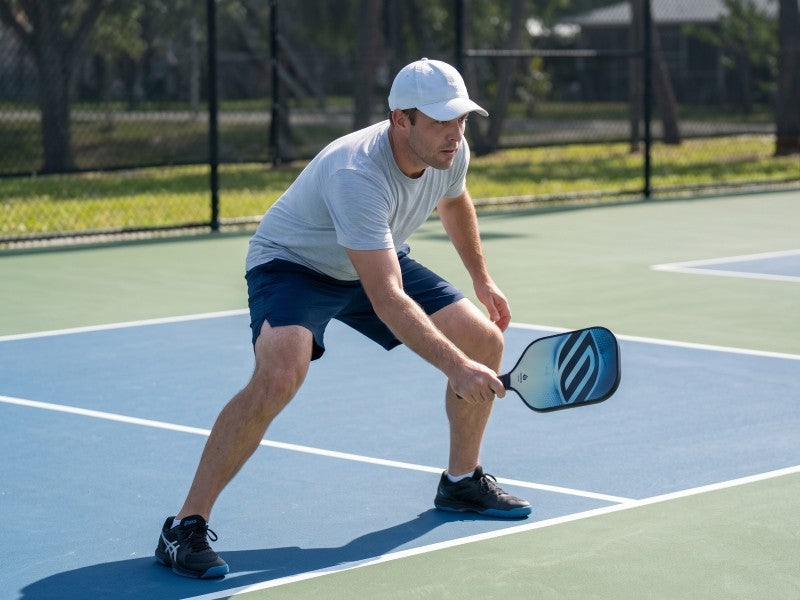
Picture this familiar scenario: You are sweating profusely at the baseline, driving the ball with every ounce of strength you possess. Meanwhile, your opponent—who might be twenty years older and barely breaking a sweat—stands calmly at the net, effortlessly tapping your fastballs right back at your feet.
If you are tired of losing to players who barely seem to move, you are likely asking yourself how to be good at pickleball when raw athletic ability is no longer enough. The hard truth is that relying on pure power (a playstyle known as "banging") will only get you to a 3.0 skill level. Once you face advanced opponents, your aggressive drives will be weaponized against you.
4 Strategic Pillars: Exactly How to Be Good at Pickleball
If power is an illusion, what is the reality? Advanced pickleball is a game of "soft" skills. To dominate the court without breaking your shoulder, you must master these four strategic pillars.
1. The Third Shot Drop (The Great Equalizer)
If you want to know what it takes to be good at pickleball, it starts and ends with the Third Shot Drop. When your opponent returns your serve, they immediately run to the net, gaining the Kitchen line advantage.
Your goal on the third shot is not to hit a winner. Your goal is to neutralize their advantage. The Third Shot Drop is a soft, arcing shot hit from the baseline that crests just over the net and lands softly inside the opponent's Kitchen. Because the ball bounces inside the NVZ, your opponents cannot hit an aggressive volley out of the air. They are forced to let it bounce and hit upward, giving you and your partner the crucial time needed to sprint forward and join them at the net.
2. Purposeful Dinking (The Assassin's Game)
Once all four players are at the Kitchen line, the game transforms into a "dink" battle—a series of soft shots hit into the NVZ. Beginners view dinking as boring, passive defense. Pros view dinking as a highly aggressive chess match.
You are not just keeping the ball in play; you are purposefully maneuvering your opponent.
- Target the Feet: Always aim for your opponent's shoelaces, forcing them to awkwardly dig the ball out from the ground.
- Force Lateral Movement: Push your dinks wide to stretch your opponents, creating gaps in the middle of the court.
- Wait for the Pop-Up: The entire goal of purposeful dinking is to frustrate your opponent into making a mistake and hitting the ball too high, allowing you to easily smash the put-away.
3. The Art of the Reset (The Ultimate Weapon)
What happens when you face a player who refuses to stop hitting hard drives? You use the Reset. This is the ability to absorb a violently fast ball and drop it harmlessly back into the Kitchen.
Executing a reset requires "soft hands." Instead of swinging back at a hard drive, you loosen your grip pressure (about a 3 out of 10) and hold your paddle steady in front of you. You let the paddle absorb the impact, using the opponent's kinetic energy to gently bounce the ball back over the net. Mastering the reset instantly neutralizes the most aggressive "bangers" on the court.

4. Patience and the "Unforced Error" Game
The single biggest difference between a 3.0 player and a 4.5 player is impulse control. Amateurs try to win points; experts let their opponents lose them.
Pickleball matches are overwhelmingly decided by unforced errors—hitting into the net or hitting out of bounds. If you simply focus on keeping the ball in play with high-percentage, un-attackable soft shots, the player relying on low-percentage power drives will eventually defeat themselves. Patience is your most lethal weapon.
Court IQ: Positioning and Movement Over Speed
In pickleball, where you stand is often more important than how hard you swing. Athleticism and sprinting speed can cover up bad positioning in lower-level games, but advanced players will expose those gaps instantly. Developing your "Court IQ" is a fundamental step in learning how to be good at pickleball without relying on physical exertion.
Moving as a Pendulum
In doubles, you and your partner must act as a single, cohesive unit. Imagine a 10-foot invisible rope connects your waists. If the ball is hit wide to your partner's side, they must shift to return it—and you must shift in the exact same direction to cover the middle.
This is known as moving like a pendulum. If you fail to shift with your partner, you leave a massive, gaping hole in the center of the court (the most vulnerable area in doubles). By shifting laterally together, you mathematically cut off your opponent's passing angles without needing to sprint.
Holding the Line
A common reflex for players facing a fast, aggressive drive is to take a step backward away from the Kitchen line to give themselves more reaction time. Never back up.
Taking a step back puts your weight on your heels, opens up the court angles for your opponent, and often results in you hitting the ball into the net. Instead, hold your ground at the NVZ line. Widen your stance, stay low, and use a compact block volley to absorb the pace. Trust your paddle to do the work.
Gear Check: Are You Using a "Banger" Paddle?
If you are actively trying to transition from a power game to a tactical, soft game, your equipment might be actively working against you.
Many beginners purchase lightweight, fiberglass-faced paddles. Fiberglass acts like a trampoline, designed to give the ball maximum "pop" and speed. While this feels great for baseline drives, it makes executing a delicate Third Shot Drop or a controlled dink incredibly difficult. The ball simply bounces off the paddle face too aggressively, resulting in high pop-ups that your opponents can easily smash.
To master the soft game, switch to a control paddle. Look for these specifications:
- Raw Carbon Fiber Face: This material provides intense surface friction, allowing you to grip the plastic ball and apply topspin or backspin to keep your shots low.
- 16mm Core Thickness: A thicker polymer core acts as a shock absorber. It provides a "plush" feel that deadens the impact of a hard drive, making resets and drops infinitely easier to execute.
Frequently Asked Questions (FAQs)
Q: If power is an illusion, when should I actually use a hard drive in pickleball?
Power is only effective when it is earned. You should use a hard drive when your opponents hit a weak, high return, or when they are caught in the "transition zone" (mid-court) and haven't reached the Kitchen line yet. Drive the ball at their feet to force a weak pop-up, then follow it up with a soft drop.
Q: How do I stop popping the ball up during dink rallies?
Popping the ball up is usually caused by excessive wrist movement or standing up straight during the shot. To fix this, keep your wrist completely locked. Use your shoulder to gently push the ball, and make sure your knees stay bent throughout the entire motion.
Q: How long does it take to learn the soft game?
If you only play recreational matches, it can take months. If you actively practice specific drills—like spending 30 minutes just hitting drops or doing cross-court dinking with a partner—you can completely transform your game and learn how to be good at pickleball's soft strategies in just three to four weeks.
Q: Do these "soft game" strategies apply to singles pickleball as well?
While mastering the soft game is the ultimate secret for how to be good at pickleball doubles, singles is a very different beast. Singles relies much more on baseline drives, deep serves, and pure athleticism to cover the entire 20-foot width by yourself. However, having a reliable drop shot in singles is still an essential tool for safely approaching the net without getting passed.
Q: What is the best drill to practice letting go of my "power" habit?
Try the "Transition Zone Drill." Have your practice partner stand at the Kitchen line while you stand back at the baseline. Have them intentionally feed you aggressive, hard shots. Your only goal is to absorb the pace and hit soft drops into the Kitchen until you can safely walk up to join them at the net. If you try to drive the ball hard, you instantly lose the point. It forces your brain to prioritize placement over pace.
Conclusion
Learning how to be good at pickleball is fundamentally a journey of unlearning the urge to smash every ball. Pure power is a dead-end street that will keep you permanently stuck at an intermediate level.
By mastering the Third Shot Drop, embracing the strategic chess match of dinking, and learning to reset aggressive drives with soft hands, you elevate your Court IQ and take control of the game's momentum.

Leave a comment
This site is protected by hCaptcha and the hCaptcha Privacy Policy and Terms of Service apply.