
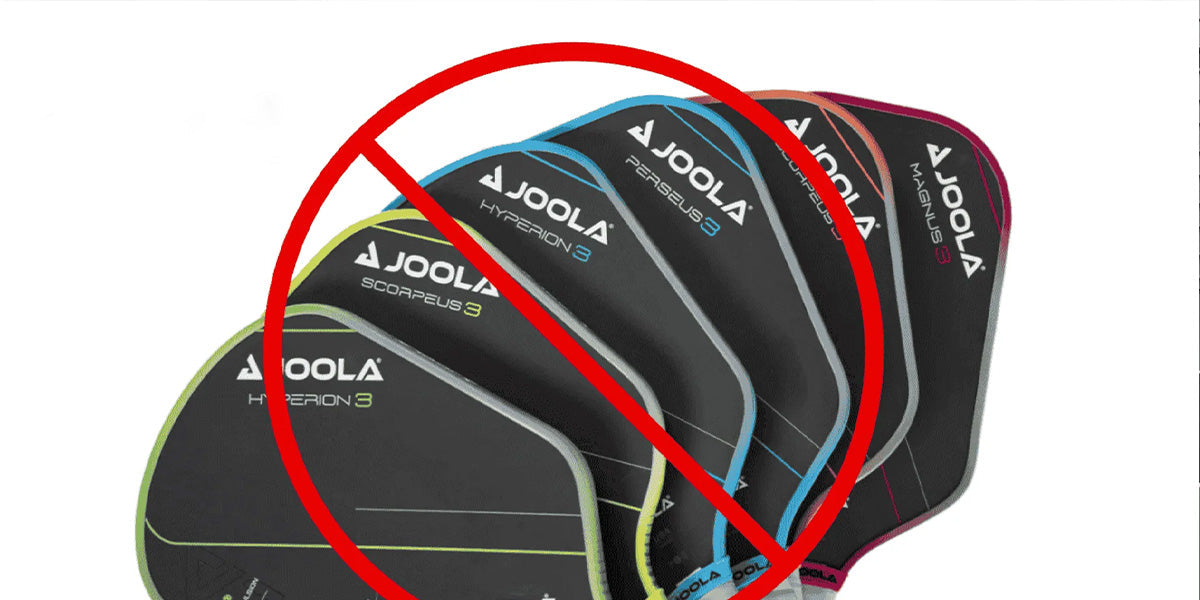
A banned pickleball paddle is any model removed from the official USA Pickleball approved list. The most common reason? Failing updated testing standards for power or surface grit. In this 2026 guide, we clarify the difference between legal vs illegal paddles, break down the current banned pickleball paddles list, and show you exactly how to verify your gear so you never show up to the court with equipment that won't pass inspection.
Why Some Pickleball Paddles Are Banned
Understanding why a paddle gets "blacklisted" is about more than just following rules—it’s about protecting the integrity of the sport. As technology evolves, USA Pickleball (USAP) constantly updates its standards to ensure that matches are decided by a player’s skill, not by "mechanical cheating" from high-tech gear.
In 2026, the criteria for banned pickleball paddles have become stricter than ever, focusing on three main areas:
1. Technical Violations: The "Trampoline Effect" & PBCoR
The biggest shift in 2026 involves PBCoR (Paddle-Ball Coefficient of Restitution). Essentially, this measures how fast the ball "pops" off the paddle.
- The Trampoline Effect: Some modern paddles are designed with flexible faces that compress and snap back, acting like a trampoline. This gives players unearned power, making the game dangerously fast.
- The New Rule: Since July 1, 2025, USAP has enforced a strict PBCoR limit. Any paddle exceeding this rebound threshold is delisted from official play. This ensures the game remains a sport of strategy rather than just raw, uncontrollable speed.
2. Surface Friction & Spin Generation
Spin is a huge part of the game, but it must come from your wrist and technique, not from the sandpaper on your paddle.
- Surface Friction: USAP limits how "gritty" a paddle face can be. If the surface roughness exceeds 30 micrometers, the paddle is banned because it allows for "unnatural" spin generation that is nearly impossible for opponents to return.
- Deflection Testing: On-site testing at 2026 "Golden Ticket" events now uses sensors to check for paddle thickness and rigidity. If a paddle is too soft or deflects too much under pressure, it's out.
3. Material & Physical Restrictions
To keep the equipment standardized, there are strict "no-go" zones for manufacturers:
- Core Material: 100% EVA foam cores remain banned in most sanctioned play because they are too quiet and provide too much propulsion. Approved cores typically use honeycomb polymer or specialized foams that meet sound and bounce standards.
- Dimensions: A legal paddle cannot exceed 17 inches in length, and the combined length and width cannot exceed 24 inches.
- Pro-Level Debt Bans: Interestingly, not all bans are technical. As of March 2026, brands like Proton were banned from professional play (PPA/MLP) due to commercial bad standing and debts. While these paddles might still be "physically" fine for a local park game, they are prohibited in the professional circuit.
The Bottom Line: If you're looking for a new gear, always check for the "USA Pickleball Approved" seal. At Srikel, we ensure all our AURA and DURAFOAM series are engineered to stay right on the edge of high performance while remaining 100% legal for tournament play.

What Makes a Pickleball Paddle Illegal?
Identifying an illegal paddle isn't always obvious just by looking at it. Most bans happen because a paddle provides an unfair mechanical advantage that disrupts the balance of the game. If you are competing in a sanctioned event, remember: “Only paddles listed on the USA Pickleball approved list are legal in tournaments.”
Here are the primary reasons a paddle is deemed illegal in 2026:
- Too Much Surface Roughness: This is the most common violation. If the texture on the paddle face (the "grit") is too high, it allows for excessive spin generation. USAP uses a specialized meter to ensure the friction level isn't so high that it makes the ball’s flight path unpredictable for the opponent.
- Non-Approved Materials: Manufacturers are constantly experimenting, but not all materials are allowed. For example, paddles with 100% EVA foam cores or those containing prohibited metals or reflective surfaces are banned to keep the sound and bounce levels consistent.
- Oversized Dimensions: There is a strict "Rule of 24." The combined length and width of the paddle (including any edge guard and butt cap) cannot exceed 24 inches. Additionally, the paddle length alone cannot exceed 17 inches.
- Modified Paddles: Even if you buy a legal paddle, you can make it illegal by altering it. Applying extra-gritty decals, specialized "spin tapes," or thick coatings to the face after purchase will immediately disqualify the equipment.
- Homemade or Custom Gear: While DIY projects are fun, homemade or custom paddles are not permitted in official play unless they have gone through the formal USAP lab testing and certification process.
Before you head to your next tournament, always double-check your gear against the official database to avoid an unnecessary disqualification.
Are There Official Banned Paddle Lists?
Here's something that surprises many players: USA Pickleball does not publish an official "banned paddle list." What they do maintain is an approved equipment list—a searchable database of every paddle that has passed certification and is legal for sanctioned tournament play. The rule is simple: if your paddle isn't on the USA Pickleball approved list, it's considered an illegal paddle for competition. As of the 2026 rulebook, all paddles must also display "USA Pickleball Approved" markings to be fully compliant.
So where do you find out which paddles are no longer allowed? You have to read between the lines by tracking paddle certification updates and delisting announcements. Below is the current list of paddles that are not legal for USAP-sanctioned tournament play in 2026.
Delisted Paddles: What's Not Allowed in 2026
Paddles Removed Due to PBCoR Exceedance (Effective July 1, 2025)
In late 2024, USAP introduced the PBCoR (Paddle/Ball Coefficient of Restitution) standard to limit the "trampoline effect"—where the paddle face springs the ball back with unnatural speed. Any paddle exceeding the 0.44 PBCoR threshold was scheduled for removal from certification starting July 1, 2025. The following models were delisted:
|
Brand |
Model |
Reason |
|
JOOLA |
Perseus 14mm Mod TA-15 |
|
|
JOOLA |
Perseus 16mm Mod TA-15 |
|
|
Gearbox |
Pro Power Elongated |
|
|
ProKennex |
Black Ace Ovation |
|
|
ProKennex |
Black Ace Pro |
|
|
ProKennex |
Black Ace XF |
Exceeded PBCoR standards |
Important update on ProKennex Black Ace LG: This model was originally on the delisting schedule but was officially relisted in June 2025 after passing new PBCoR testing. It is fully legal for competition as of today.
Paddles Removed Due to Certification Issues
|
Brand |
Model |
Reason |
|
JOOLA Gen 3 Series |
Perseus 3, Scorpeus 3, Magnus 3, Hyperion 3 |
Manufacturer submitted wrong paddles for certification in 2023; resubmitted paddles did not meet standards |
Pro-Tour Only Bans (Not Affecting Amateur Play)
|
Brand |
Model |
Reason |
|
Proton |
All models |
Banned from professional PPA/MLP events effective March 30, 2026, due to unpaid league debts. This is a commercial decision, not a performance ruling—your Proton paddle is fine for recreational play |
What This Means for You
If you play recreational pickleball at your local courts, you're unlikely to be stopped for using any of the paddles above. But if you compete in USAP-sanctioned tournaments, checking the USA Pickleball approved list before you pack your bag is non-negotiable. The list is searchable and updated regularly—make it part of your pre-tournament routine.
Bottom line: There's no single "banned list" to check, but the approved list tells you everything you need to know. And if you're in the market for a new paddle, choosing one that's USA Pickleball approved ensures you'll never have to worry about showing up to a tournament with illegal gear. Every Srikel paddle is fully certified and appears on the official approved list—so you can focus on your game, not on the rulebook.

Common Pickleball Paddles That Got Removed or Restricted
Over the past few years, several previously approved paddles have been removed from the USA Pickleball approved list—often surprising players who had been using them legally for months or even years. Here are the main reasons why:
Surface Too Rough. In 2022, CRBN paddles were delisted after in-field testing revealed commercially available models exceeded surface roughness limits. The excessive grit generated illegal spin, giving players an unfair advantage.
Excessive Power Under New Rules. The introduction of the PBCoR (Paddle/Ball Coefficient of Restitution) standard in late 2024 changed everything. Paddles like the JOOLA Perseus Mod TA-15 (14mm and 16mm), Gearbox Pro Power Elongated, and several ProKennex Black Ace models (Ovation, Pro, XF) exceeded the new power threshold and were removed from tournament play effective July 1, 2025.
Certification Issues. JOOLA's Gen 3 series (Perseus 3, Scorpeus 3, Magnus 3, Hyperion 3) was removed in May 2024 after the company informed USAP it had submitted the wrong paddles for certification.
The key takeaway: a paddle being approved today doesn't guarantee it stays legal forever. Rule updates can change eligibility overnight.
How Are Pickleball Paddles Tested?
When a paddle gets banned or delisted, it's not because someone thought it looked too powerful—it's because it failed specific, measurable tests. Here's exactly how governing bodies determine whether a paddle is legal or not.
The Three Core Tests
USA Pickleball evaluates paddles through three primary performance tests, all conducted at Element U.S. Space & Defense, an independent third-party laboratory contracted for certification. The first is PBCoR (Paddle/Ball Coefficient of Restitution) , introduced in late 2024 to measure what players call the "trampoline effect"—when the paddle face flexes and springs back on contact, amplifying ball speed beyond what your swing actually generates. Paddles exceeding the 0.44 PBCoR threshold fail certification and are removed from tournament play.
The second is deflection testing. This test applies a 3-kilogram load to the center of the paddle face while the paddle rests on parallel blocks. The average deflection must not exceed 0.005 inches. Excessive deflection creates that same trampoline effect, giving players an unfair power advantage without additional skill.
The third is surface roughness testing. Using an optical profilometer, the lab scans the paddle face and measures average roughness in micrometers. The limit is 40 micrometers—anything rougher generates illegal spin by gripping the ball longer than allowed. This test specifically targets the surface roughness and spin generation issues that have gotten paddles delisted in the past.
The Certification Process
Manufacturers submit paddles along with technical specifications and material declarations to Element. The lab also checks paddle dimensions (combined length and width cannot exceed 24 inches, with a maximum length of 17 inches) and paddle weight (capped at 10 ounces). The full certification process typically takes 4-6 weeks for standard processing. Even after approval, USA Pickleball pulls paddles from the market for ongoing compliance testing—certification is not a one-time event.
What's New in 2026: On-Site Field Testing
USA Pickleball and Pickleball Instruments launched a field-testing program at tournaments beginning in 2026. At participating events, players must submit their paddles for on-site compliance checks that take less than five minutes per paddle. Initial testing covers coefficient of friction, deflection, and weight/balance properties. PBCoR and spin measurements will be added in future phases once laboratory certification is complete. Each tested paddle receives an RFID sticker, and a mobile app allows players to track their equipment data over time.
USAP vs. UPA-A: Two Different Governing Bodies
This is where things get nuanced. USA Pickleball (USAP) governs the vast majority of amateur and recreational tournament play in the United States. But at the professional level—specifically PPA and MLP events—the UPA-A (United Pickleball Association of America) sets the equipment standards.

The two organizations use meaningfully different testing approaches. UPA-A tests paddles after a break-in period, recognizing that all paddles change over time and often become more powerful. USAP, by contrast, tests paddles only when they are brand new. UPA-A also uses a direct spin test—firing a ball at the paddle and tracking rotation with high-speed cameras—rather than USAP's proxy method of measuring surface roughness. This difference is measurable: during UPA-A's 2025 certification cycle, approximately 40% of USAP-approved paddles that were submitted failed UPA-A testing.
Here's the practical takeaway: a paddle can be perfectly legal for your local tournament (USAP-approved) but banned in pro competition (not UPA-A certified). For example, Proton paddles remain fine for recreational and USAP-sanctioned play but are banned from professional PPA and MLP events due to commercial disputes, not performance issues. Conversely, a paddle delisted by USAP for PBCoR violations—like the Joola Mod TA-15—is illegal across the board for any sanctioned tournament play.
If you play recreationally or in local USAP-sanctioned tournaments, checking the USA Pickleball approved list is sufficient. If you're competing professionally, you need to verify UPA-A certification as well.
What Happens If You Use a Banned Paddle?
Using a banned paddle might seem like a minor oversight, but in the world of competitive pickleball, the consequences are swift and strict. As of 2026, governing bodies like USA Pickleball and the UPA-A have significantly ramped up enforcement to ensure a level playing field.
If you are caught using a non-compliant paddle in a sanctioned event, here is what you can expect:
- Tournament Disqualification: If a pre-match inspection reveals your gear isn't on the USA Pickleball approved list, you won't be allowed to start the game with it. While most amateur events allow a penalty-free switch before the first serve, professional circuits now impose heavy fines and immediate disqualification for repeat offenders.
- Match Forfeiture: If your paddle is discovered to be illegal during or after a match, you face an automatic forfeiture. All your hard work on the court is wiped away, and the win is awarded to your opponent.
- Equipment Inspection Failure: Modern tournaments now use on-site surface testers. If your paddle fails a random spot check for surface roughness or the new PBCoR (rebound) limits, it is confiscated for the duration of the event.
To avoid the frustration of a match forfeiture, always verify that your gear meets the 2026 standards before you pack your bag. At Srikel, we prioritize compliance so you can focus on your game, not the rulebook.
How to Check If Your Paddle Is Legal
Checking your paddle's status takes less than five minutes and saves you from showing up to a tournament with gear that won't pass inspection. Here's exactly what to do.
-
Step 1: Search the USA Pickleball Approved List
Head to the official USA Pickleball website and navigate to the "Approved Paddle List." Enter your brand and model name exactly as it appears on the paddle. If it shows up with a "Pass" or "Approved" status, you're good to go. If it's missing or marked "Fail," that paddle is not tournament-legal. -
Step 2: Look for the Certification Mark
Legal paddles display a "USA Pickleball Approved" badge—either printed on the face or etched near the handle. Some older certified paddles may lack the mark, so always verify against the online list even if the badge is present. -
Step 3: Check the Model Number
Some brands release multiple versions of the same paddle name. A Perseus and a Perseus 3 are different paddles with different certification statuses. Match the exact model number to the approved list entry. -
Step 4: Ask the Manufacturer
Still unsure? Email the brand's support team. Ask directly: "Is this specific model currently USA Pickleball approved for 2026 tournament play?" Keep their written response as documentation. -
Step 5: Beware of Used and Modified Paddles
Paddles sold secondhand may be delisted models or counterfeits with fake certification marks. If the price seems too good to be true, it probably is. Similarly, any paddle that's been sanded, sprayed, or physically altered is automatically illegal—regardless of what the online list says. -
Step 6: Know When to Replace Your Paddle
Even a certified paddle can become illegal over time. Surface wear and delamination—where the face separates from the core—can increase spin and power beyond legal limits. If your paddle looks visibly worn or sounds "dead" on contact, consider replacing it every 6 to 12 months.
The Safest Option
If you're unsure about your current paddle or simply want peace of mind, choosing a paddle from a brand that prioritizes compliance is always the safest bet. Every Srikel paddle is fully certified and appears on the USA Pickleball approved list, so you can walk onto any court knowing your gear won't let you down.
The Srikel Edge: Performance Without the Risk
When navigating the complex world of equipment regulations, your choice of brand matters as much as your choice of paddle. At Srikel, we believe players shouldn't have to choose between elite power and tournament eligibility.
Our AURA and DURAFOAM series are engineered with a "compliance-first" mindset. During the R&D stage, every prototype undergoes rigorous internal testing to ensure it strictly follows USAP standards for both PBCoR (rebound speed) and surface roughness. We don't just aim for high performance; we aim for legal high performance.
The Srikel Edge means you get pro-level grit and explosive core technology without the fear of a "banned" label. By choosing Srikel, you are investing in gear that is built to last and guaranteed to pass on-site inspections. We provide professional-grade performance that stays 100% within the rules, saving you from the frustration of returns or the embarrassment of a mid-tournament disqualification. Play with confidence—play with Srikel.

Leave a comment
This site is protected by hCaptcha and the hCaptcha Privacy Policy and Terms of Service apply.