
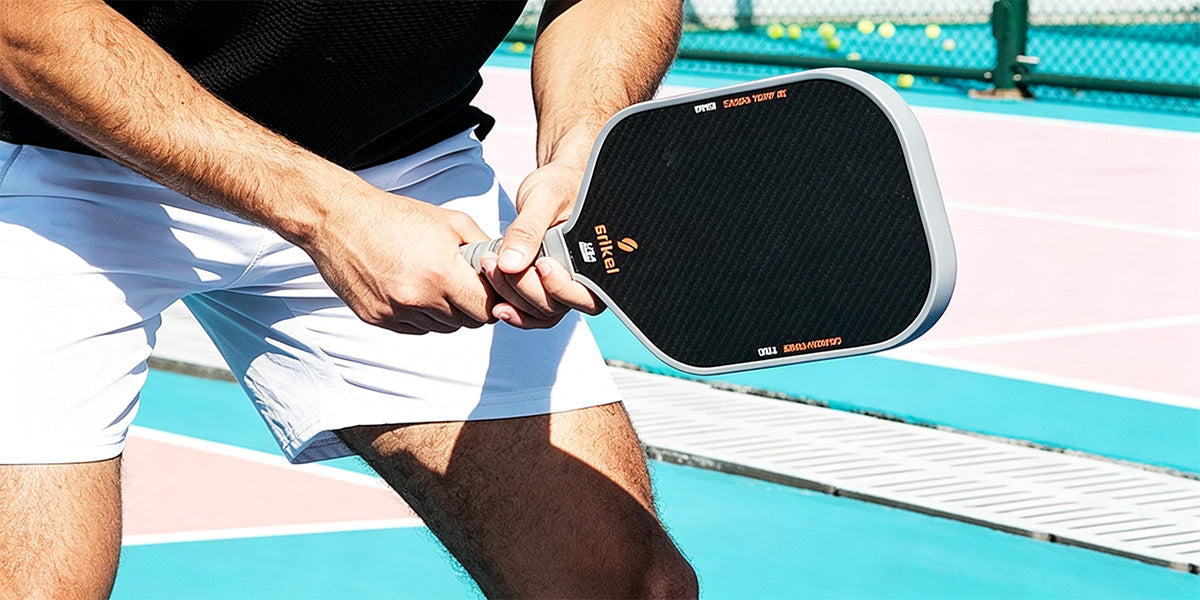
Whether you are stepping onto a court for the first time or you're a seasoned regular looking to upgrade your gear, you're likely noticed the sheer volume of equipment options available. Walk into any local club, and you'll see players wielding paddles that range from $50 to nearly $300. This leads to the ultimate question: What is a good pickleball paddle?
The truth is, a high price tag doesn't always equal a better game. A "good" paddle is not the one with the most expensive logo; it is the one that balances power and control while fitting your specific hand size and playing style. Selecting the wrong gear isn't just a waste of money—it can lead to missed shots, frustration, and even physical strain like "pickleball elbow."
In this guide, we will break down the three pillars of a quality paddle: materials, weight, and grip. By the end of this article, you will know exactly how to filter through the marketing noise and find a paddle that feels like a natural extension of your arm.

What Makes a Good Pickleball Paddle? The Non-Negotiable Standards
Before we dive into specs, let’s set a baseline. A good pickleball paddle must deliver on four key fronts. If it fails one, it doesn't matter how cool the graphics are.
- Control vs. Power Balance: A good paddle doesn't force you into one extreme. It allows you to dink softly at the net and drive hard from the baseline without the ball flying off the face unpredictably.
- Comfort & Feel: Vibration matters. A good paddle absorbs shock (saving your elbow) and gives you clear feedback so you know exactly where the ball hit the face.
- Durability: This is a long-term investment. A good paddle maintains its grit and spin potential over months, not just weeks.
- Skill-Level Match: A pro-level paddle with a tiny sweet spot is a terrible paddle for a beginner. A good paddle meets you where you are.
Pickleball Paddle Materials Explained (This is Where Performance Lives)
If you only read one section of this guide, make it this one. The materials inside and on the face of your paddle dictate about 80% of your on-court experience.
Core Materials – The Engine Inside
The core is the honeycomb structure inside the paddle. It absorbs impact and creates the "pop."
- Polymer Honeycomb (Polypropylene/PP): This is the modern gold standard. It’s soft, quiet, and forgiving. A 16mm Polymer Core is the industry darling for control players because it absorbs pace like a sponge, giving you more time to react at the net. A 14mm Polymer Core is slightly lighter and poppier, favored by aggressive players who want a bit more speed off the face.
- Nomex Core: The original core material. It’s stiff and loud—think hitting a ball with a piece of cardboard. It offers tons of power but minimal touch. Unless you are a former tennis pro who loves raw, hard feedback, you likely want to stick with Polymer.
- Aluminum Core: Lightweight and soft, but losing popularity due to the superior control and durability of modern polymer.
Surface Materials – The Contact Point
This is the face you actually hit. The material here dictates spin and power transfer.
- Fiberglass (Composite): This is the "power hitter's friend." Fiberglass has a trampoline-like quality. When the ball hits, the surface flexes and catapults the ball back with added velocity. It’s excellent for seniors or players who want to add easy depth to their shots without swinging out of their shoes. Downside? The surface can wear down faster than carbon fiber.
- Graphite: The classic control material. Graphite paddles are lightweight and stiff. They offer pinpoint accuracy and a very quiet, "thud" feel. However, graphite has largely been surpassed by textured carbon fiber in recent years when it comes to generating heavy topspin.
- Carbon Fiber (Especially T700 Raw Carbon): This is the gold standard for the modern game. Raw T700 Carbon Fiber has a rough, sandpaper-like texture that grabs the ball for incredible spin. More importantly, T700 is incredibly durable and provides a crisp, responsive feel that fiberglass can't match. A good paddle for advanced or aspiring players almost always features a T700 Carbon Face.
How to Choose Based on Materials:
- You love touch, drops, and long dink rallies: *Polymer Core (16mm) + Carbon Fiber Face.
- You want easy power and forgiveness: *Polymer Core (14mm) + Fiberglass Face.

How Paddle Weight Affects Your Game (And Your Arm)
Weight is the single biggest factor in how fast you can move the paddle. Pick the wrong weight, and you'll feel like you're swinging a brick. Pick the right weight, and you'll react to speed-ups effortlessly.
1. Lightweight (Under 7.3 oz / 207g)
- Pros: Lightning fast at the net. Excellent for players with tennis elbow or shoulder issues. Extremely maneuverable for hand battles.
- Cons: Lacks "plow through." You have to generate all the power yourself. Can feel fluttery against heavy drives.
- Best For: Defensive players, seniors, beginners learning fast volleys, and anyone with a history of joint pain.
2. Midweight (7.3 oz – 8.4 oz / 207g – 238g)
- Pros: The "Goldilocks Zone." This is the sweet spot for 90% of recreational players. You get enough mass to block hard shots without the paddle twisting, yet it's light enough to reset and flick with ease.
- Cons: It’s a balance—meaning it's not the absolute fastest nor the absolute most powerful.
- Best For: All-around players, intermediate level, and anyone unsure of where to start. If in doubt, start here.
3. Heavyweight (Over 8.5 oz / 240g)
- Pros: Unmatched stability. Drives feel like cannonballs. You barely have to swing; the paddle does the work.
- Cons: Slow at the net. High risk of arm fatigue and injury (tennis/golfer's elbow) if your mechanics aren't perfect.
- Best For: Strong singles players and former tennis players with strong wrists.
Choosing the Right Grip Size (The Injury Preventer)
This is the most overlooked—and arguably most important—spec for comfort. A grip that is too small or too large can cause tendinitis and elbow pain, even if the paddle weight is perfect.
Common Grip Sizes:
- Small (4" - 4 1/8"): Best for smaller hands or players who use a lot of wrist snap for spin.
- Medium (4 1/4" - 4 3/8"): The average male hand size.
- Large (4 1/2" and up): For large hands or players who prefer a very firm, locked-in feel.
How to Measure:
Hold your hand out, fingers together. Look at the two main creases in your palm. Measure from the middle crease to the tip of your ring finger. That length (in inches) is your ideal grip circumference.
The Pro Tip: If you are between sizes, always size down. You can easily add an overgrip (a thin, tacky wrap) to build up the size by about 1/16th or 1/8th of an inch. You cannot make a grip smaller.
Shape & Sweet Spot: The "Advanced" Metrics
Beyond the basics, you’ll see two main shapes:
- Standard (Wide Body): Usually 16" long and 8" wide. These have the largest sweet spots and are very forgiving.
- Elongated: Usually 16.5" long and 7.5" wide. These are the trend in 2026. The extra length gives you more reach and more "leverage" for power, but the sweet spot is slightly higher up and smaller.
Best Paddle Specs for Different Skill Levels
Now that you know the what and why, let's apply it to who you are.
|
Skill Level |
Material |
Weight |
Shape |
Goal |
|
Beginner |
Fiberglass face |
Lightweight to Midweight |
Standard or Wide-Body |
Get the ball over the net consistently without hurting your arm. |
|
Intermediate |
Raw Carbon Fiber (T700) |
Midweight |
Hybrid or Elongated |
Consistency in dinking and reliable resets from the transition zone. |
|
Advanced |
T700 Raw Carbon Fiber |
Midweight to Heavyweight |
Elongated |
Maximum spin RPMs, pinpoint accuracy on passing shots, and stability against bangers. |
Common Mistakes When Choosing a Paddle (And How to Avoid Them)

Even smart players fall into these traps. Avoid these three pitfalls, and you're ahead of 80% of the crowd.
1. The Price Tag Bias: Assuming the $279 paddle will fix your backhand. Reality: Technique trumps tech every time. A $100 paddle with the right specs will outplay a $250 paddle with the wrong specs any day of the week.
2. Ignoring Weight for "Pop": Buying a heavy paddle because it "hits harder" and then wondering why you're three steps late at the kitchen line. Reality: Pickleball is a game of handspeed. Lighter is usually better until you've mastered the soft game.
3. The Pro Imitation Trap: Buying the exact same paddle as Ben Johns or Anna Leigh Waters. Reality: You are not a professional athlete with elite hand-eye coordination. Those paddles are often highly customized with tiny sweet spots. You need forgiveness, not a scalpel.
Quick Buying Checklist
Before you click "buy," run through this list:
- Materials Match My Play: Am I a spinner (Carbon Fiber) or a banger (Fiberglass)? Am I a controller (16mm) or a speed demon (14mm)?
- Weight Suits My Strength: Will I be able to swing this for three hours without my elbow aching?
- Grip Fits My Hand: Did I measure? Is there room for an overgrip if needed?
- Certification: Does it have the "USA Pickleball Approved" seal? (Essential if you ever want to play in a tournament).
- Budget: Am I paying for technology, or just a fancy logo?
A "good" pickleball paddle is one that disappears in your hand. It shouldn't feel like a heavy rock, nor should it feel like a flimsy toy. It should be a balanced tool that allows you to play your best game without pain.
At Srikel, we believe in the "Zero Brand Tax" philosophy. We use the same high-end materials you find in the $250 "tour" paddles—like T700 Raw Carbon Fiber and precision-engineered Polymer Honeycomb cores—but we focus on the engineering rather than the expensive marketing.
Our Aura Pro series, for example, is designed to give you that premium "pro-level" spin and reset capability at a price that makes sense for the everyday player. Whether you choose a Srikel or another brand, remember: focus on the Materials, Weight, and Grip. If those three are right, the wins will follow.
Ready to find your perfect match? [Explore the Srikel Paddle Collection here] and see how high-performance tech feels when it's built for players, not for billboards.

Leave a comment
This site is protected by hCaptcha and the hCaptcha Privacy Policy and Terms of Service apply.