


With the explosive growth of the sport over the past few years, a concerning trend has emerged at local courts: the guy who just won his first local 3.5 tournament is suddenly handing out business cards and charging $80 an hour for lessons.
Because the barrier to entry is currently so low, the market is flooded with enthusiastic but wildly unqualified instructors.
To protect your time and your body, you must know how to separate the passionate amateurs from the true professionals. Whether you are trying to master your third-shot drop or preparing for your first major tournament, this guide will reveal the exact qualities you must look for before handing your money over to a pickleball coach.
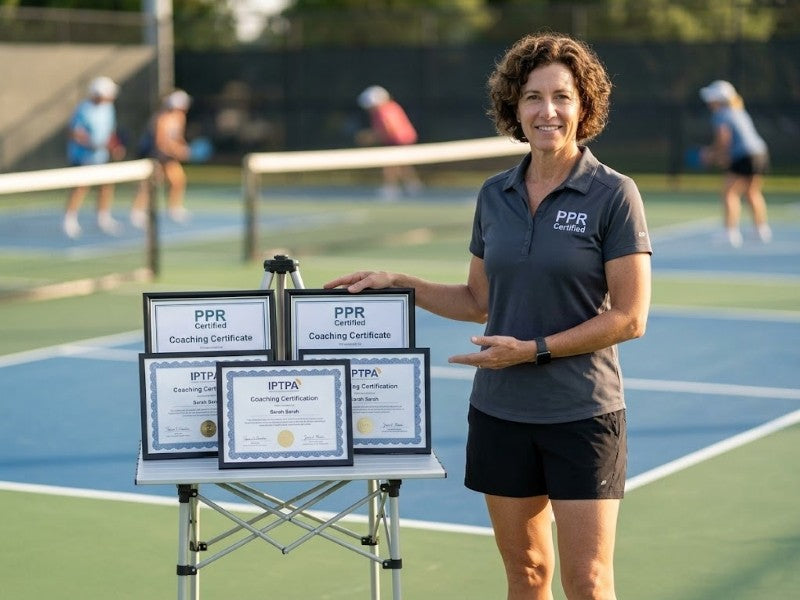
Quality 1: Recognized Official Certifications
Just because someone can execute an unattackable dink does not mean they know how to teach you to do it. The most fundamental baseline for hiring a professional is verifying their educational credentials.
Why Certification Matters
A certified pickleball coach has undergone rigorous, standardized testing. They haven't just memorized the rules; they have been trained and evaluated on teaching methodologies, court safety, injury prevention, and the biomechanics of proper stroke production. Certification proves that the instructor has invested time and money into their craft as a profession, not just a weekend side hustle.
The Major Organizations in 2026
When vetting a potential coach, look for credentials from these industry gold standards:
- PPR (Professional Pickleball Registry): Widely considered the premier certification in the industry. The PPR serves as the official education and certification partner of USA Pickleball. If a coach holds a PPR certification, they have passed comprehensive exams on the sport's standard teaching frameworks.
- IPTPA (International Pickleball Teaching Professional Association): Another highly respected global organization. IPTPA certification is notoriously rigorous, requiring coaches to pass written exams, a skills test, and a live teaching evaluation.
If a prospective coach scoffs at certifications or claims they "don't need them because they play at a 5.0 level," take your money elsewhere.

Quality 2: Exceptional Communication and "Breakdown" Skills
Teaching is, at its core, an act of translation. A professional pickleball coach must take complex kinetic movements and translate them into simple, actionable cues that your brain and body can instantly understand.
The "Cure, Don't Just Diagnose" Approach
A mediocre coach acts like a live commentator. They will watch you hit the ball into the net and say, "You hit that into the net, you need to hit it higher." That is a diagnosis, and it is entirely useless—you already know it went into the net.
A professional pickleball coach provides the cure. They will stop the drill and say, "You hit the ball into the net because your paddle face was closed and your grip was too tight. Loosen your pinky finger and angle the paddle slightly up toward the sky before contact." They identify the root mechanical flaw and provide a specific, actionable adjustment.
Adaptability to Learning Styles
Humans process information differently, and a top-tier coach recognizes this immediately.
- Visual Learners: Need to see the motion. A great coach will physically demonstrate the stroke repeatedly, showing the exact paddle path.
- Auditory Learners: Rely on verbal cues and metaphors. A coach might say, "Brush up the back of the ball like you are rolling a wheel up a hill" to teach topspin.
- Kinesthetic Learners: Need to feel the movement. The coach will ask permission to step in and physically guide your arm and paddle through the correct swing path to build muscle memory.
If a coach only teaches using one method and grows frustrated when you don't "get it," they are lacking essential communication skills.
Quality 3: A Structured, Player-Centric Curriculum
One of the biggest red flags on the court is the "just hit around" lesson. If you show up for your hour and the coach immediately just starts playing games with you without a plan, you are paying for a hitting partner, not a coach.
Goal Setting Starts on Day One
Before you ever hit a ball, a professional pickleball coach will sit down and ask about your specific goals. They need to understand your baseline. Are you trying to aggressively climb the DUPR ratings to win a 4.0 tournament, or do you just want to stop popping the ball up so you can comfortably beat your neighbors on Sunday mornings? A pro tailors the intensity and focus of the lesson to your personal ambitions.
Progressive Lesson Plans
True improvement requires a roadmap. A professional instructor does not randomly feed you balls and shout advice. They build a progressive, week-by-week curriculum.
For example, if your goal is mastering the transition zone, the curriculum might look like this:
- Week 1: Isolating the mechanics of the block volley (absorbing pace).
- Week 2: Movement and footwork while retreating or advancing.
- Week 3: Executing the dink reset off a hard drive.
- Week 4: Combining all three skills in live-point simulations.
By isolating specific mechanics before integrating them into a live game, a structured curriculum ensures that your skills actually translate to real match scenarios, rather than falling apart the moment the pressure is on.
Quality 4: High Court IQ (Over Pure Playing Ability)
There is a common misconception in the pickleball world that you must hire a 5.0+ pro tour player to get top-tier instruction. In reality, the best player on the court is rarely the best teacher.
Strategy Over Flashiness
While a professional pickleball coach certainly needs a high level of personal skill (typically possessing a solid 4.5+ rating to deeply understand advanced mechanics), their ability to hit a flashy, behind-the-back ATP (Around the Post) shot is not what helps you improve. What truly matters is their "Court IQ."
A great coach understands the geometry of the court. They teach you why a shot is effective, not just how to hit it. They will explain the percentage-based reasoning behind dropping the ball into the opponent's left kitchen corner rather than driving it down the middle. They teach you how to read your opponent's paddle angle and anticipate their next move. Pure athleticism fades, but strategic court positioning wins matches at every level.
The Ability to "Feed" Balls
This is perhaps the most underrated and crucial physical skill a coach must possess. A professional does not just rally with you; they "feed" you.
If you are trying to learn how to defend against a fast drive to your backhand, a true pickleball coach has the physical control to stand at the kitchen line and hit the ball to the exact same square inch on your backhand side, at the exact same speed, 50 times in a row. This flawless repetition is the only way for your brain to develop reliable muscle memory. If the coach lacks the control to feed balls accurately, you will spend half your lesson reacting to wild shots rather than practicing the specific mechanic you paid to learn.
Quality 5: Patience and Emotional Intelligence
Pickleball is an incredibly mental game. Changing your mechanics—especially if you are trying to unlearn years of ingrained tennis habits, like taking a massive backswing on volleys—is a deeply frustrating process. You will inevitably get worse before you get better.
Building Confidence Through Positive Reinforcement
A high-quality pickleball coach operates with immense emotional intelligence (EQ). They understand that screaming, aggressive criticism, or showing visible frustration when you miss a shot will instantly trigger your fight-or-flight response, making it impossible for your brain to absorb new information.
Instead, professionals build a positive, supportive environment. They celebrate the small mechanical victories (e.g., "The ball went out, but your paddle path was absolutely perfect that time!"). They keep you relaxed, ensuring that your muscles stay loose and your mind stays open to instruction.
Knowing When to Push
However, patience does not mean complacency. A truly great coach knows exactly how to read your body language to find the perfect balance. They know when you are overwhelmed and need a water break, but they also know when you are getting comfortable and need to be pushed slightly outside of your comfort zone to achieve real growth. They dictate the pacing of the lesson based entirely on your emotional and physical state on that specific day.

Bonus Section: 3 Massive Red Flags When Hiring a Pickleball Coach
If you are evaluating a new instructor, keep your eyes open. If you spot any of these three red flags during your first lesson, do not book a second one:
- Red Flag 1: The Glory Days Complex. If your coach spends half the lesson talking about their own DUPR rating, their recent tournament medals, or how they "almost beat Ben Johns once," run. The lesson is about your game, not their ego.
- Red Flag 2: The Day-One Total Overhaul. A bad coach will look at your swing on the first day and tell you to change everything: your grip, your stance, and your follow-through all at once. This is overwhelming and ineffective. A professional makes targeted micro-adjustments, changing one small variable at a time so you can actually digest the information.
- Red Flag 3: The Disengaged Feeder. If the coach is constantly checking their phone, staring at the court next door, or just mindlessly hitting balls back to you without watching your footwork or paddle face, they are stealing your money. A pro's eyes should be locked on your mechanics at all times.
Conclusion
Finding the right instructor is one of the most rewarding investments you can make in your athletic journey. A phenomenal pickleball coach will not only elevate your DUPR rating and win rate, but they will also protect your body from injury and deepen your love for the sport.
Before committing to a massive, multi-week lesson package, do your homework. Ask the instructor for a quick 15-minute phone consultation to discuss your goals, or book a single trial lesson. Look for official certifications, demand structured lesson plans, and ensure their communication style clicks with your brain. When you find a coach who meets all five of these criteria, you will be amazed at how quickly your game transforms.

Leave a comment
This site is protected by hCaptcha and the hCaptcha Privacy Policy and Terms of Service apply.