


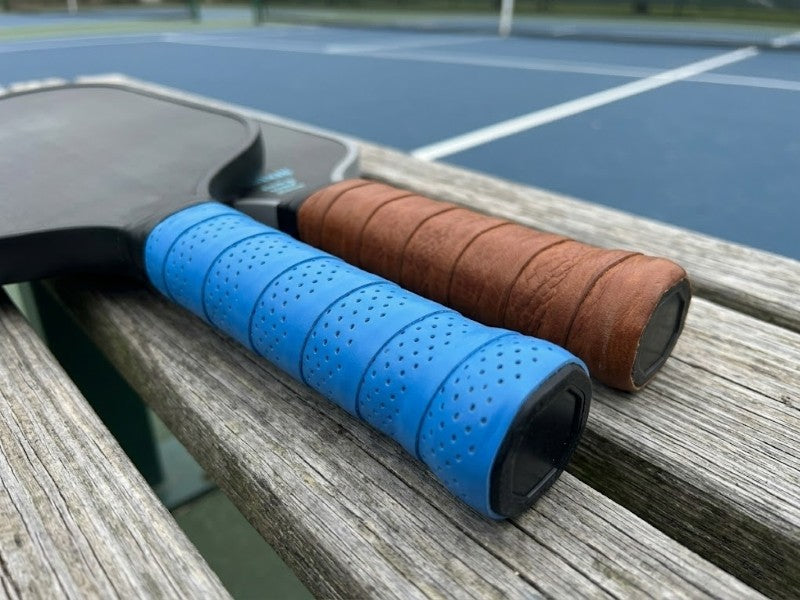
You can spend hundreds of dollars on a state-of-the-art paddle featuring aerospace-grade raw carbon fiber, a thermoformed unibody construction, and a multi-density polymer core. However, all that advanced engineering is useless if you cannot properly hold onto the paddle. Your grip is the single physical connection point between your body and your equipment.
Despite this, the handle is often the most neglected part of a player's setup. A slippery, uncomfortable, or incorrectly sized handle is the root cause of countless unforced errors.
The good news? Upgrading and customizing your handle is the cheapest, fastest, and most impactful modification you can make to your game.
The Fundamentals: Replacement Grips vs. Overgrips

Before diving into sizing and textures, we must address the most common point of confusion for players looking to upgrade their handles. When you search for pickleball grips, you will encounter two entirely different products: Replacement Grips and Overgrips. Understanding the distinction is critical for your paddle's maintenance.
What is a Replacement Grip (Base Grip)?
The replacement grip—often referred to as the base grip—is the thick, cushioned layer that comes pre-installed on your paddle straight from the factory.
- Application: It is wrapped directly over the bare carbon, polymer, or wooden handle of the paddle. It features a strong adhesive backing to keep it permanently in place.
- Function: This grip provides the primary shock absorption for your hand and defines the bevels (the flat edges) of the handle, which help you intuitively feel the angle of your paddle face without looking.
- Lifespan: Base grips are durable and only need to be replaced every 3 to 6 months, depending on how often you play and whether you use an overgrip.
What is an Overgrip?
An overgrip is a thin, relatively inexpensive strip of material designed to be wrapped over your existing base grip.
- Application: It does not have an adhesive backing (save for a tiny sticky tab at the start). Instead, it relies on tension and a piece of finishing tape at the top to stay secure.
- Function: Overgrips are used to customize the texture (making it tackier or more absorbent), protect the base grip from sweat degradation, and slightly increase the overall thickness of the handle.
- Lifespan: Overgrips are meant to be disposable. Serious players who sweat heavily often change their overgrips every 10 to 15 hours of play to maintain maximum friction.
Factor 1: Grip Thickness and Wrist Health
When it comes to pickleball grips, size absolutely matters. The circumference of your handle drastically alters your biomechanics on the court. Playing with a grip that is too big or too small not only ruins your shot control but can lead to chronic injuries.
Thin Grips (4.0" - 4.125")
A thinner grip allows the handle to sit deeper in your fingers rather than resting fully in your palm.
- Pros: Thin grips provide maximum wrist mobility. If you come from a table tennis background and rely on snappy wrist flicks, aggressive topspin rolls, and fast hands at the non-volley zone, a thin grip gives you unparalleled maneuverability. It is also the ideal choice for players with smaller hands.
- Cons: If your hands are large, a thin handle forces you to squeeze aggressively to keep the paddle from twisting when blocking hard drives. This constant squeezing quickly fatigues the forearm muscles and can strain the wrist.
Thick Grips (4.25" and above)
A thicker grip fills the palm of your hand, providing a much more substantial foundation.
- Pros: Stability and injury prevention. A thicker handle naturally prevents the paddle from twisting in your hand during off-center hits. More importantly, it requires significantly less grip pressure to hold securely. For this reason, upgrading to a thicker grip is the #1 equipment recommendation for players trying to alleviate or prevent tennis elbow (lateral epicondylitis).
- Cons: The added bulk restricts your wrist's range of motion. You will lose some of the "whip" required for deceptive flick shots, forcing you to rely more on your shoulder and core for power.
How to Measure Your Ideal Grip Size at Home
Not sure which size you need? Try these two simple methods:
1. The Index Finger Test: Grab your paddle with your normal forehand grip. Look at the gap between the tip of your ring finger and the base of your thumb pad. You should be able to slide the index finger of your non-hitting hand snugly into that gap. If your ring finger is touching your palm, the grip is too small. If there is a massive gap, the grip is too big.
2. The Ruler Method: Open your hitting hand flat, fingers extended together. Place a ruler at the bottom lateral crease of your palm and measure to the tip of your ring finger. That measurement (typically between 4.0 and 4.5 inches) corresponds to your ideal grip circumference.
Factor 2: Texture & Feel (Tacky vs. Dry)
Once you have established the correct size, you must determine how you want the paddle to feel against your skin. The texture of your pickleball grips should be dictated entirely by your body chemistry (how much your hands sweat) and your local playing climate.
Tacky Pickleball Grips
Tacky grips are engineered to feel sticky and slightly rubbery to the touch.
- Characteristics: When you hold a tacky grip, it feels as though the material is lightly clinging to your skin, essentially locking the paddle into your palm.
- Best For: Players with naturally dry hands, or those who play indoors/in cooler winter climates. Because the grip is naturally sticky, you can hold the paddle very loosely (improving your soft dink game) without fear of dropping it.
- The Warning: If you are a heavy sweater or play in the humid summer heat, a tacky grip is your worst enemy. Once moisture hits a tacky polyurethane surface, it loses all its stickiness and turns into a slippery, uncontrollable nightmare.
Dry / Absorbent Grips
Dry grips (sometimes called "Tour" grips) have a distinctly different feel right out of the package.
- Characteristics: They feel smooth, papery, or slightly suede-like. Initially, they might not feel very secure, but their magic is in their chemistry. Dry grips are highly porous. As your hands begin to sweat, the material absorbs the moisture and actually becomes grippier and more secure as the match goes on.
- Best For: The heavy sweaters, players in hot/humid climates like Florida or Texas, and intense tournament scenarios where sweat mitigation is critical.
Ribbed / Contoured Grips
If you struggle with the paddle twisting in your hand regardless of sweat, a contoured grip might be your perfect match.
- Characteristics: These grips feature a raised EVA foam ridge sewn into the material that spirals down the handle once wrapped. This creates physical, ergonomic grooves for your fingers to rest in.
- Best For: Beginners who are still developing their hand strength, or players who frequently mis-hit the ball. The raised ridges act as physical barrier, making it nearly impossible for the paddle to slip or rotate in your hand, providing a viselike hold.
Factor 3: Materials and Perforations

Beyond thickness and texture, the actual physical composition of your pickleball grips plays a vital role in both durability and moisture management. Manufacturers use a variety of materials and structural designs to fine-tune the feel of the handle.
Polyurethane (PU)
Walk into any pro shop, and 95% of the grips on the wall will be made from Polyurethane (PU).
Why it is the Industry Standard: PU is an incredibly versatile synthetic material. It is highly durable, tear-resistant, and most importantly, stretchable. This elasticity allows the grip to be wrapped tightly around the octagonal bevels of a pickleball paddle without wrinkling, ensuring a perfectly smooth finish. Manufacturers can easily manipulate PU during production to be either intensely tacky or highly porous and dry.
Perforated vs. Smooth Designs
As you browse different pickleball grips, you will notice some models feature hundreds of tiny, punched-out holes. This is not just an aesthetic choice; it serves a highly functional purpose.
- Perforated Grips: The tiny holes increase the surface area and promote airflow underneath your hand. This accelerates moisture wicking, drawing sweat away from your skin faster than a smooth grip. Additionally, the perforations make the PU material slightly softer and more compressible, offering a plusher, more cushioned feel.
- Smooth Grips: Without holes, smooth grips offer maximum surface-area contact with your skin. If you want the absolute highest level of pure "tackiness" and friction, a smooth PU grip will provide the most secure lock on your paddle.
Cloth / Toweling Grips
While highly niche in pickleball, cloth or terry-cloth toweling grips are a secret weapon for players dealing with extreme hyperhidrosis (excessive sweating).
The Ultimate Sweat Solution: Operating exactly like a thin towel wrapped around your handle, these grips offer zero tackiness but infinite absorbency. Often paired with grip powder or rosin bags, cloth grips ensure that no matter how much you sweat, the paddle will never slip out of your hand. Keep in mind that cloth grips add significant thickness to the handle and need to be replaced very frequently to remain hygienic.
Conclusion
While it is easy to obsess over carbon fiber faces and thermoformed polymer cores, you should never underestimate the power of the handle. Investing a few dollars into the right pickleball grips is the most cost-effective way to instantly improve your paddle control, maximize your spin potential, and protect your body from joint fatigue.
Whether you need the viselike hold of a tacky polyurethane, the sweat-wicking magic of a dry overgrip, or the joint-saving relief of a thicker, cushioned circumference, the perfect handle is out there waiting for you. Do not be afraid to experiment: buy a multi-pack of different textures and thicknesses, wrap them up, and hit the courts to discover the perfect feel that elevates your game to the next level.

Leave a comment
This site is protected by hCaptcha and the hCaptcha Privacy Policy and Terms of Service apply.