


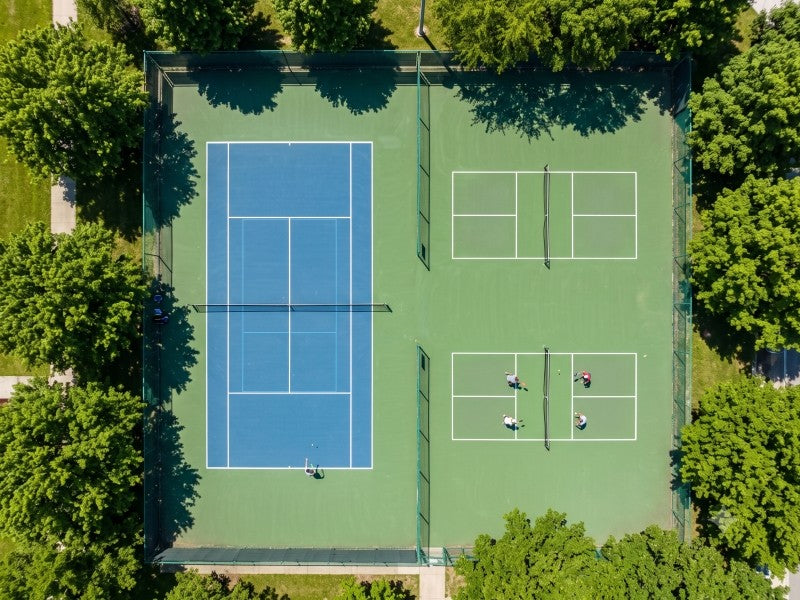
The biggest mistake tennis veterans make is attempting to dominate a pickleball match using pure, unadulterated power. When transitioning between these two sports, you are not just learning a new paddle; you must completely rewire your tactical instincts.
As a racket sport veteran, exactly how do you play pickleball without letting your ingrained tennis habits ruin your game?
The Mindset Shift: Why "Smash and Win" Fails in Pickleball
In tennis, a perfectly executed, heavy-topspin baseline drive is often a clean winner. In pickleball, that exact same shot is a tactical error against advanced players. You must fundamentally change how you view court dominance.
The Speed Illusion and Aerodynamics
Unlike a pressurized felt tennis ball, a pickleball is a hollow, perforated piece of hard plastic. It is a slave to aerodynamic drag. No matter how hard you hit a baseline drive, the ball decelerates rapidly as it crosses the net. Advanced pickleball players stationed at the net will effortlessly block your 60 MPH drive, dropping it softly at your feet before you can even blink.
Patience Over Power
To succeed in pickleball, you must adopt a "patience over power" mindset. Tennis is often a baseline sprinting match won by absolute force and extreme angles. Pickleball, by contrast, is a high-speed game of physical chess played at the net. The objective is not to hit through your opponent, but to hit unattackable soft shots until your opponent makes a mistake and pops the ball up.

How Do You Play Pickleball? The 3 Rule Traps for Tennis Players
The physical transition is difficult, but the rulebook is where most tennis players lose their first few matches. If you find yourself asking, "how do you play pickleball without constantly giving away free points?" you must memorize these three critical rule traps.
Trap 1: The Two-Bounce Rule
- The Tennis Habit: The classic "Serve and Volley." In tennis, you can hit a massive serve and instantly sprint to the net to put away the return out of the air.
- The Pickleball Fix: Pickleball enforces the strict Two-Bounce Rule. When the ball is served, the receiving team must let it bounce once before hitting it. Then, the serving team must also let the return bounce once before hitting it. You cannot rush the net immediately after serving. If you volley the third shot out of the air, it is an instant fault.
Trap 2: The Kitchen (The Non-Volley Zone)
- The Tennis Habit: Crowding the net. Tennis players are taught to close the gap as tightly as possible to hit aggressive, downward volleys.
- The Pickleball Fix: Every pickleball court features a 7-foot area on both sides of the net called the Non-Volley Zone (NVZ), universally known as "The Kitchen." You cannot hit the ball out of the air (volley) while any part of your body is touching the Kitchen zone or its line.
- The Momentum Clause: This is where tennis players struggle the most. Even if you hit a legal volley outside the Kitchen, if your forward momentum carries your foot onto the Kitchen line after the shot, it is still a fault. You must learn to aggressively stop your forward momentum.
Trap 3: The Side-Out Scoring System
- The Tennis Habit: The 15-30-40 scoring system, where a point can be won regardless of who served the ball.
- The Pickleball Fix: Traditional pickleball utilizes a "Side-Out" scoring system. You can only score a point if you or your team is serving. If the receiving team wins the rally, they do not get a point; they simply win the right to serve.
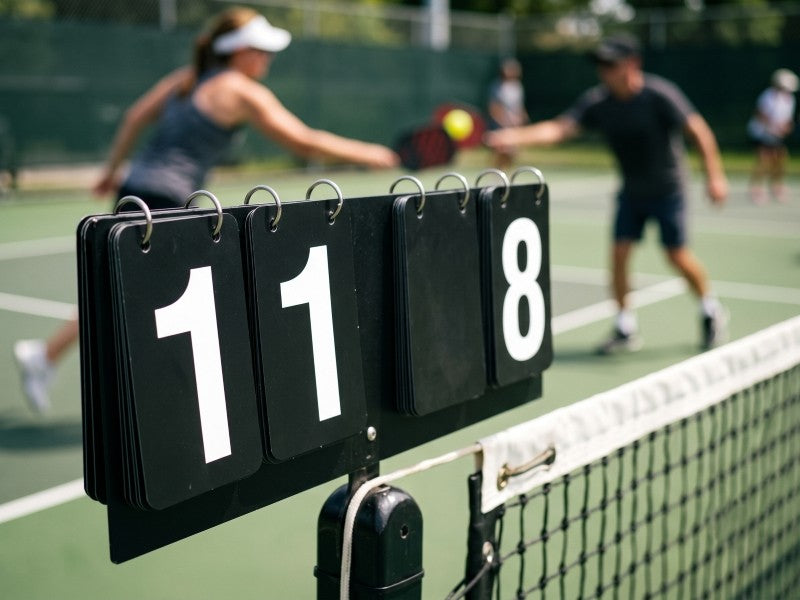
- The Three-Number Call: Because of this, the score is always called using three numbers (e.g., 0-0-2). The sequence represents the serving team's score, the receiving team's score, and which server on the team (Server 1 or Server 2) is currently serving.
Tactical Translation: Adapting Your Tennis Strokes
When tennis players ask, "how do you play pickleball strategically?" the answer always points to stroke mechanics. Your tennis strokes are designed for a 78-foot court and a bouncy ball. To dominate in pickleball, you must shrink your mechanics and prioritize precision over pace.
Stroke Comparison Matrix
This matrix highlights the critical adjustments required to translate your tennis muscle memory into effective pickleball techniques.
|
Tennis Technique |
Pickleball Equivalent |
The Critical Adjustment |
|
Heavy Topspin Groundstroke |
The Third Shot Drop |
Shorten the backswing dramatically. Prioritize a high arc and a soft landing inside the Kitchen over raw pace. |
|
Wide Stance Aggressive Volley |
Compact Block Volley |
Keep the paddle completely in front of your chest. Use the opponent's pace to block rather than swinging through the ball. |
|
The Overhand Smash |
The Overhead Put-Away |
Wait for a significantly higher bounce. Hit downward at a sharper angle because the plastic ball lacks the weight to travel deep. |
|
"No Man's Land" Avoidance |
The Transition Zone Reset |
Stop running mid-court, execute a split-step, and hit soft resets into the Kitchen instead of blindly rushing the net. |
The Third Shot Drop vs. The Baseline Drive
In tennis, a deep baseline drive sets up your net approach. In pickleball, driving the third shot is often a trap against skilled opponents waiting at the Kitchen line.
You must master the Third Shot Drop. This is a soft, arcing shot hit from the baseline that lands harmlessly in the opponent's Kitchen. It neutralizes their offensive net position and buys you the time needed to sprint forward and join them at the Non-Volley Zone.
Shortening the Backswing
Because a pickleball court is incredibly compact, the reaction time during a net exchange (a "hand battle") is practically zero. A traditional tennis takeback will leave you jammed and late on every shot.
You must adopt a highly compact stroke. Keep your elbows in front of your ribs and use your shoulders and core to push the ball. Think of it as a firm "block" rather than a full swing.

Equipment Transition: Ditching the Strings for a Paddle
Transitioning your gear is much simpler than transitioning your tactics. Fortunately, your tennis background gives you an immediate physical advantage when holding a pickleball paddle.
The Grip Transfer Advantage
If you use a Continental grip (the "hammer" grip) for your tennis volleys and serves, do not change a thing. The Continental grip is the gold standard for pickleball. It allows you to transition seamlessly between forehand and backhand blocks at the net without wasting precious milliseconds shifting your hands.
Choosing the Right Paddle
Do not buy a power-focused paddle. As a tennis player, you already generate more than enough kinetic energy through your hips and shoulders.
Your biggest challenge will be keeping the ball in play and executing delicate drop shots. You should invest in a thick-core, raw carbon fiber control paddle. These paddles absorb the ball's impact, maximizing dwell time and spin, which will immediately help you tame your excessive power.
Frequently Asked Questions (FAQs)
Why do my pickleball shots keep popping up too high?
This is a classic tennis player symptom. You are likely gripping the paddle too tightly and using an extreme low-to-high topspin motion. Loosen your grip pressure to a "3 out of 10" and focus on pushing the paddle directly forward through the ball, rather than pulling up on it.
Can I use my tennis shoes for pickleball?
Absolutely. In fact, hard-court tennis shoes are considered the optimal footwear for outdoor pickleball. Their reinforced rubber outsoles and aggressive lateral support will protect your ankles during the rapid side-to-side shuffling required at the Kitchen line.
How do you play pickleball singles compared to doubles?
While doubles is a game of patience and soft "dinking," pickleball singles plays much more like traditional tennis. Singles requires explosive baseline drives, sharp passing shots, and immense cardiovascular endurance to cover the entire 20-foot width by yourself.

Leave a comment
This site is protected by hCaptcha and the hCaptcha Privacy Policy and Terms of Service apply.