


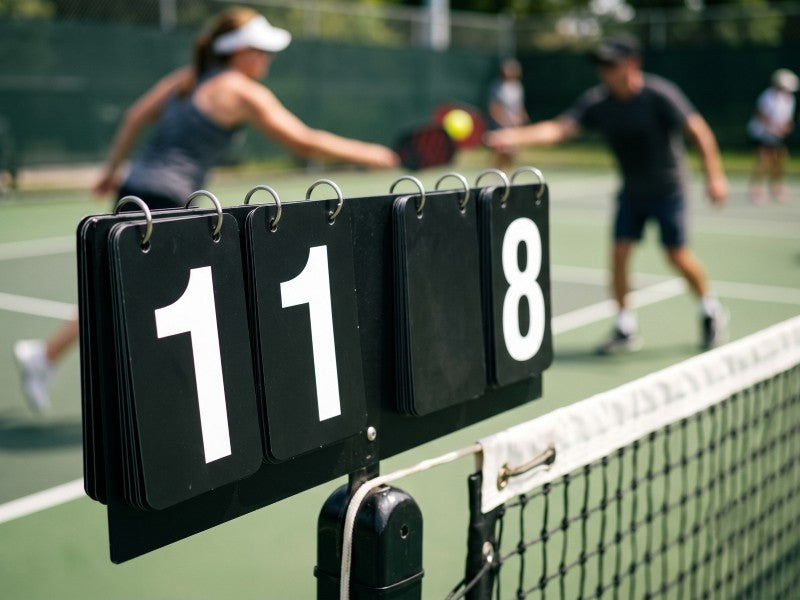
If you are just getting started with America's fastest-growing sport, the rules can occasionally feel like a moving target. You might have watched a professional match on television that ended at 21, but when you showed up to your local park, the players packed up and rotated off the court after someone reached 11.
This inconsistency can leave beginners scratching their heads, wondering: in a standard game, exactly what do you play to in pickleball?
The definitive answer is that a standard game of pickleball is played to 11 points, and you must win by a margin of at least 2 points.
The Golden Rule: The 11-Point Standard
If you are packing your paddle bag for a casual weekend game, you should mentally prepare for an 11-point sprint. For roughly 90% of all pickleball matches played globally, 11 is the undisputed magic number.
Why 11 Points?
The 11-point limit was intentionally adopted from table tennis (ping-pong) to keep the game fast, dynamic, and physically accessible. Because the court is small and the rallies are intense, playing to 11 points hits the "Goldilocks zone"—it is long enough to establish a clear winner based on skill, but short enough to prevent players from suffering extreme cardiovascular exhaustion.
An average game played to 11 points using traditional side-out scoring takes exactly 12 to 20 minutes to complete.
The "Open Play" Ecosystem
If you visit a public park for "Open Play," you will always play to 11 points. Open Play relies on a paddle-saddle or queuing system where strangers mix and match. Playing to 11 ensures rapid court turnover. If a park has 20 people waiting for 4 courts, capping games at 11 points guarantees that nobody is sitting on the sidelines for more than 15 minutes at a time. It is the ultimate tool for community efficiency.
Tournament Main Brackets
In officially sanctioned tournaments (such as those regulated by USA Pickleball), 11 points is the gold standard for the main winner's bracket. However, instead of playing a single game, competitors play a "Best 2 out of 3 matches to 11 points." This multi-game format neutralizes lucky streaks, forcing the truly superior team to prove their consistency over a longer period.

The Non-Negotiable Caveat: "Win By 2"
Knowing what you play to in pickleball is only half of the equation. You must also understand the sport's most dramatic rule: the "Win By 2" mandate.
Whether you are playing to 11, 15, or 21, you can never win a game by a single point. If the score is tied at 10-10 in a standard game, the match does not end when a team scores the 11th point. The game goes into "overtime."
How it works in practice:
- If the score is 10-10, you must reach 12 (winning 12-10).
- If your opponents tie it up at 11-11, you must reach 13 (winning 13-11).
- There is absolutely no ceiling to this rule. Theoretically, if both teams refuse to yield, a game to 11 could stretch to 24-22.
The "Win By 2" rule exists to eliminate cheap victories. It prevents a team from winning a championship based on a lucky net-cord roll or a gust of wind, demanding that the victorious team clearly outplay their opponents during the final, high-pressure moments of the match.
When Do You Play to 15?
While 11 is the recreational standard, 15 points is the second most common target score. You will almost exclusively encounter the 15-point format in organized tournament settings, where event directors are battling against the clock.
The Consolation Bracket (The Loser's Bracket)
Most amateur pickleball tournaments operate on a double-elimination format. If you lose your first match in the main bracket (which was 2 out of 3 to 11), you are sent down to the "Opportunity Bracket."
Because the tournament director needs to keep dozens of matches running on schedule, they cannot afford for the loser's bracket matches to take an hour each. To speed things up, matches in the consolation bracket are typically played as one single game to 15 points (still requiring a win by 2). It is a rapid-fire sprint for survival.
Round-Robin Formats
In a round-robin tournament, your team plays against every other team in your assigned pool. Playing a "Best 2 out of 3" against five different teams in a single afternoon would cause severe physical fatigue. To balance competitive fairness with efficiency, round-robin matches are frequently played as one single game to 15 points.
When Do You Play to 21?
Playing a match to 21 points is relatively rare in amateur public parks, but it has become highly visible on television in 2026, largely due to professional leagues.
Major League Pickleball (MLP)
If you turn on the TV and see players battling it out to 21, you are likely watching Major League Pickleball. To make the sport more television-friendly and guarantee a specific broadcast window, the MLP utilizes a single-game format to 21 points.
Local Marathon Leagues
Occasionally, you might join an indoor winter league or a localized club that prefers the 21-point format. Some advanced players prefer playing one long game to 21 rather than stopping at 11, as it allows for deeper tactical adjustments and momentum swings against a single opponent without the interruption of switching games.

FAQs
Do players switch sides of the court during a game?
Yes, to account for sun, wind, and background distractions. In a standard game to 11, teams switch ends of the court when the first team reaches 6 points. If you are playing a game to 15, you switch when the first team reaches 8 points. In a game to 21, you switch at 11 points.
What happens if a tournament runs out of time?
If a local tournament is running drastically behind schedule (perhaps due to rain delays), the tournament director has the authority to change the scoring format mid-event. They might announce that all remaining matches will be played as a single game to 11 or 15, rather than the standard "best out of 3."
Do you still have to win by 2 in Rally Scoring?
Yes. Even in professional leagues like Major League Pickleball where rally scoring is used up to 21 points, the "win by 2" rule is strictly enforced to ensure a definitive, earned victory. (Note: In some strict rally scoring variations, you can only score the final winning point while serving).
How long does an average 11-point game take to play?
In recreational "Open Play," an 11-point game typically takes between 12 to 15 minutes. However, advanced or professional matches played to 11 can easily stretch past 20 to 25 minutes. Advanced players rely heavily on slow, strategic dink rallies at the net, which drastically increases the length of every single point.
Is there a maximum score cap if a game is tied 10-10?
No, there is no official ceiling or score cap in standard pickleball. Because you are strictly required to "win by 2," the game will continue indefinitely until that margin is reached. While a final score of 12-10 is common, it is not unusual to see intensely competitive tournament matches end with grueling scores like 18-16 or even 22-20.
Are pickleball games ever played with a time limit instead of a score limit?
Officially, no. Pickleball is entirely score-based. However, if you are playing at an incredibly crowded public park with a massive line of waiting players, the local community might enforce a temporary "10-minute rule." When the timer goes off, whoever is leading wins, ensuring the court rotation doesn't stall during a stubbornly long match.
Conclusion
So, the next time a beginner steps onto the court and asks, "what do you play to in pickleball?" you possess the complete answer.
If you are at a local park, prepare for a fast-paced sprint to 11. If you are fighting your way out of a tournament loser's bracket, gear up for a single battle to 15. And if you ever find yourself on a professional stage, be ready for the marathon to 21. No matter what the target score is, never forget the golden rule: keep your paddle up, stay out of the Kitchen, and always win by two!


Leave a comment
This site is protected by hCaptcha and the hCaptcha Privacy Policy and Terms of Service apply.