


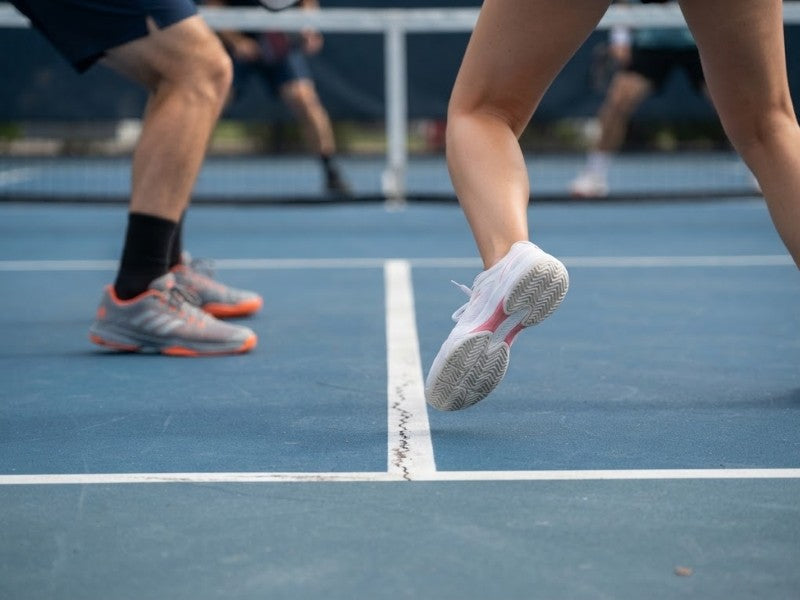
If you are looking for the definitive medical and biomechanical answer in the ultimate racquetball vs pickleball debate for joint health, here is the honest truth: Pickleball is significantly better for your knees and long-term joint health. While racquetball requires explosive, 360-degree lunges and sudden, violent stops that place extreme shear force on the meniscus and ACL, pickleball relies on controlled, lateral shuffling. Furthermore, the slower, wiffle-like plastic ball allows players to position their feet safely before striking, drastically reducing the risk of acute joint injuries.
In this comprehensive guide, we are going to look past the hype and break down the biomechanics of both sports. We will dissect exactly how each game loads your joints, why the speed of the ball dictates your orthopedic health, and how you can seamlessly transition your skills to the pickleball court without bringing the pain along with you.
The Biomechanics of the Court: How You Move
To truly understand why one sport leaves you feeling refreshed and the other leaves you reaching for an ice pack, we have to look at movement patterns. Sports medicine physicians evaluate the danger of a sport by analyzing how the body is forced to start, stop, and change direction.
Racquetball: The 360-Degree Shear Force
Racquetball is a magnificent cardiovascular workout, but it is an absolute nightmare for human joints. The game takes place inside a fully enclosed room, meaning the ball can bounce off the front wall, the side walls, the ceiling, and the back wall.
Because the ball can come from literally any angle, your movement pattern is completely chaotic. You are constantly required to execute 360-degree pivots. Imagine sprinting at full speed toward the front wall, only to realize the ball is rocketing past you. You must abruptly slam your foot onto the floor to stop your momentum, violently twist your hips, and lunge backward.
This specific sequence creates what biomechanists call shear force. When your foot is planted firmly on the floor but your femur (thigh bone) and torso violently twist in the opposite direction, the rotational torque goes directly into your knee. This is the exact mechanism that causes catastrophic ACL tears and grinds down the protective cartilage of your meniscus. In racquetball, you are subjecting your knees to this extreme shear force dozens of times per game.
Pickleball: Lateral Shuffling and the "Dink" Stance
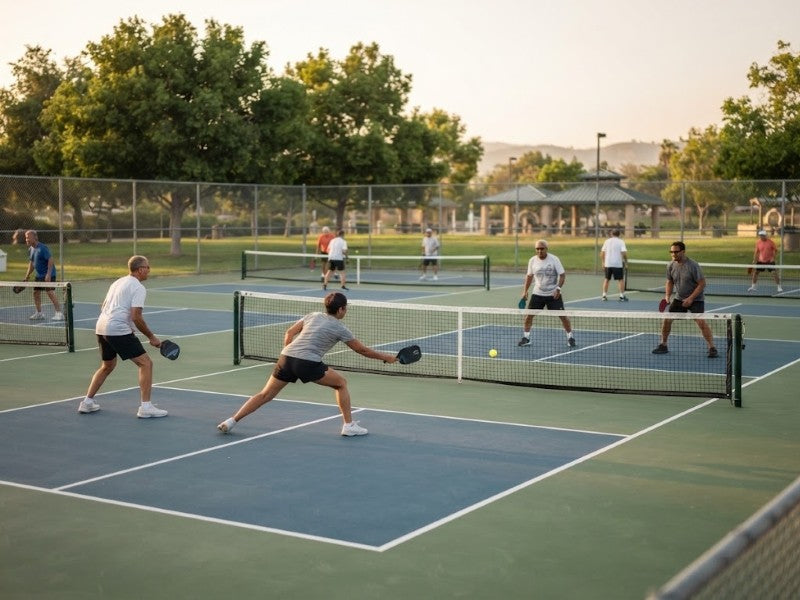
Pickleball, on the other hand, is a linear and highly predictable game. Because you are separated from your opponents by a center net, the ball is almost always coming from directly in front of you.
Once the initial serve and return are completed, players quickly move up to the Non-Volley Zone (the Kitchen) line. At this point, the explosive sprinting completely stops. High-level pickleball at the Kitchen line is a game of patience and geometry, characterized by soft shots called "dinks."
Your primary movement pattern becomes lateral shuffling (stepping side-to-side). To maintain balance, you must bend your knees and drop your hips into a half-squat athletic stance.
Does this burn? Absolutely. It causes intense isometric fatigue in your quadriceps and glutes. However, muscle fatigue is entirely different from joint destruction. By keeping your chest forward, your feet parallel, and avoiding violent rotational twists, pickleball safely loads the strong muscles of your thighs while completely sparing the fragile ligaments inside your knee joint.

The Speed Factor: How the Ball Dictates Your Joints
There is a hidden, often overlooked concept in sports science: The speed of the projectile dictates your skeletal alignment. The faster the ball travels, the less time your brain has to tell your feet to get into a safe position. Hitting a ball while your body is severely off-balance is the fastest route to an orthopedic surgeon's office.
The 100 MPH Rubber Bullet (The Racquetball Reality)
A standard racquetball is a highly pressurized, solid rubber sphere. When struck by a professional player, it can easily exceed speeds of 100 to 140 miles per hour. It retains its velocity as it ricochets off multiple walls.
Because the ball is moving faster than human foot speed, players are constantly "caught out of position." You simply do not have the time to take three perfect steps, plant your feet firmly, rotate your shoulders, and swing. Instead, you are forced into desperate, lunging, off-balance strikes. You often have to reach far behind your body or wildly flick your wrist while your body weight is falling in the opposite direction. Striking a heavy rubber ball while your body is hyperextended puts massive, unnatural stress on your rotator cuff, lower back, and elbows.
The Aerodynamic Wiffle Ball (The Pickleball Buffer)
This is where pickleball performs its greatest orthopedic magic. The standard pickleball is made of lightweight plastic and features 40 precision-drilled holes.
These holes are not just for show; they create immense aerodynamic drag. Even if your opponent hits a massive, aggressive overhead smash, the moment the ball leaves their paddle, the air resistance begins to aggressively slow it down.
This aerodynamic braking system gifts you the most valuable asset for joint health: Time.
Because the ball decelerates as it crosses the net, your brain has the extra fraction of a second needed to read the trajectory, move your feet, and establish a wide, balanced base. In pickleball, you hit 90% of your shots with your feet firmly planted and your body weight safely transferred forward.
"Plant first, strike second." This simple physical reality of pickleball means your muscles absorb the impact of the swing, rather than your vulnerable shoulder and knee joints compensating for an off-balance lunge.
The Surface Paradox: Hardwood vs. Concrete
To provide a truly objective analysis in the racquetball vs pickleball debate, we must acknowledge the one area where racquetball actually holds an orthopedic advantage: the floor you stand on.
The Hidden Benefit of Racquetball Courts
Indoor racquetball is played on specially engineered, sprung hardwood floors. Beneath the polished wooden surface is a complex grid of rubber shock absorbers and sleeper boards. When you land heavily from a jump or a hard sprint, the floor actually depresses slightly, absorbing a significant portion of the kinetic impact before it reaches your shins and knees.
The Unforgiving Nature of Pickleball Hardcourts
Pickleball, conversely, is predominantly an outdoor sport played on repurposed tennis courts, asphalt, or poured concrete. Concrete is ruthless; it has zero energy return and zero shock absorption. Every ounce of force you put into the ground is sent violently right back up your skeletal chain.
If you step onto a concrete pickleball court wearing worn-out running shoes with compressed foam, you will inevitably suffer from plantar fasciitis, shin splints, and knee swelling. This is why, as we detailed in our essential Pickleball Accessories guide, upgrading to a premium, hard-court specific tennis or pickleball shoe with elite midsole cushioning is an absolute necessity to protect your joints from the concrete.
Common Joint Injuries: What to Watch Out For
No sport is 100% injury-free. However, the type of injuries sustained in these two sports highlights the fundamental difference between acute joint trauma and repetitive muscular strain.
The Racquetball Toll (Catastrophic Joint Trauma)
Because of the explosive sprinting, sudden stops, and extreme rotational forces, racquetball injuries tend to be acute, sudden, and severe.
- Achilles Ruptures: The sudden forward acceleration required to chase a fast-dropping ball frequently causes the Achilles tendon to snap under tension.
- Meniscus & ACL Tears: As mentioned earlier, planting the foot while twisting the torso shreds the cartilage and ligaments inside the knee.
- Rotator Cuff Blowouts: Constantly swinging at a heavy rubber ball from behind the body or high above the head tears the delicate stabilization muscles in the shoulder joint.
The Pickleball Toll (Repetitive Overuse)
Pickleball injuries, by contrast, are rarely career-ending joint failures. They are almost entirely driven by overuse, poor mechanics, and lack of flexibility.
- "Pickleball Elbow" (Lateral Epicondylitis): Caused by gripping the paddle too tightly and violently flicking the wrist to generate power.
- Lower Back Strain: Sustaining the bent-knee, forward-leaning "dink" posture for two hours can severely fatigue the lumbar spine muscles.
- Calf Strains: Stepping backward for a high lob without properly warming up the calf muscles often leads to micro-tears in the lower leg.
Making the Switch: A Joint-Preserving Guide to Pickleball
If your knees have finally convinced you to make the transition, welcome to the club! Thousands of former racquetball players are currently dominating the pickleball courts in 2026. However, to keep your joints healthy, you must adapt your mechanics. Here is your roadmap:
1. Unlearn the Wrist Snap
In racquetball, power is generated by a violent, whip-like snap of the wrist. If you bring this mechanic to pickleball, the rigid paddle hitting the plastic ball will send terrible shockwaves directly into your forearm tendons, resulting in instant tennis elbow. In pickleball, keep your wrist locked and firm. Generate power by pushing from the shoulder and rotating your core.
2. Invest in Knee-Saving Gear
You are leaving the forgiving sprung hardwood behind. You must compensate by wearing heavily cushioned, laterally stable court shoes. Furthermore, consider investing in graduated compression knee sleeves. They keep the synovial fluid in your joints warm and provide proprioceptive feedback, reminding your body to step carefully rather than lunge wildly.
3. Play Smart with DUPR
The fastest way to ruin your knees in pickleball is to play against disorganized, chaotic opponents who hit the ball wildly out of bounds or constantly force you to sprint backward. As we explained in our comprehensive breakdown of What is DUPR (Dynamic Universal Pickleball Rating), you should use the official rating system to find players at your exact skill level. By playing evenly matched, highly strategic opponents, the game becomes a chess match at the net, keeping your running to an absolute minimum and your joints perfectly safe.
Frequently Asked Questions (FAQs)
Is pickleball safe if I’ve had a knee replacement?
While you must always consult your orthopedic surgeon first, many doctors actively recommend doubles pickleball as a post-rehabilitation activity. Because the court is small (each player only covers a 10x10 foot square) and the ball moves relatively slowly, you can enjoy competitive play without the high-impact jumping and sprinting that would damage a prosthetic joint.
Do racquetball skills translate well to pickleball?
Incredibly well. Former racquetball players possess elite hand-eye coordination, lightning-fast reflexes, and a deep understanding of court geometry. The biggest hurdle is simply learning to "calm down." You must train your brain to stop running frantically and learn the patient, soft-touch game required at the pickleball net.
Why do my knees hurt after playing pickleball if it is supposed to be low-impact?
Knee pain in pickleball usually stems from muscular weakness, not the sport itself. If your quadriceps and glutes are too weak to hold you in a proper athletic stance, your body shifts the burden directly onto the cartilage and ligaments of your knees. Incorporating basic bodyweight squats into your weekly routine will almost always eliminate this "pickleball knee ache."

Leave a comment
This site is protected by hCaptcha and the hCaptcha Privacy Policy and Terms of Service apply.