


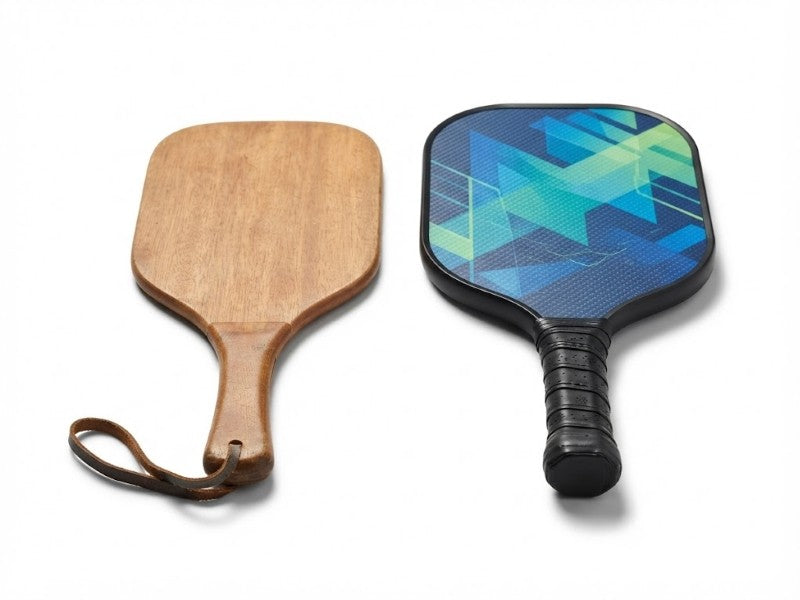
If you are trying to navigate the massive boom in racket sports, you are not alone. It is incredibly easy to get confused by the terminology. If you are simply looking for the short answer to the paddle ball vs pickleball debate, here it is: The main difference lies in the court setup and the objective. Pickleball is played over a center net using a perforated plastic ball, emphasizing strategic placement and patience. Paddle ball is typically played against a solid wall without a net, using a highly pressurized rubber ball, making it a game of extreme reflexes and speed.
The Great Confusion: What Exactly IS Paddle Ball?
Before we can compare the two, we have to address a massive problem. If you search for "paddle ball" online, you will likely be fed incorrect information. Many low-quality blogs completely confuse it with Padel (a sport played on an enclosed turf court with glass walls and a net) or Paddle Tennis (essentially a shrunken version of traditional tennis).
Let’s set the record straight: True Paddle Ball does not have a net. It is a wall-based or open-air game. To make things slightly more complicated, the term "Paddle Ball" actually refers to two completely different variations of play.
Variant 1: Walled Paddleball (The Competitive Sport)
When sports purists talk about Paddleball, they are referring to the intense, wall-based game that originated in the 1930s.
- The Setup: It is played on either a One-Wall outdoor court (famously popular in New York City parks), a Three-Wall court, or an indoor Four-Wall court (identical to a Racquetball court).
- The Gameplay: There is no net separating the players. Instead, players stand side-by-side and take turns hitting a small, highly bouncy rubber ball against the front wall. If the ball bounces twice on the floor before you return it to the wall, you lose the rally. It is incredibly fast, physically demanding, and requires lightning-fast hand-eye coordination.
Variant 2: Beach Paddleball / Matkot (The Recreational Game)
This is the version you have likely seen on summer vacations.
- The Setup: There are no courts, no walls, no boundaries, and no nets.
- The Gameplay: Two players stand a few yards apart on the sand and hit a small rubber ball back and forth. It is purely cooperative; the only goal is to keep the ball from hitting the ground for as long as possible.
Note: For the purpose of comparing it to the highly competitive nature of pickleball, the rest of this guide will focus primarily on the athletic, court-based Walled Paddleball.
What is Pickleball? (The Modern Phenomenon)
If you have been awake at any point over the last few years, you have heard of pickleball. By 2026, it has cemented itself as a global phenomenon, transforming from a backyard pastime into a highly organized, professional sport with massive television deals and millions of recreational players.
- The Hybrid Nature: Pickleball is best described as a hybrid of tennis, badminton, and ping-pong.
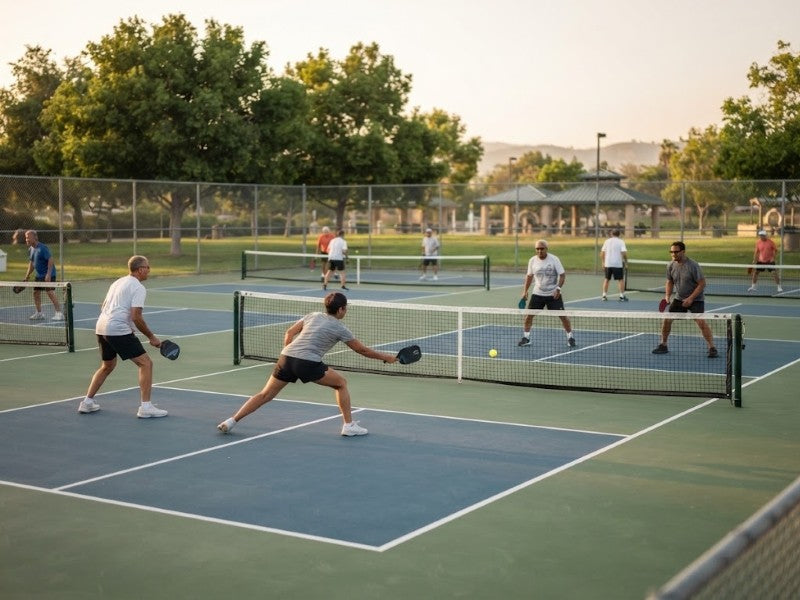
- The Court Setup: It is played on a badminton-sized court (20 feet wide by 44 feet long) with a modified tennis net draped across the center, measuring exactly 34 inches high in the middle.
- The Equipment: Players use high-tech, solid paddles (usually made of raw carbon fiber and foam cores) to hit a hollow, perforated plastic ball—very similar to a Wiffle ball.
- The Strategic Twist: What makes pickleball entirely unique is the "Non-Volley Zone," affectionately known as the Kitchen. This is a 7-foot area on both sides of the net where players are strictly forbidden from hitting the ball out of the air (volleying). This single rule prevents tall, powerful players from simply standing at the net and smashing the ball downward. It forces the game to be about patience, geometry, and delicate "dinking" (soft shots) rather than just raw, overwhelming power.
Pickleball is inherently social. The majority of recreational games are played as Doubles (four players on the court), meaning you are constantly communicating with a partner and standing just feet away from your opponents, making it as much a social gathering as it is a physical workout.

Paddle Ball vs Pickleball: 5 Key Differences Explained
Now that we have clearly defined the two sports, it is time to put them head-to-head. If you are standing on the sidelines trying to decide which gear to buy and which court to step onto, you need to understand how drastically these games differ in execution.
1. The Court Setup (Nets vs. Walls)
The most glaring difference is spatial orientation and how you interact with your opponent.
- Pickleball: You are physically separated from your opponent by a 34-inch net. The game is about depth control, hitting the ball over the barrier, and keeping it inside painted boundary lines. It is a game of facing your enemy.
- Paddleball: You share the exact same physical space as your opponent. You stand side-by-side (or front-to-back) and strike the ball against a common front wall. The challenge is spatial awareness—avoiding collisions with other players while predicting the geometric angles of the ball as it violently ricochets off the concrete.
2. The Equipment (Paddles and Balls)
Despite the names, you cannot use the equipment interchangeably.
- The Balls: The pickleball is a lightweight, perforated plastic ball. The holes create aerodynamic drag, actively slowing the ball down as it flies through the air, giving players time to react. The paddleball is a solid, highly pressurized rubber ball (similar to a racquetball). It does not slow down; it accelerates off the wall at blistering speeds.
- The Paddles: Modern pickleball paddles are high-tech marvels made of raw carbon fiber and foam cores, designed to grab the plastic ball and generate topspin. They usually weigh around 7.5 to 8.5 ounces. Paddleball paddles are often heavier and denser, traditionally made from solid wood, graphite, or fiberglass. Many feature drilled aerodynamic holes through the face to reduce air resistance, allowing players to swing faster to catch up with the high-speed rubber ball.
3. The Rules and Scoring Systems
- Pickleball Mechanics: Pickleball incorporates the famous "Double-Bounce Rule," meaning the ball must bounce once on the serve, and once on the return, before anyone is allowed to hit it out of the air. Combined with the Kitchen rules, this forces the game into a slow, strategic rhythm before a fast-paced "firefight" breaks out.
- Paddleball Mechanics: In walled paddleball, the rule is simple: the ball must hit the front wall before it touches the floor. Once it hits the wall, you can hit it out of the air (a volley) or after exactly one bounce. There are no "no-volley zones," meaning the game is played at maximum speed from the very first serve.
4. Physical Intensity and Movement
Both sports will make you sweat, but they load the body in entirely different ways.
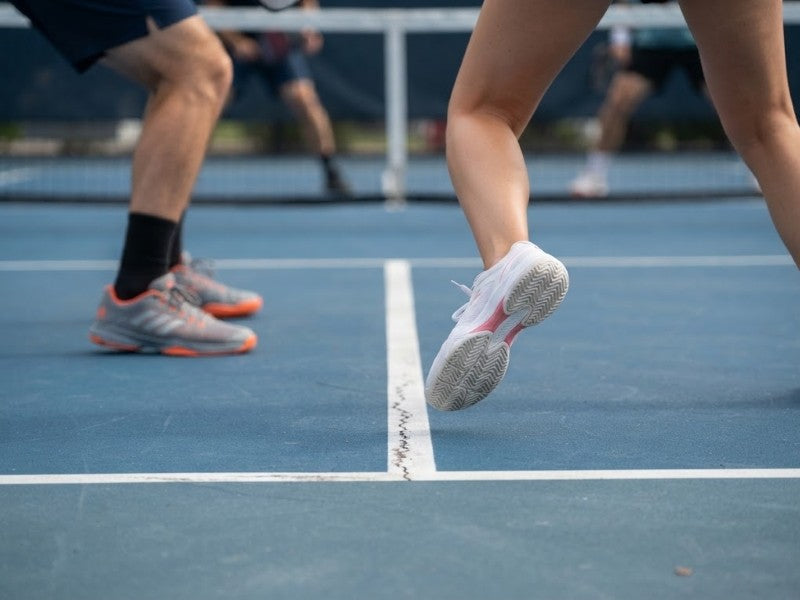
- Pickleball (Lateral & Low): Pickleball is dominated by side-to-side shuffling. Because the best strategy is to stand right at the Kitchen line and hit soft "dinks," players must hold a low, squat-like athletic stance for extended periods. It is incredibly taxing on the quadriceps and lower back, but generally low-impact on the knees if proper footwear is worn.
- Paddleball (Explosive & Linear): Paddleball requires aggressive, explosive sprinting. You are constantly running forward to dig a ball out of the front corner, and immediately backpedaling to return a deep lob. Because the ball travels so fast, it is a superior cardiovascular workout and requires elite-level hand-eye coordination and reflex speed.
5. Social Vibe and Accessibility
- Pickleball Accessibility: Pickleball is the most accessible sport in the world right now. Courts are everywhere—from dedicated country clubs to taped-off tennis courts in public parks. Because the plastic ball moves slower, a 25-year-old and a 70-year-old can play a highly competitive, incredibly social game together.
- Paddleball Accessibility: Walled paddleball is much more niche. Finding dedicated One-Wall or Three-Wall courts can be difficult outside of major metropolitan areas (like New York, California, or Florida) or indoor racquet clubs. The learning curve is also much steeper; beginners often find it frustrating to track the high-velocity rubber ball as it bounces off multiple walls.
Quick Comparison Table: Paddle Ball vs Pickleball
To summarize the technical breakdown, here is a quick-reference matrix of the two sports:
|
Feature |
Pickleball |
Walled Paddleball |
|
Court Type |
Divided by a center net |
Open floor facing a solid wall |
|
The Ball |
Perforated, hollow plastic (slow) |
Solid, pressurized rubber (fast) |
|
The Paddle |
Carbon fiber / Polymer core |
Wood, fiberglass, or graphite (often with holes) |
|
Primary Movement |
Lateral shuffling (side-to-side) |
Explosive sprinting (front-to-back) |
|
Pace of Play |
Patient, strategic, bursts of speed |
Extremely fast, constant high velocity |
|
Core Skill Required |
Placement, patience, and spin |
Raw reflexes, speed, and angle prediction |
The Decision Matrix: Which Sport Should You Play?
Still torn on which gear bag to pack this weekend? Your decision ultimately comes down to your fitness goals, your athletic background, and the kind of community you want to join.
You Should Choose Pickleball If...
- You want a highly social, collaborative game that you can play with friends and family of all ages.
- You prefer strategic, chess-like shot placement over raw, overwhelming physical speed.
- You have a background in tennis, badminton, or ping-pong and want to instantly translate your net skills.
- You are looking for a low-impact sport that is easier on the cardiovascular system while still providing an excellent lower-body workout.
You Should Choose Paddleball If...
- You thrive on adrenaline and want a sport that pushes your reaction times to the absolute human limit.
- You are looking for a brutal, calorie-torching cardiovascular workout.
- You have a background in racquetball or squash and naturally understand how to read wall angles.
- You prefer sharing the same side of the court with your opponent, engaging in aggressive, close-quarters athletic combat.

FAQs
Can I use a pickleball paddle to play paddle ball?
Absolutely not. This is a very expensive mistake. Pickleball paddles are engineered to hit lightweight, hollow plastic. If you strike a heavy, dense rubber paddleball with a carbon fiber pickleball paddle, the intense kinetic shock will instantly crush the internal honeycomb core, permanently ruining your paddle.
Is paddle tennis the same as paddle ball?
No. Paddle Tennis (often called Pop Tennis) is essentially a shrunken version of regular tennis. It uses a net, a decompressed tennis ball, and a solid paddle. Paddle ball, as established in this guide, uses a wall instead of a net.
Which sport is easier for older adults to learn?
Pickleball is undeniably easier for older adults. The aerodynamic drag of the plastic wiffle-like ball drastically slows the game down, giving players ample time to read the trajectory, position their feet, and execute a swing without needing elite, twitch-muscle reflexes.

Leave a comment
This site is protected by hCaptcha and the hCaptcha Privacy Policy and Terms of Service apply.