


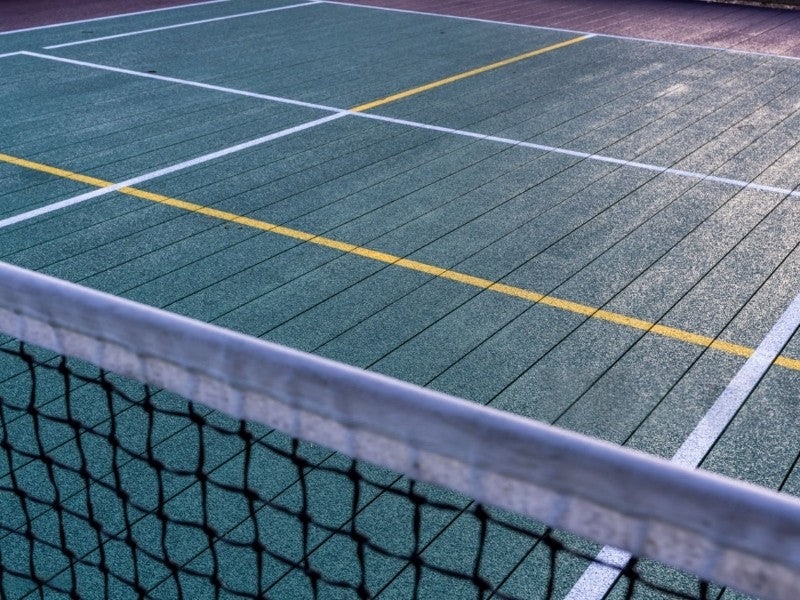
As pickleball continues to grow at a pace faster than most recreational sports, one challenge has become increasingly common: the lack of dedicated courts. Many players today rely on shared spaces—basketball courts, badminton halls, gym floors, school playgrounds, or multi-use community facilities—to play pickleball.
This reality creates a consistent problem: how to set up a playable, accurate court without permanent markings. Portable pickleball lines exist precisely to solve this issue.
What Are Portable Pickleball Lines
Portable pickleball lines are removable court boundary systems designed to replicate official pickleball court dimensions without permanent installation. They are typically made from rubber, PVC, vinyl, or modular plastic sections and can be laid on top of existing surfaces.
What they are:
- A way to create a repeatable and accurate court layout
- Suitable for indoor and outdoor temporary use
- Designed to be removed after play without damaging surfaces
What they are not:
- A replacement for professionally painted courts
- A “set it anywhere and forget it” solution
- A guarantee of accuracy without proper setup
A common misconception is that portable lines are simply visual guides. In reality, they directly affect footwork, ball judgment, player safety, and fairness. Poorly placed or unstable lines can disrupt rallies, create tripping hazards, and undermine confidence in line calls.
Understanding their limitations is just as important as understanding their advantages.

When Portable Pickleball Lines Make Sense
Portable pickleball lines are not ideal for every situation, but they are highly effective in the right contexts.
They make sense when:
- Courts are shared with other sports
- Permanent painting is not allowed or not cost-effective
- The playing area needs to be reconfigured frequently
- Pickleball is played seasonally or intermittently
Common use cases include:
- Basketball courts converted for pickleball during off-hours
- Indoor gyms hosting multiple sports
- Schools and recreation centers with rotating schedules
- Temporary tournament setups or community events
- Backyard or driveway practice areas
They are less suitable when:
- The surface is extremely uneven or damaged
- Wind conditions frequently displace lightweight lines
- High-level competitive play demands permanent visual clarity
Recognizing whether portable lines are the right tool for your environment is the first step toward using them effectively.
Understanding Pickleball Court Dimensions Before Laying Lines
One of the most common reasons portable pickleball lines fail is not the product—it is incorrect layout due to poor understanding of court dimensions.
Before laying a single strip, it is essential to understand the basic structure of a pickleball court:
- Overall court size
- Placement of baselines and sidelines
- The exact size and position of the non-volley zone (kitchen)
- Centerline alignment on both sides
While many players know the kitchen is “7 feet,” fewer understand how errors compound when lines are placed out of sequence. A small misalignment early in the setup often leads to:
- A kitchen that feels too shallow or too deep
- Uneven service boxes
- Sidelines that are technically correct in length but visually skewed
Portable pickleball lines demand sequence discipline. Dimensions must be respected not just individually, but in relation to each other. Accuracy at this stage determines whether the court will feel natural—or subtly wrong—throughout play.
Types of Portable Pickleball Lines and Their Use Implications
Not all portable pickleball lines behave the same once they are on the ground. The material, weight, and structure of the lines directly affect stability, safety, and setup time.
Rubber or PVC Strip Lines
These are among the most commonly used systems. They are typically weighted, flat, and designed to resist movement during play.
Advantages:
- Good friction on most indoor surfaces
- Lower profile reduces tripping risk
- Relatively easy to reposition
Limitations:
- Can curl over time if stored improperly
- May shift on dusty or wet outdoor courts
- Require careful alignment to stay straight
These lines work best when the surface is clean and dry, and when users take the time to align each segment precisely.
Interlocking or Sectioned Line Systems
These systems consist of modular segments that connect together, creating consistent angles and intersections.
Advantages:
- Easier to maintain straight lines
- Faster setup once familiar
- More consistent court geometry over repeated use
Limitations:
- Bulkier to transport
- Less flexible on irregular surfaces
- Require correct assembly order
They are particularly useful for facilities that set up courts frequently and want repeatable results with minimal guesswork.
Tape-Based Temporary Lines
Tape-based solutions are often chosen for convenience, but they come with trade-offs.
Advantages:
- Low initial cost
- Easy to apply in small areas
Limitations:
- Adhesive residue
- Inconsistent line width
- Increased slipping risk
- Difficult to realign once placed
Tape may work for short-term demonstrations or one-off events, but it is rarely the best long-term solution for shared courts.
How to Use Portable Pickleball Lines Correctly
Correct use of portable pickleball lines follows a clear process. Skipping steps or improvising often leads to frustration later.
Step 1: Evaluate and Prepare the Shared Surface
Before any lines are placed, the surface must be evaluated honestly.
Key factors to check:
- Cleanliness (dust, sand, moisture)
- Surface texture and grip
- Existing painted lines from other sports
- Flatness and drainage
Sweeping or wiping the surface is not optional—it directly affects how well lines stay in place. On shared courts, existing sport lines should be visually identified so they do not interfere with pickleball boundaries.
Preparation is the foundation of stability.
Step 2: Establish a Reliable Reference Point
One of the most common mistakes is starting from a random edge of the court.
Instead, choose a reference line that can be trusted:
- A known straight baseline
- A center court marking
- A symmetrical feature of the surface
All other lines should be measured and aligned from this reference. This approach ensures the court remains square and balanced, even if the surrounding space is imperfect.
Step 3: Lay Out the Court in the Correct Sequence
Sequence matters more than speed.
A recommended order:
1. Baselines
2. Sidelines
3. Centerlines
4. Non-volley zone (kitchen) lines
Placing the kitchen last allows for fine adjustments and prevents early measurement errors from affecting the most sensitive area of the court.
Each line should be checked visually and physically before moving on to the next.
Step 4: Secure and Fine-Tune the Lines
Once all lines are placed according to measurements, the next step is stabilization and fine adjustment. Even high-quality portable pickleball lines can shift slightly if they are not seated properly on the surface.
Start by pressing each line firmly along its full length. Pay special attention to:
- Line intersections
- Corners of the non-volley zone
- Ends of baselines and sidelines
If the surface allows, lightly walking along the lines helps them settle evenly. Avoid dragging feet or making sudden lateral movements during this step, as it can unintentionally misalign the setup.
Visual alignment matters as much as measurement. Step back and view the court from multiple angles. If any line appears curved or skewed—even slightly—it is better to correct it now than to tolerate confusion during play.
Step 5: Final Walk-Through and Play Test
Before starting a match, perform a short walk-through of the court. This step is often skipped but plays a critical role in preventing disputes and safety issues.
Check the following:
- Are all lines lying flat with no raised edges?
- Do intersections meet cleanly without gaps?
- Are kitchen lines clearly distinguishable from other court markings?
- Does the court feel symmetrical when standing at center court?
A brief warm-up rally can reveal issues that are not obvious at rest. If players hesitate near the kitchen line or frequently glance down to confirm boundaries, the setup likely needs refinement.

Common Problems with Portable Pickleball Lines (and How to Avoid Them)
Lines Shift During Play
This is the most frequently reported issue. Shifting usually occurs due to surface conditions rather than line quality.
Common causes:
- Dusty or sandy courts
- Moisture from humidity or cleaning
- Lightweight line materials on smooth surfaces
Preventive measures include thorough surface cleaning, using heavier line systems when possible, and rechecking placement after the first few games.
The Court Feels “Off” Even Though Measurements Are Correct
Players often describe a court as feeling too narrow, too shallow, or awkward—despite correct measurements.
This usually stems from:
- Misaligned reference points
- Visual conflict with existing sport lines
- Slight angular errors that affect perception
Comparing both halves of the court from the net can quickly reveal asymmetry. Trusting visual alignment is essential in shared environments.
Confusion with Existing Sport Lines
Shared courts often contain basketball, volleyball, or badminton markings that intersect with pickleball boundaries.
To reduce confusion:
- Ensure pickleball lines form complete, continuous shapes
- Avoid partial or broken boundaries
- Briefly explain court lines to new players before play begins
Clear visual hierarchy minimizes disputes and improves flow.
Safety Concerns: Tripping and Slipping
Portable pickleball lines must never compromise player safety.
Higher risk situations include:
- Thick or curled line edges
- Tape with glossy surfaces
- Uneven floor transitions
If players alter footwork to avoid lines, the setup is unsafe and should be corrected immediately.
Portable Pickleball Lines vs Other Court Marking Options
Portable pickleball lines are one of several court marking options. Understanding how they compare helps users choose realistically.
Compared to painted courts:
- Less permanent, but more flexible
- Lower cost and no surface damage
- Slightly reduced visual clarity
Compared to tape or chalk:
- More stable and repeatable
- Safer under lateral movement
- More consistent over multiple sessions
For temporary and shared courts, portable lines often represent the best balance between accuracy and practicality.

Leave a comment
This site is protected by hCaptcha and the hCaptcha Privacy Policy and Terms of Service apply.