


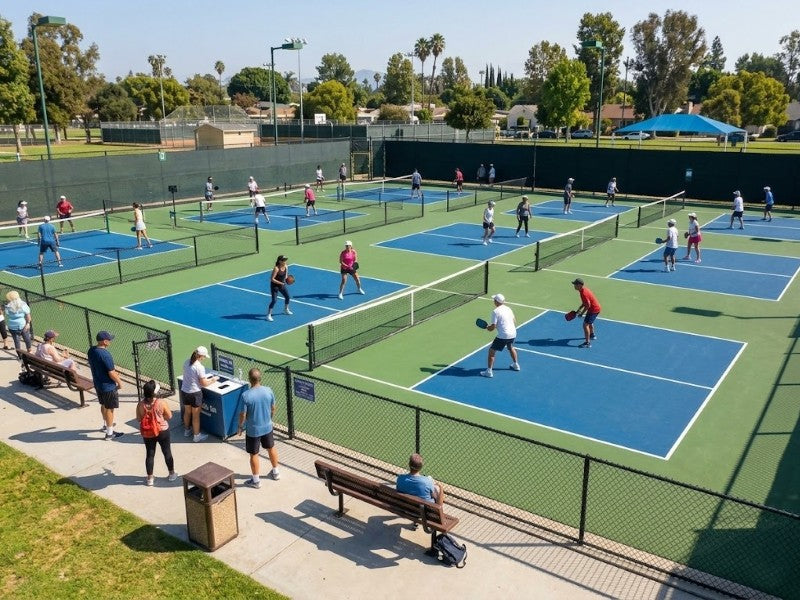
By 2026, finding a court is rarely the problem—the real challenge is knowing how to seamlessly integrate into the local playing community. You pack your bag, arrive at a bustling facility, and immediately face a wall of unwritten rules: paddles stacked in mysterious tubes, players rotating on and off courts in seconds, and varying levels of intensity across different nets.
Showing up without understanding how the system works can be intimidating. You might accidentally walk onto an advanced-only court or wait 45 minutes because you did not place your paddle in the correct queue. The solution is understanding the mechanics of Pickleball Open Play.
What Exactly is Pickleball Open Play?
Pickleball Open Play—frequently referred to as "drop-in play"—is a designated block of time where courts are reserved for community rotation rather than private group bookings. You do not need to bring a partner, and you do not need to organize a foursome in advance. You simply show up, mix in with the crowd, and play.
The Heart of the Sport's Culture
Unlike traditional tennis, where you typically rent a court for an hour and play only with the people you brought, pickleball is inherently communal. Open play sessions are designed to maximize court utilization and social interaction. A typical game lasts between 10 and 15 minutes (usually played to 11 points, win by 2). Once a game finishes, players rotate off, and new players rotate on. This rapid turnover means you will interact with dozens of locals, experience different playing styles, and find yourself playing with and against different partners throughout the session.
Structured vs. Unstructured Sessions
Not all open play environments operate the same way. Understanding the venue type is crucial before you arrive:
- Unstructured (Public Parks): These are free, city-run courts. The community manages the rotation entirely through an honor system and physical paddle queues. It is highly social but can be chaotic during peak hours (evenings and weekend mornings).
- Structured (Private Clubs & Rec Centers): These facilities usually charge a drop-in fee (ranging from $5 to $20). In 2026, most structured open play sessions are strictly managed by court hosts or digital queuing software. These sessions often group players by specific skill ratings (e.g., "3.0 - 3.5 Open Play"), ensuring highly competitive and balanced matches.

How Do You Actually Get to Play?
The absolute biggest barrier for a newcomer arriving at Pickleball Open Play is figuring out how to get onto the court. If all the courts are full, you cannot just stand by the net and wait. You must enter the queue.
The Traditional "Paddle Saddle" System
At 90% of public parks, the queue is managed by a physical rack—often called a "paddle saddle" or paddle stack. This is a slotted metal or plastic holder attached to the fence.
1. Stacking: You place your paddle into the next available slot, moving from left to right.
2. Forming a Foursome: When four paddles are grouped together in consecutive slots, that signifies the next "group of four" ready to take the next available court.
3. Mixing In: If you arrive alone, simply place your paddle next to the last paddle in the rack. The people whose paddles are next to yours are now your group for the next game.
Standard Rotation Rules
When a game finishes on the court, the players yell "Court open!" What happens next depends on how crowded the facility is:
- 4-On, 4-Off: If there are many people waiting (more than 10 paddles in the rack), all four players who just finished their game must leave the court and place their paddles at the back of the queue. The next four paddles in the rack take the open court.
- 2-On, 2-Off (Winners Stay): If the park is less crowded, standard etiquette allows the winning team to stay on the court, while the losing team rotates off. The next two players in the paddle rack walk onto the court and split up to play against the winners. Note: Even if you keep winning, most parks enforce a "two-game maximum" rule to prevent court hogging.
Digital Queues and Whiteboards
As courts have become busier leading into 2026, many dedicated facilities have abandoned the physical paddle stack for digital solutions. You will often see an iPad kiosk or a large digital screen near the entrance. You swipe your club card or enter your name, and an algorithm assigns you to a specific court (e.g., "John, Sarah, Mike, and Dave to Court 4"). Alternatively, some venues use a dry-erase whiteboard where you write your name under the "Next Game" column.
Challenge Courts vs. Social Courts
Larger parks will designate specific nets to prevent drastic skill mismatches.
- Social Courts: Perfect for beginners and intermediate players. The focus is on exercise, practicing shots, and having fun.
- Challenge Courts: These are the domain of advanced players (4.0+). The rule here is strictly "winners stay on." If you place your paddle in the queue for a challenge court, you are expected to know the rules flawlessly, understand advanced strategies like stacking, and be prepared for high-velocity drives.
The Top 5 Apps to Find Pickleball Open Play Near You in 2026
You no longer have to drive to a park and hope people are there. The digital ecosystem for pickleball is robust. Using these top five platforms will help you instantly locate the best Pickleball Open Play sessions in your zip code.
1. PlayTime Scheduler
Despite newer apps entering the market, PlayTime Scheduler remains the undisputed king of grassroots open play organization. It operates on a region-based system rather than GPS.
- How it works: You select your region, and the app displays a calendar of user-created sessions at local parks.
- Why you need it: It allows you to see exactly who is going to be at the park before you leave your house. If a local player creates a session for "Saturday Morning Open Play," you can see that 14 people have signed up, guaranteeing you won't be hitting against a wall alone.
2. Pickleheads
As the official court-finder of USA Pickleball, Pickleheads boasts the most comprehensive and verified database of courts in North America.
- How it works: You type in your city, and it maps out every single court—both public and private.
- Why you need it: Pickleheads excels at facility details. It will tell you exactly what times the facility hosts official Pickleball Open Play, whether the courts have permanent nets or painted lines on tennis courts, and if lighting is available for night play.
3. CourtReserve
If you are looking to play at premium indoor facilities or dedicated pickleball clubs, CourtReserve is the industry-standard software they use to manage their schedules.
- How it works: You download the app and search for clubs in your area. You must create a profile for the specific club you wish to visit.
- Why you need it: Private clubs heavily moderate their drop-in sessions to ensure quality. You use CourtReserve to prepay your $10 drop-in fee and reserve your slot in a capped session (e.g., "Intermediate Open Play, Max 24 players"). This guarantees you court time without the chaotic waiting associated with public parks.
4. PicklePlay
PicklePlay is the best app for players looking to integrate into a local community quickly.
- How it works: It combines a court locator with a social messaging platform.
- Why you need it: Aside from finding locations, you can join local "clubs" within the app. Park regulars often have a PicklePlay group chat where they coordinate ad-hoc open play sessions, announce weather delays, or organize post-game lunches.
5. Reclub
Initially built for broad social sports, Reclub has pivoted heavily into the pickleball space in 2026 due to extreme demand.
- How it works: Community organizers use Reclub to run structured events, round-robins, and team-based open play.
- Why you need it: If you want a bit more structure than a public park but don't want to pay high country club fees, Reclub is where local "ambassadors" host semi-organized weekly events. It tracks leaderboards and seamlessly integrates DUPR (Dynamic Universal Pickleball Rating) scores, so you know the exact skill level of the players attending.

Action Plan: Book Your First Session This Weekend
Ready to dive in? Follow this simple, step-by-step checklist to ensure your first drop-in experience is a massive success:
- Step 1: Download Pickleheads or register on PlayTime Scheduler.
- Step 2: Search your local zip code for an "All-Levels" or "Beginner-Friendly" morning slot.
- Step 3: Pack your bag with a USAPA-approved paddle, proper court shoes, and plenty of water.
- Step 4: Arrive 15 minutes before the session starts to observe the local rotation system (look for the paddle rack or digital kiosk).
- Step 5: Put your paddle in the queue, introduce yourself to your group, and enjoy the game!
Conclusion
The beauty of Pickleball Open Play is that it democratizes the sport. It tears down the traditional barriers of country clubs and organized leagues, allowing anyone with a paddle and a pair of court shoes to walk up, join a game, and instantly become part of a community.
By leveraging the right digital tools, respecting court etiquette, and choosing sessions tailored to your current skill level, you can eliminate the anxiety of showing up alone. The pickleball community is famously welcoming—all you have to do is slide your paddle into the rack and wait for your turn to play.


Leave a comment
This site is protected by hCaptcha and the hCaptcha Privacy Policy and Terms of Service apply.