


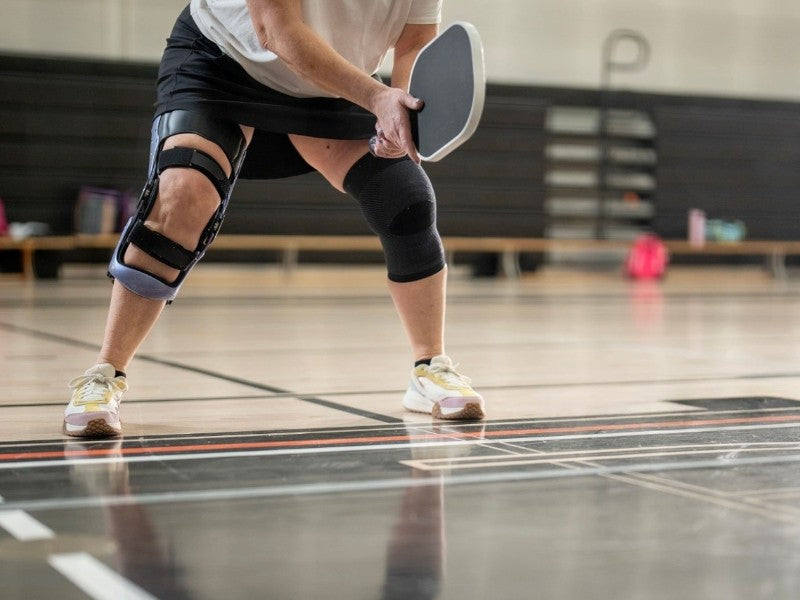
Among all pickleball rules and court markings, few generate as much confusion as the “kitchen,” formally known as the Non-Volley Zone (NVZ). New players hear warnings such as “Don’t step in the kitchen!” or “You foot faulted!” without fully understanding what the kitchen is, how large it is, and why it exists. Even experienced recreational players often misunderstand the rules that govern this area or misapply them during rallies.
Official Dimensions: Spatial Layout
Understanding the size of the kitchen starts with the official court specifications.
Kitchen (NVZ) Depth
The depth of the Non-Volley Zone is:
7 feet (2.13 meters) from the net on each side.
This creates a 14-foot (4.27-meter) no-volley corridor spanning the area directly in front of the net.
Full Court Context
A standard pickleball court measures:
- 20 feet (6.10 meters) wide
- 44 feet (13.41 meters) long (sideline to sideline, baseline to baseline)
This dimension remains the same for singles and doubles.
Kitchen Dimensions Summarized
Therefore, the kitchen’s official dimensions are:
- Width: 20 feet (entire width of the court)
- Depth: 7 feet from the net
- Total area: 140 square feet per side
Combined across both halves of the court, the NVZ represents a 280-square-foot space where volleying is restricted.
The Kitchen Line as Part of the Zone
The NVZ line is typically 2 inches wide, and by rule, it is fully considered part of the zone. This means:
- Any contact with the line places the player “in the kitchen.”
- A volley performed with any part of the body touching or over the line is a fault.
No Variations Between Singles and Doubles
Unlike other racket sports, pickleball maintains identical kitchen dimensions regardless of format.
This simplifies court construction and rule enforcement.

Rules That Govern Play in the Kitchen
Having defined the kitchen and its dimensions, the next step is understanding how players may—or may not—interact with it. These rules are frequently misapplied or misunderstood, making clear explanations essential.
The Core Rule: No Volleying in the Kitchen
The foundational rule is straightforward:
A player may not volley the ball while standing in the Non-Volley Zone or touching the NVZ line.
A volley is contacting the ball before it bounces.
The moment the ball is volleyed, the player’s feet, body, paddle, and any item attached to them must all be outside the NVZ.
Contact Includes More Than Feet
A common beginner error is assuming only foot placement matters.
Rule interpretation is broader:
· Hands
· Knees
· Clothing
· Paddle
· Wristbands or accessories
· Anything the player is holding
If any of these touch the NVZ during a volley, the action is a fault.
Momentum Rule
Volleys outside the kitchen can still result in NVZ violations.
If a player legally volleys a ball and then momentum causes them to step into the NVZ, they commit a fault.
The fault applies even if:
- The volley occurred several feet from the line
- The player enters the NVZ after the volley is completed
- They touch the NVZ long after the ball crosses the net
- They stumble or lose balance without intention
Momentum faults exist to prevent players from using their bodies as extensions of their reach to dominate the net.
Can You Enter the Kitchen at Any Time?
Yes—as long as you are not volleying.
Players may enter the kitchen:
- To play a dink
- To retrieve a dropped ball
- To chase a short bounce
- At any point when the ball has already bounced
The NVZ does not prohibit entry; it only prohibits volleying.
What if the Ball Bounces in the Kitchen?
If the ball bounces in the kitchen, players must step into the NVZ to hit it.
This is common in soft dink exchanges.
Line Contact Rules
Players often misjudge the kitchen line.
Rules state:
- Touching the NVZ line = touching the NVZ
- Toe hanging over the line without touching = legal
- Jumping from inside the NVZ to hit a volley mid-air = still a fault, because the player launched from the NVZ
Thus, players need precise footwork when approaching the line.
Serving and the NVZ
The serve must clear the net and land in the diagonal service box; the kitchen plays no direct role.
However:
- A serve hitting the kitchen or kitchen line is a fault.
- A return landing in the NVZ is legal; kitchen rules apply only to volleys.
“Erne” and Sideline Exceptions
Players may legally hit an “Erne”—a volley hit outside the NVZ but parallel to the sideline—if they:
- Jump from outside the NVZ
- Avoid touching the NVZ or kitchen line
- Land outside the NVZ after the shot
It is one of the few advanced volleying techniques that uses the kitchen boundary creatively yet legally.
Why the Kitchen Exists
Understanding why the kitchen exists provides context to the strict rules.
Safety Considerations
Pickleball is played with a lightweight paddle and a plastic ball that travels at relatively high speeds during volleys and smashes. Without a kitchen:
- Players could stand extremely close to the net
- Reactions would be dangerously fast
- Head and eye injuries would be more common
- Collisions would increase during doubles play
The kitchen creates space that prevents unsafe net play.
Maintaining Rally Length and Skill Balance
The NVZ encourages the development of:
· Soft hands
· Control
· Dinking
· Touch
· Strategy over power
Without the NVZ, matches would be dominated by quick put-away volleys at the net, dramatically reducing rally length and strategic depth.
Reducing Power Dominance
If players could stand directly at the net, the sport would heavily favor:
- Taller players
- Players with longer reach
- Purely offensive playing styles
The kitchen equalizes skill levels by rewarding technique, anticipation, and consistency rather than height and strength alone.
Common Misconceptions
Misunderstandings about the kitchen are extremely widespread. Clarifying these misconceptions helps prevent unnecessary disputes and improves on-court decision-making.
“You can’t ever go in the kitchen.”
False.
Players can enter the NVZ at any time except when volleying.
Entering the NVZ to hit a bounced ball is required in many rally scenarios.
“Your feet must touch the kitchen for it to be a fault.”
Incorrect.
Faults occur if any part of the body or anything contacting the body touches the NVZ during a volley.
This includes:
· Paddle
· Clothing
· Wristbands
· Hats
· Hair
· Accessories
“You can jump from the kitchen to hit a legal volley if you take off before contact.”
Still false.
Launching from inside the NVZ and volleying mid-air is a fault because the volley was initiated while the player was in the NVZ.
“The kitchen is different for singles and doubles.”
Incorrect.
The NVZ is the same size in both formats.
The rules regarding volleys do not change.
“You may step into the kitchen as long as the volley happens before your foot touches it.”
This overlooks the momentum rule.
If a legal volley is made outside the NVZ but momentum carries you into the zone afterward, it is still a fault.
“If the ball bounces in the kitchen, you must stay out of it.”
False.
Players must enter the kitchen to legally play a ball bouncing inside the NVZ.
“Touching the kitchen line is okay.”
Incorrect.
The line is part of the NVZ.
Touching it during a volley is a fault.
“A ball landing on the kitchen line is out.”
Also incorrect.
The kitchen line is fully in-bounds.
It is “in” for bounce purposes but “in the NVZ” for volley restrictions.

Measuring NVZ Impact on Skill Development and Drills
The kitchen is more than a restricted zone; it is a technical training tool that shapes high-level skill development. Players and coaches use its spatial limits to build precision, discipline, and strategic understanding.
Drills for Developing Touch and Control
Kitchen Dinking Ladder
Players progressively dink at slow, medium, and fast tempos to improve consistency and directional accuracy.
Crosscourt Dinking
Reinforces angle creation and forces players to use footwork inside the NVZ.
Volleys Just Outside the Line
Players stand directly behind the NVZ line to practice low volleys without breaking line rules—excellent for foot discipline.
Transition Zone Drills
Since players must approach the NVZ strategically, the following drills help:
· Drop-to-the-Kitchen Drill: Start at the baseline, hit controlled drop shots, and move forward.
· Approach-and-Hold Drill: Move from mid-court to the kitchen line, freeze, and respond to opponent drives.
These help eliminate hesitation and improve forward movement patterns.
Momentum Awareness Training
The kitchen’s rules encourage body-control training.
Useful exercises include:
· Controlled volley stops: Volley a ball and freeze the body immediately to prevent entering the NVZ.
· One-foot hold drills: Teaches players to balance near the NVZ line without stepping into it.
Coaching Points Based on NVZ Dimensions
Coaches emphasize:
· Proper spacing relative to the line
· Staggered foot placement in doubles
· Paddle height adjustments for NVZ-driven exchanges
· Patience and shot selection within tight spatial constraints
Mastery of the NVZ is often the clearest predictor of advancement from intermediate to advanced skill levels.

Leave a comment
This site is protected by hCaptcha and the hCaptcha Privacy Policy and Terms of Service apply.