


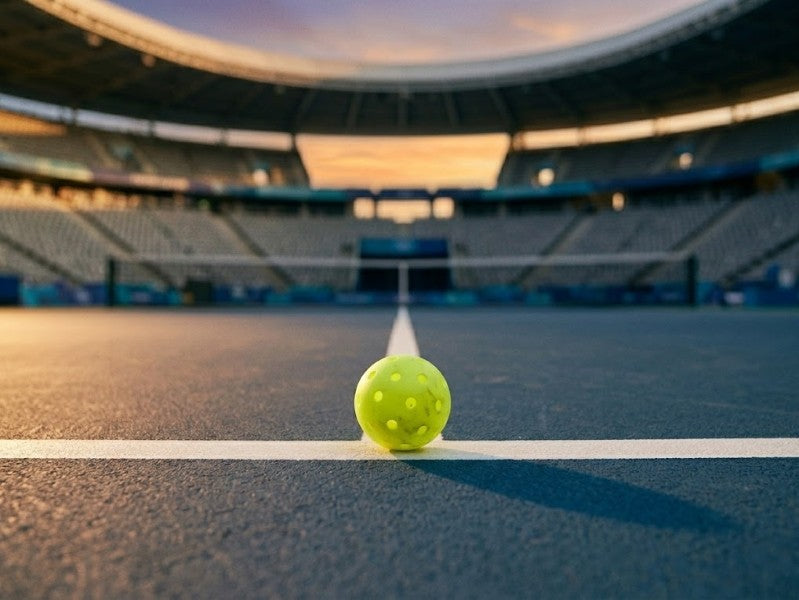
It is nearly impossible to walk past a local park or recreation center today without hearing the familiar, rhythmic pop-pop-pop of a plastic ball striking a composite paddle.
With everyone from your next-door neighbor to elite professional athletes picking up a paddle, a massive question has begun to echo across the sports world: If everybody is playing it, why isn't pickleball in the Olympics?
The Short Answer: Is Pickleball an Olympic Sport Yet?
To cut right to the chase: No, pickleball is not currently an Olympic sport.
While you will not see it as an official medal event at the upcoming summer games, it is crucial to understand that becoming an Olympic sport is a multi-tiered process. A sport does not simply jump from the local courts to the Olympic podium overnight.
First, a sport must be officially "recognized" by the IOC. From there, it may be included as a "demonstration" or "exhibition" sport, which allows the host city to showcase a popular regional activity without awarding official Olympic medals. Finally, it can be voted in as an "Official Medal Event."
Currently, the sport is being heavily advocated for by the International Pickleball Federation (IPF) and other governing bodies who are working tirelessly behind the scenes to align the sport with Olympic standards. However, despite their best efforts, the sport has not yet reached the official starting line.

Why Isn't Pickleball in the Olympics? The 3 Major Hurdles
The International Olympic Committee does not hand out Olympic rings just because a sport goes viral or sees a massive spike in paddle sales. The IOC has an incredibly strict, traditional set of criteria designed to ensure that only truly global, well-regulated sports make the cut.
Right now, pickleball is facing three major hurdles.
Hurdle 1: The "75/40" Rule (Global Reach)
The single biggest roadblock for a pickleball Olympics debut is the IOC's stringent global popularity requirement, often referred to as the "75/40" rule.
To even be considered for the Summer Games, a sport must prove that it is widely practiced on a global scale. Specifically:
- For Men's Events: The sport must be widely played in at least 75 countries spread across 4 continents.
- For Women's Events: The sport must be widely played in at least 40 countries spread across 3 continents.
While pickleball is an absolute juggernaut in North America (specifically the US and Canada), its footprint in Europe, Asia, South America, and Africa is still in its infancy. The IOC demands true international parity. If 90% of the world's elite players reside in just one or two countries, the sport lacks the competitive global diversity required for the Olympics. The sport is growing rapidly overseas, but it has not yet hit the critical mass required by the 75/40 rule.
Hurdle 2: The 7-Year Wait Rule
Even if pickleball magically met the 75/40 rule tomorrow, you still wouldn't see it in the Olympics next year. The Olympic machinery moves incredibly slowly to allow host cities adequate time to build infrastructure, secure broadcasting rights, and organize qualifiers.
Under normal IOC protocols, a new sport must be officially added to the Olympic program seven years before the games in which it will debut. This means that if the IOC voted to approve pickleball today, the absolute earliest it could appear as an official, permanent medal event would be a decade from now. While host cities have recently been granted the power to propose "temporary" sports for their specific games (like breakdancing or skateboarding), becoming a permanent fixture requires immense patience.
Hurdle 3: WADA Compliance and Unified Governance
The Olympics require absolute administrative order. For a sport to be accepted, it must be governed by a single, undisputed International Federation (IF) that is recognized by the IOC.
Currently, the administrative landscape of pickleball is somewhat fragmented. While organizations like the International Pickleball Federation (IPF) are making massive strides in unifying the global community, there are still competing professional tours and differing regional rulesets.
Furthermore, this unified governing body must strictly enforce and comply with the World Anti-Doping Agency (WADA) code. Implementing a comprehensive, global drug-testing protocol across a sport that has only recently transitioned from a recreational hobby to a professional powerhouse takes significant time, funding, and administrative infrastructure. Until the governance of the sport is globally unified and perfectly compliant with WADA, the Olympic doors will remain firmly closed.
The Rivalry: Pickleball vs. Padel vs. Squash
Pickleball is not the only racquet sport fighting desperately for a ticket to the Olympic Village. In fact, it faces incredibly stiff competition from other established and rapidly growing paddle and racquet sports, creating a fiercely competitive landscape for IOC approval.
The most direct rival is Padel. While pickleball dominates the United States and Canada, padel holds massive influence across Europe, South America, and the Middle East. Played in an enclosed glass court, padel arguably has a more established international footprint and professional infrastructure overseas than pickleball currently does. Because the IOC looks for global parity, padel's strong presence in multiple continents currently gives it a slight edge in the international recognition race.
Additionally, we must look at Squash. For decades, squash campaigned tirelessly for Olympic inclusion, repeatedly facing heartbreak and rejection. However, the persistence finally paid off, and squash has officially been added to the roster for the upcoming 2028 Olympic Games in Los Angeles. The success of squash serves as both a sobering reminder of how long the Olympic approval process takes, and a beacon of hope that persistent, organized racquet sports can eventually break through the Olympic ceiling.
When Will Pickleball Be in the Olympics? (Timeline & Predictions)
If we accept that pickleball still has administrative and global hurdles to clear, the ultimate question remains: When will we actually see it happen? Let's break down the realistic timeline and what industry experts are predicting for a true pickleball Olympics debut.
Los Angeles 2028: The Showcase Opportunity
Because the 2028 Summer Olympics are being hosted in Los Angeles, California—the epicenter of the American sports market—many fans assumed this would be the perfect moment for pickleball's debut. The IOC does allow host cities to propose "temporary" sports that hold cultural significance to the region.
However, the official list of added sports for LA 2028 has already been finalized (including baseball/softball, cricket, flag football, lacrosse, and squash). Pickleball missed the cut for official medal contention. That being said, because the sport is a cultural phenomenon in the US, there is still a massive likelihood that we will see pickleball as an exhibition or showcase event in LA. While athletes won't take home official Olympic gold, a high-profile exhibition match would provide the global broadcast exposure the sport desperately needs.
Brisbane 2032: The First Real Window
The 2032 Summer Games in Brisbane, Australia, represent the first genuine window for official inclusion. Outside of North America, Australia is currently experiencing one of the biggest pickleball booms in the world. The sport is growing exponentially down under.
If the International Pickleball Federation can solidify its governance, achieve WADA compliance, and significantly expand its reach into Asia and Europe over the next three to four years, Australian organizers could potentially propose pickleball as a temporary medal event for the 2032 games. It is an aggressive timeline, but mathematically possible.
2036 and Beyond: The Realistic Goal
If you ask the ultimate insiders and sports governance experts, 2036 is the most realistic target for pickleball to debut as a permanent, official Olympic medal event.
A decade provides the exact runway the sport requires. Ten years is enough time for grassroots programs in Europe, Africa, and Asia to mature. It is enough time to build dedicated courts overseas, unify global rules, and safely exceed the IOC's strict "75/40" country requirement. Targeting 2036 allows the sport to transition naturally from a trending sensation into a mature, globally stabilized athletic discipline.

What Needs to Happen Next?
To get from the local neighborhood driveway to the grand Olympic stage, the international pickleball community has a specific to-do list. The focus must shift from domestic expansion to global infrastructure.
First, there must be a massive investment in building dedicated courts in Europe and Asia. Currently, many international players are forced to tape lines onto existing tennis or badminton courts. Permanent infrastructure creates permanent communities.
Second, the sport must aggressively fund youth grassroots programs. To shake the outdated stereotype that pickleball is merely a "recreational activity for retirees," international federations need to develop robust junior leagues. Showcasing highly athletic, teenage phenomenons playing at blistering speeds will prove to the IOC that the sport requires elite physical prowess and has a sustainable future.

Leave a comment
This site is protected by hCaptcha and the hCaptcha Privacy Policy and Terms of Service apply.