


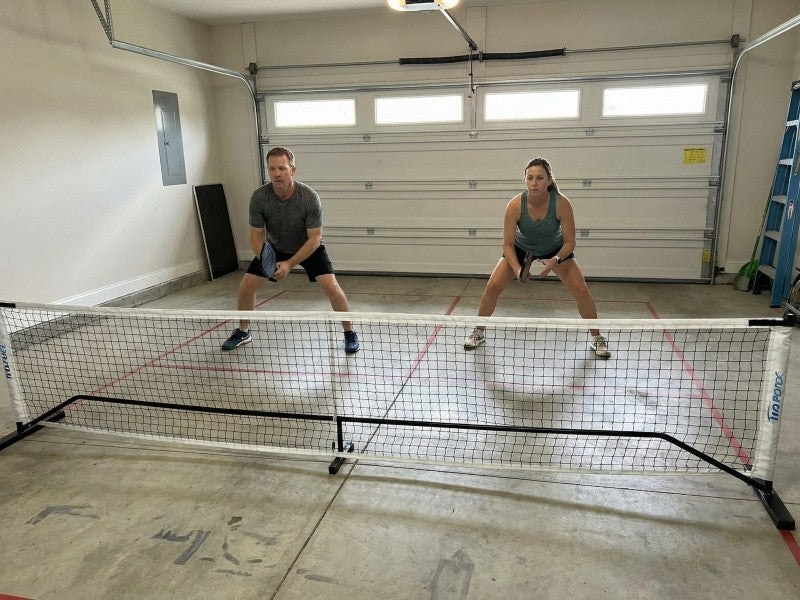
Pickleball is undeniably the fastest-growing sport in the world, but as its popularity skyrockets, players are increasingly colliding with a frustrating physical bottleneck: space. A standard, regulation-sized pickleball court requires a footprint of 20 by 44 feet, plus adequate safety buffer zones. Enter the mini pickleball net.
What Exactly is a "Mini" Pickleball Net?
Before you invest in any equipment, you must understand the architectural standards of the sport.
The Dimensions: Width vs. Height
A regulation pickleball net is 22 feet wide. A true mini pickleball net (often referred to as a half-court net) typically measures between 10 feet and 11 feet wide. This specific width is not arbitrary; it perfectly replicates exactly one-half of a standard court, making it the exact width of a single player's service box.
While the width is sliced in half, the height must remain an absolute constant. This is the golden rule of buying a mini net.
The Material Science: Steel vs. Aluminum vs. Carbon Fiber
The structural integrity of your net dictates its lifespan and playability.
- Powder-Coated Steel: This is the gold standard for driveway and garage use. Steel provides the necessary weight to keep the net anchored during windy days or when struck by a fast-moving ball. The powder coating prevents rapid rusting if accidentally left out in the rain.
- Aluminum: Significantly lighter, making it great for tossing into a car trunk for a beach trip. However, aluminum nets often require external sandbags to prevent them from tipping over on windy outdoor days.
- Fiberglass/Carbon Fiber Tension Rods: Found in premium models, these flexible rods are used to pull the net tape taut, ensuring there is no "smiley face" sagging in the middle of your 10-foot span.
Why You Need a Mini Pickleball Net in Your Arsenal
If you are serious about leveling up your rating (DUPR score), simply playing casual rec games is not enough. You need isolated drilling, and a mini net provides the ultimate platform for high-repetition practice.
1. The Driveway & Garage Savior
The most immediate benefit is spatial problem-solving. A 10-foot mini pickleball net easily spans the width of a single-car garage bay or a short suburban driveway. It transforms previously unusable concrete into a high-functioning practice facility. Rain or shine, summer or winter, you can clear out the cars, roll out some painter's tape to mark a 7-foot Non-Volley Zone (NVZ), and get 500 touches on the ball without ever leaving your property.
2. Mastering the "Soft Game" and Dinking
Matches are won and lost at the Kitchen line. The "soft game"—the delicate exchange of unattackable dinks—requires immense precision and patience.
Practicing on a mini net acts as a physical blinder. Because you do not have the full 22-foot width to bail you out, you are forced to hit with laser-like accuracy. A 10-foot width demands that you focus deeply on paddle face angle, grip pressure, and footwork. It shrinks your margin of error, meaning that when you transition back to a full-sized court, the Kitchen will suddenly feel massive and incredibly easy to hit into.
3. Skinny Singles Practice
"Skinny Singles" is a wildly popular 1v1 practice game where players only use half of the court (either straight down the line or cross-court). A mini net is the literal physical embodiment of a Skinny Singles court. It allows two players to engage in an exhausting, highly competitive cardiovascular workout, focusing entirely on sharp angles, deep returns, and aggressive volleying without the need to reserve a full public court.
The 7 Best Mini Pickleball Nets of 2026
Based on our rigorous engineering analysis and real-world drilling tests, here are the top mini nets that will actually improve your game and withstand the test of time.
1. Best Overall for Durability & Tension: Srikel Mini Pickleball Net

When evaluating equipment for long-term, heavy-duty drilling, structural rigidity and consistent net tension are the most critical metrics. In our 2026 evaluations, the emerged as a masterclass in material engineering for small spaces, bridging the gap between a portable net and a permanent facility fixture.
- The Breakdown: What elevates the Srikel system above standard market offerings is its uncompromising approach to its frame architecture. It utilizes heavy-duty, rust-resistant powder-coated steel tubes that are noticeably thicker and denser than average. This added weight in the base legs acts as a natural anchor, providing phenomenal wind resistance in outdoor driveway setups without the need to pile on unsightly sandbags.
- Performance: The defining triumph of the Srikel net is its proprietary tension system. While many 10-to-11-foot nets suffer from a slight "smiley face" sag due to the lack of a center post, Srikel’s heavy-duty strap and high-grade nylon tape ensure the net remains razor-straight, holding a flawless 34-inch center height. If you clip the tape during a dink drill, the net reacts exactly like a tournament-grade fixture—the ball rolls over or drops dead, rather than the whole frame shuddering.
- Assembly: Despite its robust steel build, the interlocking push-button design allows for a seamless, tool-free setup in under three minutes.
- Pros: Exceptional structural stability and wind resistance; superior top-tape tension holding a strict 34-inch height; heavy-duty rust-resistant coating; incredibly durable carrying bag included.
- Cons: Due to the thicker gauge steel used for enhanced stability, the carrying bag is slightly heavier than aluminum alternatives, though still highly portable for a single adult.
Here is the second half of the definitive guide. We will now explore the remaining top-tier mini nets—each catering to highly specific needs—and provide the ultimate, step-by-step masterclass on transforming your driveway into a professional-grade drilling zone.

2. The Industry Standard for Drilling: Franklin Sports Half-Court Pickleball Net
Franklin Sports is a behemoth in the pickleball manufacturing world, and their half-court net is one of the most recognizable training tools on the market. It is specifically designed to replicate the Kitchen experience in tight spaces.
- The Breakdown: Measuring exactly 10 feet wide, this net utilizes a classic steel frame construction. It is highly functional, utilizing a simple slip-on net sleeve that slides over the vertical end posts. Because it is only 10 feet wide, Franklin managed to maintain a relatively tight top cord without needing an overly complex tensioning system.
- Performance: It serves its purpose beautifully for indoor garage drilling or flat driveway dinking. The setup takes approximately 3 to 4 minutes once you memorize the interlocking pipe sequence.
- Pros: Trusted brand reputation; achieves the standard 34-inch center height; very straightforward assembly; fits perfectly in standard garages.
- Cons: The steel tubing is slightly thinner than premium competitors, making it a bit susceptible to denting if dropped; the tension can occasionally loosen after heavy impacts, requiring manual readjustment.
3. The Multi-Sport Transformer: Boulder Portable Badminton Net Set
Not every driveway is exclusively dedicated to pickleball. For active families with diverse athletic interests, investing in a rigid, single-height net might feel overly restrictive. The Boulder Portable Net solves this by prioritizing ultimate adaptability.
- The Breakdown: The Boulder system completely abandons the traditional heavy-steel-pipe architecture. Instead, it utilizes a bungee-corded, telescoping pole design—much like modern camping tent poles. The standout feature is its adjustable height mechanism. You can lower it to the 34-inch pickleball standard for dinking drills, and then slide the side posts up to 60.5 inches to instantly convert your driveway into a badminton or kids' volleyball court.
- Performance: Because it is designed to fold up into an incredibly small carrying case and adapt to multiple sports, it sacrifices some structural rigidity. When set at the pickleball height, the net tape is functional, but it lacks the ultra-tight tension of dedicated models like the Srikel.
- Pros: Unbeatable versatility for families; sets up in under two minutes; collapses into a fraction of the size of traditional nets; highly affordable.
- Cons: The net tension is relatively loose, leading to a noticeable sag if the ball strikes the top cord; the lightweight frame is prone to tipping over in moderate winds or if a player accidentally kicks the base.
4. The Budget-Friendly Choice: A11N Half Size Pickleball Net
For absolute beginners, or players who only plan to drill in their garage a few times a month during the rainy season, spending top dollar on a heavy-duty net might not make sense. The A11N Half Size Net is the undisputed champion of the budget category.
- The Breakdown: A11N provides a no-frills, highly functional 10-foot or 11-foot net. The frame utilizes a standard interlocking metal tube system, painted in bright, high-visibility colors. It relies on a simple slip-on nylon net sleeve to create tension.
- Performance: For its price point, the A11N performs admirably. It sits at the correct regulation height at the sidelines. However, because the metal tubing is thinner to keep costs down, the overall weight of the unit is quite low. In a sheltered garage, it works perfectly. On an exposed driveway, you may need to place a dumbbell or sandbag on the base legs to keep it anchored.
- Pros: Highly cost-effective; bright net tape provides excellent visual contrast against dark asphalt; simple assembly process.
- Cons: Thinner metal frame is susceptible to denting; the lack of a heavy-duty tension strap means the center height can droop slightly after extended use.
5. The Premium Coach’s Tool: Oncourt Offcourt Mini Net
If you are a certified pickleball instructor, or a highly analytical 5.0-rated player who treats practice like a science experiment, standard recreational nets often fall short. Oncourt Offcourt caters specifically to the hardcore training demographic.
- The Breakdown: This net is engineered with specific coaching metrics in mind. It often features raised side poles and a highly visible, reinforced top tape. Some variations from this brand even include attachable target zones or physical "window" attachments that force players to hit the ball through a specific trajectory, eliminating high, floating dinks.
- Performance: The build quality is exceptional, utilizing oval-shaped steel tubing that resists twisting and bending far better than standard round pipes. The tension is tournament-grade.
- Pros: Elite-level construction; specifically designed for high-repetition coaching and target practice; exceptionally durable nylon netting.
- Cons: It is the most expensive option on this list; the heavy-duty oval tubing makes it slightly more cumbersome to pack up and transport frequently.
6. The Ultra-Lightweight Traveler: Kvenho Portable Net
For the player who wants to drill while on vacation, at the beach, or during a camping trip, portability trumps heavy-duty stability.
- The Breakdown: The Kvenho Portable Net focuses on minimizing carry weight. By utilizing a hybrid of thin-walled aluminum and hollow plastic connectors, the entire system weighs significantly less than standard steel frames.
- Performance: It is the ultimate "throw it in the trunk" net. It achieves the necessary 34-inch center height, making it valid for muscle-memory training. However, the trade-off for extreme portability is a severe lack of wind resistance. If you are playing near the coast or in an open park, the Kvenho will require external anchoring.
- Pros: Incredibly lightweight and easy to carry over long distances; perfect for travel and vacations; very fast assembly.
- Cons: Extremely vulnerable to wind; the lightweight connectors can crack if forced or stepped on.
7. The Kids & Family Pick: Zume Portable Net
Introducing young children (ages 5 to 10) to racquet sports requires equipment that is safe, unintimidating, and instantly gratifying.
- The Breakdown: The Zume Portable Net is essentially a highly refined toy designed to mimic the pickleball experience. It frequently utilizes molded plastic bases rather than heavy steel pipes, completely eliminating the risk of sharp metal edges or pinched fingers during setup.
- Performance: It is designed to be set up in the living room, the basement, or on the grass in seconds. While it does not hold the strict 34-inch center height required for adult tournament training, it provides the perfect, low-barrier entry point for toddlers and young children to start hitting foam balls or indoor pickleballs.
- Pros: Maximum safety with no sharp metal parts; incredibly light; can be used indoors without any fear of scratching floors.
- Cons: Not a serious training tool for adults; does not meet regulation height or tension standards; plastic parts will degrade if left in the harsh outdoor sun.

Leave a comment
This site is protected by hCaptcha and the hCaptcha Privacy Policy and Terms of Service apply.