


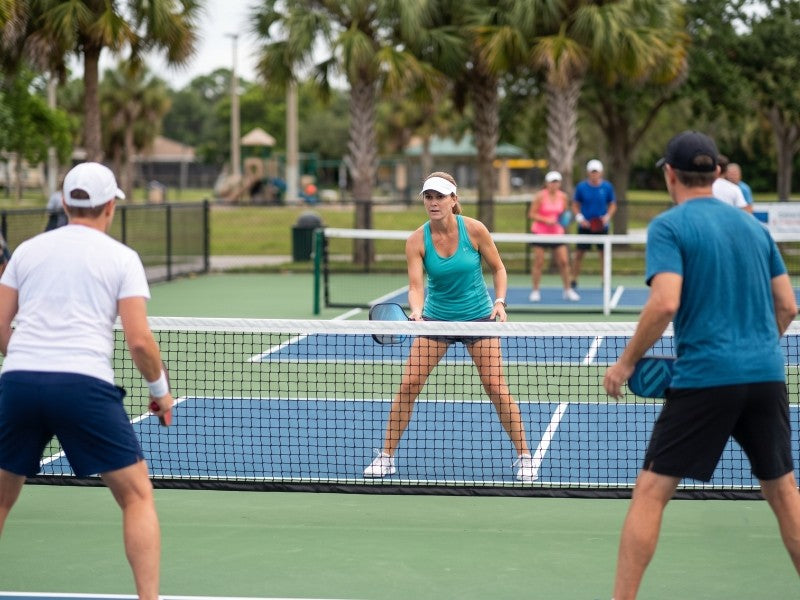
If you are exhausted by the monotonous grind of the treadmill, you are not alone. As we move through 2026, the fitness world is undergoing a massive racket sports renaissance. If you are ditching the traditional gym for the court and wondering about the average pickleball calories burned, here is the quick answer: A 160-pound person can expect to burn between 400 to 600 calories per hour of competitive pickleball play, whereas an hour of tennis can burn between 500 to 700 calories.
The Short Answer: Which Sport Burns More?
If we look strictly at the mathematics of energy expenditure, tennis burns more calories per hour than pickleball.
A tennis court is roughly four times the size of a pickleball court, and a tennis racket is significantly heavier than a pickleball paddle. The sheer physics of sprinting across 78 feet of baseline and generating the torque required to hit a heavy, pressurized tennis ball naturally demands a massive amount of cardiovascular output.
However, pickleball offers a highly sustained, low-impact calorie burn that is far more accessible for the average person. Below is a quick data comparison of what a standard 160-pound (72 kg) adult can expect to burn in 60 minutes of continuous play:
|
Sport & Format |
Average Calories Burned (Per Hour) |
Intensity Level |
|
Pickleball (Casual Doubles) |
350 - 400 kcal |
Moderate |
|
Pickleball (Competitive Singles) |
500 - 600 kcal |
Vigorous |
|
Tennis (Casual Doubles) |
400 - 450 kcal |
Moderate |
|
Tennis (Competitive Singles) |
600 - 700+ kcal |
Very Vigorous |
While tennis wins the raw data battle, pickleball might actually be the superior weight-loss tool for one simple reason: sustainability. To understand why, we need to break down the specific metabolic science of each sport.

Deep Dive: The Science of Pickleball Calories Burned
Pickleball is often deceiving. Because you are playing on a badminton-sized court with a lightweight plastic wiffle ball, it is easy to assume you aren't getting a "real" workout. Yet, players routinely step off the court drenched in sweat, completely exhausted. Here is the science behind why pickleball is such a phenomenal fat-burning engine.
The MET Value of Pickleball
In sports science, energy expenditure is measured in METs (Metabolic Equivalent of Task). One MET is the amount of energy your body uses while sitting completely still.
According to sports health analytics, pickleball typically registers between a 4.5 and 6.0 MET value, depending on the intensity of the game and whether you are playing singles or doubles. This classifies pickleball as a "moderate to vigorous" aerobic activity, placing it in the exact same calorie-burning neighborhood as brisk walking, light jogging, or a moderate session on the elliptical machine.
Calories Burned per Hour (By Weight & Format)
Because heavier bodies require more energy to move, your exact pickleball calories burned will depend largely on your body weight. Here is a detailed breakdown of what you can expect to torch during a 60-minute session:
|
Body Weight |
Rec Doubles (Leisure) |
Comp Doubles (Aggressive) |
Singles (High Intensity) |
|
130 lbs (59 kg) |
~ 250 kcal |
~ 350 kcal |
~ 450 kcal |
|
160 lbs (72 kg) |
~ 320 kcal |
~ 430 kcal |
~ 550 kcal |
|
190 lbs (86 kg) |
~ 380 kcal |
~ 510 kcal |
~ 650 kcal |
Biomechanics: Where Does the Energy Go?
Unlike running, which is entirely linear, pickleball forces your body to move in dynamic, multi-directional planes. The high calorie burn comes directly from the unique biomechanics of the game:
- The "Dinking" Squat: In advanced pickleball, players spend massive amounts of time at the Non-Volley Zone (the Kitchen) hitting soft shots called "dinks." To hit these effectively, you must stay low with your knees bent in a sustained athletic crouch. This acts as a continuous isometric hold for your quadriceps and glutes.
- Lateral Lunges: The court is narrow (20 feet wide), meaning you are constantly performing quick side-shuffles and explosive lateral lunges to cover angles. This heavily engages your inner and outer thighs (abductors and adductors), muscles that are often neglected in traditional gym workouts.
- Torso Rotation: Every time you drive the ball or hit a quick volley at the net, you are violently twisting your core. This constant rotation provides a phenomenal oblique and abdominal workout without ever doing a single crunch.
Deep Dive: The Science of Tennis Calories Burned
Tennis is a historically elite cardiovascular workout. It is grueling, explosive, and demands full-body athletic coordination. If your singular goal is to maximize caloric expenditure in the shortest amount of time possible, tennis is an undisputed heavyweight champion.
The Cardio Engine of Tennis
Because tennis demands full sprints, violent changes of direction, and heavy, full-body swings, the MET value of tennis ranges from 7.0 for doubles up to a staggering 8.0 for competitive singles. This places singles tennis squarely in the category of "vigorous" to "extreme" aerobic and anaerobic exercise, comparable to fast-paced lap swimming or competitive soccer.
Calories Burned per Hour (By Weight & Format)
The energy required to constantly propel your body weight across a massive 78-foot by 27-foot singles court results in a dramatic calorie expenditure. Here is the estimated 60-minute burn rate for tennis players:
|
Body Weight |
Rec Doubles (Leisure) |
Comp Doubles (Aggressive) |
Singles (High Intensity) |
|
130 lbs (59 kg) |
~ 300 kcal |
~ 420 kcal |
~ 500+ kcal |
|
160 lbs (72 kg) |
~ 380 kcal |
~ 520 kcal |
~ 650+ kcal |
|
190 lbs (86 kg) |
~ 450 kcal |
~ 620 kcal |
~ 780+ kcal |
The "Sprint and Stop" Dynamic
The high calorie burn in tennis is a direct result of its HIIT (High-Intensity Interval Training) nature.
A tennis rally typically lasts between 5 to 15 seconds of absolute maximal effort. You are recognizing the ball, aggressively sprinting 15 to 20 feet, planting your feet, twisting your entire core to generate power through a 300-gram racket, and then immediately recovering to the center of the baseline.
This "sprint and stop" dynamic repeatedly spikes your heart rate into the anaerobic zone (Zone 4 and Zone 5). While this triggers a massive calorie burn, it also leads to rapid muscular fatigue. This is why a one-hour tennis singles match can leave a beginner feeling completely physically devastated, whereas they could comfortably play two hours of pickleball doubles.

Head-to-Head: The 4 Key Fitness Factors
If we base our conclusion solely on a 60-minute stopwatch, tennis wins the calorie battle. But fitness is rarely that simple. When we evaluate how these sports actually impact the human body in real-world scenarios, the narrative drastically changes. Let us break down the four critical fitness factors that dictate the true quality of a workout.
1. Active Time vs. Dead Time
One of the most overlooked metrics in sports science is the ratio of "active play" to "dead time."
- Tennis: Because the court is massive and the ball travels at incredibly high speeds, amateur tennis is plagued by dead time. You hit two shots, the ball flies into the fence, and you spend 45 seconds walking to retrieve it. In a typical one-hour amateur tennis match, the ball is only in active play for about 10 to 15 minutes.
- Pickleball: The compact court and slower wiffle-style ball result in significantly longer, sustained rallies. Furthermore, when the ball goes out of bounds, you only have to take two steps to pick it up. The sheer density of active play means that your heart rate remains elevated for a much larger percentage of the hour, allowing the actual pickleball calories burned in a recreational setting to frequently rival recreational tennis.
2. Joint Impact and Longevity
Burning 700 calories is fantastic—unless it leaves you with a torn meniscus.
- Tennis: Tennis is a highly traumatic sport for the joints. The heavy racket causes severe wear on the elbow and shoulder (especially during the overhead serve), while the high-speed, long-distance sprinting causes immense impact trauma on the knees and ankles.
- Pickleball: Pickleball was inherently designed to be a low-impact sport. The paddle is lightweight, serves are hit underhand (saving the rotator cuff), and the smaller court requires short, controlled lateral shuffles rather than violent, full-speed sprints. It provides a phenomenal cardiovascular workout without the punishing orthopedic toll, extending your athletic longevity by decades.
3. Heart Rate Zones
To burn fat efficiently, you need to understand Heart Rate (HR) zones.
- Tennis: The explosive, start-and-stop nature of tennis frequently pushes your heart rate into Zone 4 and Zone 5 (Anaerobic). This builds incredible peak cardiovascular capacity, but it burns through glycogen (stored carbohydrates) faster than it burns fat, and it requires significant recovery time.
- Pickleball: An intense game of doubles pickleball perfectly anchors your heart rate in Zone 2 and Zone 3 (The Fat-Burning Zone). In this aerobic state, your body utilizes stored body fat as its primary energy source. Because the intensity is steady and manageable, you can sustain this fat-burning state for two or even three hours without hitting a wall.
4. The EPOC Effect (Afterburn)
EPOC (Excess Post-exercise Oxygen Consumption) refers to the calories your body continues to burn after your workout is over, as it works to return to its resting state.
Because tennis involves more intense anaerobic sprinting, it generates a higher EPOC effect, meaning your metabolism stays elevated longer after you leave the court. However, an aggressive game of pickleball singles will also trigger a highly respectable EPOC response, ensuring you continue to torch calories while driving home.
The "Better" Workout: How to Choose for Your Goals
So, which racket sport should you dedicate your time to? The "better" workout entirely depends on your personal physiology, your current fitness level, and your ultimate goals.
Choose Tennis If...
- You are already in excellent physical condition and want to push your maximum cardiovascular limits.
- You are looking to build explosive lower-body power and top-end sprinting speed.
- Your joints (specifically your knees, hips, and shoulders) are completely healthy and can withstand high-impact trauma.
Choose Pickleball If...
- Your primary goal is sustainable weight loss and fat burning without extreme exhaustion.
- You have previous joint injuries or want a low-impact workout that protects your knees and back.
- You want a highly social exercise environment that allows you to chat and laugh while still getting a great sweat.
The Adherence Factor (The Ultimate Tie-Breaker)
In exercise psychology, there is a golden rule: The best workout is the one you will actually do.
Tennis has a notoriously steep learning curve; it can take months of frustrating, expensive lessons just to sustain a rally. This leads to a massive drop-out rate.
Pickleball, conversely, is famously addictive. Beginners can sustain rallies within 15 minutes of picking up a paddle. Because it is incredibly fun and highly social, players often find themselves playing for three hours at a time, four days a week. While tennis might burn more calories per hour, the cumulative pickleball calories burned over a month will vastly exceed tennis simply because you will actually look forward to playing it every single day.
FAQs
Is pickleball alone enough exercise to lose weight?
Yes, playing pickleball is an excellent cardiovascular foundation for weight loss. However, you cannot out-train a bad diet. To successfully lose weight, your pickleball calories burned must be combined with a caloric deficit in the kitchen. If you burn 500 calories on the court but drink a 600-calorie milkshake afterward, you will not lose fat.
Why does my Apple Watch say I burned fewer calories in pickleball than tennis?
Fitness trackers rely heavily on stride length, arm swing velocity, and GPS distance to calculate exertion. Because pickleball uses a compact swing and short, choppy steps, many smartwatches currently underestimate the effort. As algorithms update specifically for pickleball biomechanics in 2026, these readouts are becoming much more accurate.
Can playing pickleball reduce belly fat?
While you cannot "spot reduce" fat from specific areas, playing pickleball will lower your overall body fat percentage, which eventually reveals a slimmer waistline. Furthermore, the constant torso rotation required to hit forehands and backhands acts as a dynamic core workout, deeply strengthening and toning your obliques and abdominal walls.

Leave a comment
This site is protected by hCaptcha and the hCaptcha Privacy Policy and Terms of Service apply.