


If you are new to the world’s fastest-growing racquet sport, holding a pickleball for the first time might trigger a wave of childhood nostalgia. Looking at that hollow, perforated plastic sphere, your mind likely flashes back to warm summer afternoons in the backyard, swinging a long yellow plastic bat. At a cursory glance, the equipment looks nearly identical, leading countless beginners to ask a very logical question: Are we just playing tennis with a Wiffle ball?
While it is true that these two iconic items share a profound historical connection, the pickleball vs wiffle ball debate is not a matter of semantics. They are entirely different pieces of sporting equipment.
Difference #1: Hole Design and Aerodynamics
If you want to sound like an absolute expert the next time the pickleball vs wiffle ball topic comes up, point directly to the holes. The hole configuration is the single most important mechanical difference between the two, as it completely alters the fluid dynamics and the flight path of the ball.
The Wiffle Ball: Engineered for Curveballs and Chaos
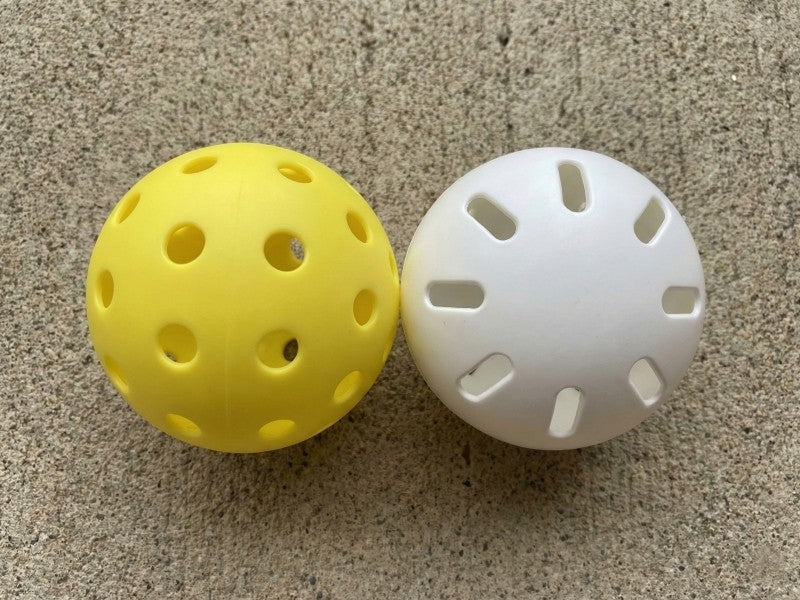
Take a close look at a traditional Wiffle ball. You will notice two glaring structural anomalies:
- The Shape: It does not have circular holes. It features exactly 8 elongated, oblong slots.
- The Distribution: This is the critical factor. All 8 of those oblong slots are located on only one hemisphere of the ball. The other half of the Wiffle ball is completely solid, un-drilled plastic.
This highly asymmetrical design is a stroke of aerodynamic genius by the Wiffle ball's inventor, David N. Mullany. The asymmetrical hole placement intentionally disrupts the airflow around the sphere. When a pitcher throws a Wiffle ball with specific spin, the air catches the perforated side differently than the solid side. This creates a massive pressure differential (leveraging a dramatic variation of the Magnus effect), which forces the ball to violently curve, sink, or slide in mid-air.
The Wiffle ball is explicitly engineered to be unpredictable. It is designed to deceive a batter.

The Pickleball: Engineered for Absolute Stability
Now, examine a modern, tournament-sanctioned pickleball. The engineering philosophy is the exact opposite.
- The Shape: A pickleball features perfectly circular holes.
- The Distribution: Whether it is an indoor ball (which typically has 26 larger holes) or an outdoor ball (which typically has 40 smaller holes), the perforations are spaced symmetrically and evenly across the entire surface area of the sphere.
In a racquet sport, unpredictability is your enemy. When you hit a precise third-shot drop or a blistering cross-court drive, you need the ball to travel exactly where your paddle face dictates. The symmetrical hole distribution of a pickleball allows air to flow uniformly through and around the sphere, drastically reducing aerodynamic drag while completely eliminating the erratic curving effect of a Wiffle ball.
Even in a stiff outdoor breeze, the heavy, symmetrical design of a 40-hole outdoor pickleball allows it to cut through the wind and maintain a true, predictable, and stable flight path.
Difference #2: Material Composition and Hardness
The second most noticeable difference between a pickleball vs wiffle ball becomes obvious the moment you squeeze them in your hand. The material science behind each ball dictates its durability and its safety profile.
The Wiffle Ball: Pliable, Forgiving, and Safe
The Wiffle ball was invented in 1953 as a solution to broken windows. Kids were playing baseball in cramped suburban neighborhoods, and hard rubber or leather baseballs were causing severe property damage.
Therefore, a Wiffle ball is manufactured using a very thin, highly pliable, lightweight plastic blend. If you pick one up, you can easily compress it and squeeze the sides together with just your thumb and index finger. It yields to pressure. Because of this structural softness and its incredibly light weight, a Wiffle ball cannot retain enough kinetic energy to break a glass window or injure a child if they are struck by a wild pitch. It is fundamentally a backyard toy engineered for safety.
The Pickleball: Thick, Rigid, and Built for Brutality
A pickleball is not a toy; it is a piece of high-impact athletic equipment. Modern pickleballs are manufactured using high-density plastics (such as polyethylene or polyurethane blends). Many are created through a rotational molding process to ensure a single, seamless piece of plastic, while others are injection-molded and heat-welded together.
Regardless of the manufacturing process, a pickleball is exceptionally rigid. If you attempt to squeeze a sanctioned outdoor pickleball with your bare hand, it will barely yield. It feels thick, hard, and solid.
This extreme material hardness is an absolute necessity. During a competitive match, a pickleball is subjected to tremendous blunt force trauma. It is routinely smashed by carbon fiber and fiberglass paddles at speeds exceeding 40 miles per hour, only to instantly violently collide with the abrasive surface of an asphalt or concrete court. If you were to hit a soft Wiffle ball with a modern, heavy pickleball paddle at full force, the Wiffle ball would likely crack, cave in, or shatter upon the very first impact.
Difference #3: Weight and Size Regulations
When discussing the pickleball vs wiffle ball distinction on a professional level, we must look at the strict parameters set by governing bodies. A backyard toy has no legal specifications; a piece of competitive athletic equipment is subjected to rigorous laboratory testing.
USA Pickleball (USAPA) Regulations
To be used in a sanctioned tournament, a pickleball must pass a battery of tests dictated by USA Pickleball. The dimensional and weight requirements are incredibly narrow to ensure absolute fairness and consistency across the sport.
- The Size: A sanctioned pickleball must have a diameter between 2.87 inches and 2.97 inches.
- The Weight: This is the most crucial metric. A legal pickleball must weigh between 0.78 and 0.935 ounces.
While that might sound incredibly light, in the realm of hollow plastic spheres, it is substantial. This highly specific weight allows the ball to carry kinetic momentum. When an outdoor pickleball (which leans toward the heavier end of that spectrum) is struck, its mass allows it to punch through the air, resisting wind deflection and maintaining a lethal, driving velocity.
The Featherweight Wiffle Ball
By contrast, a classic Wiffle ball is noticeably lighter. Because it is manufactured with thinner, pliable plastic and is exempt from any athletic governing body's standards, its weight typically hovers around 0.7 ounces or less.
In the context of fluid dynamics, this lack of mass is a severe detriment to racquet sports. If you attempt to hit a featherweight Wiffle ball across a 44-foot court, it simply lacks the mass to sustain its forward momentum. Aerodynamic drag takes over immediately, causing the ball to decelerate rapidly and "float." If there is even a three-mile-per-hour breeze, the Wiffle ball will be blown completely off course, making a competitive rally mathematically impossible.
Difference #4: Bounce Dynamics and The "Soft Game"

The rules of a sport are dictated by the physical properties of the ball. The entire strategic framework of pickleball relies on a consistent, predictable upward kinetic transfer.
The Critical Pickleball Bounce
According to USAPA equipment standards, if you drop a sanctioned pickleball from a height of 78 inches onto a concrete floor, it must bounce back up to a height of 30 to 34 inches.
This precise bounce dynamic is the lifeblood of the sport. The two most iconic rules in pickleball—the Double Bounce Rule (where the serve and the return must both bounce before they can be volleyed) and the Kitchen/Non-Volley Zone (where players must let short balls bounce before striking them)—function only because the ball is rigid enough to rebound efficiently off a hard surface. The "soft game" (dinking) requires a ball that can predictably pop back up into the air after softly grazing the asphalt.
The Dead Bounce of a Wiffle Ball
A Wiffle ball produces what athletes call a "dead bounce." Because the plastic is soft and pliable, it acts as a shock absorber. When a Wiffle ball strikes a hard surface, the plastic compresses, absorbs the kinetic energy of the impact, and fails to transfer that energy back into an upward rebound.
If you attempt to play a game of pickleball with a Wiffle ball, the Double Bounce Rule becomes a nightmare. A deep serve will hit the ground and essentially skid or stop, failing to bounce high enough for the receiver to make a clean return. Dinking at the Kitchen line becomes physically impossible, as a soft Wiffle ball dropped just over the net will simply hit the concrete and die.
Difference #5: Equipment Compatibility (Bat vs. Paddle)
The final piece of the pickleball vs wiffle ball puzzle lies in the instruments we use to strike them. The ball dictates the weapon.
The Wiffle Bat: Long, Hollow, and Flexible
The traditional companion to the Wiffle ball is the iconic, elongated yellow plastic bat. It is hollow, extremely lightweight, and highly flexible. It is designed with a very narrow barrel (the striking surface). Because the Wiffle ball is so soft, the plastic bat does not need to be reinforced. When the bat meets the ball, both pieces of plastic flex slightly, resulting in a muffled "thud" and a safe, localized flight path suitable for a small backyard.
The Pickleball Paddle: Rigid, Wide, and Explosive
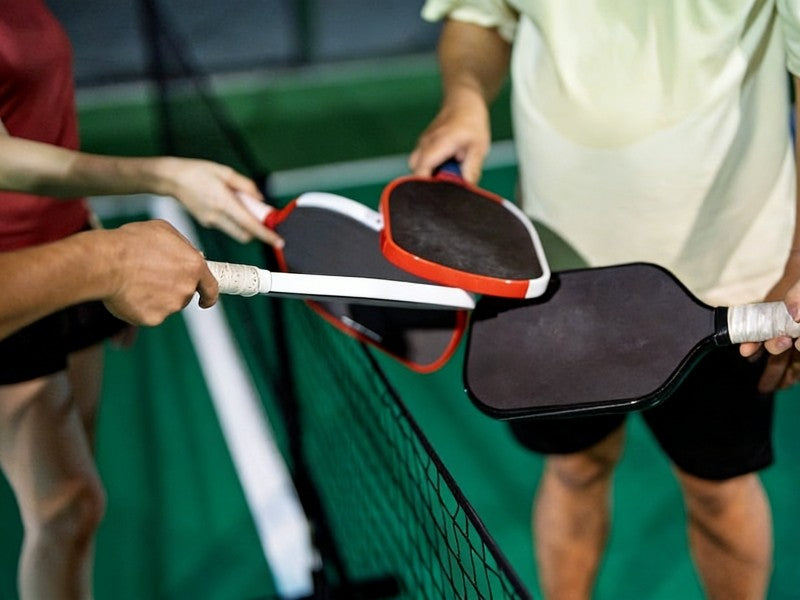
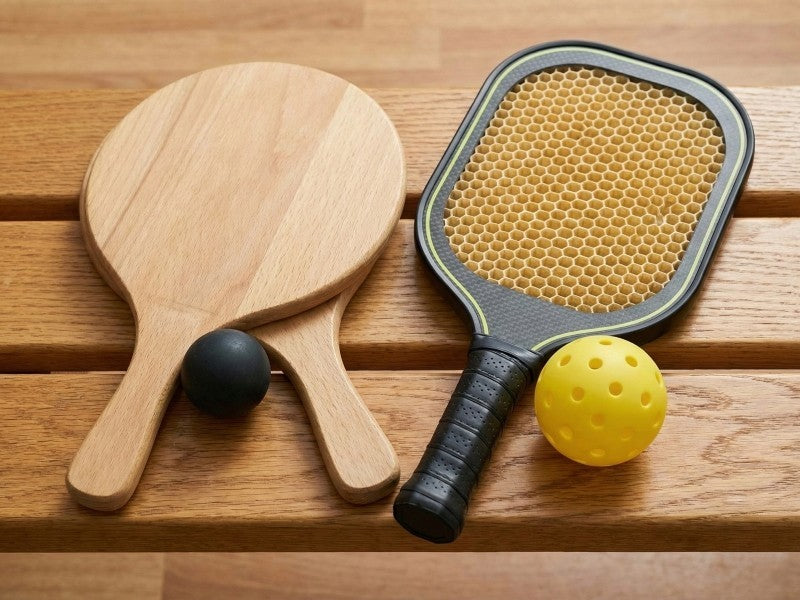
A modern pickleball paddle is a masterpiece of composite engineering. It features a wide, flat striking face (usually made of woven carbon fiber, raw fiberglass, or graphite) layered over a dense polymer honeycomb core. The paddle is incredibly rigid, completely inflexible, and provides a massive "sweet spot."
When the rigid carbon fiber face of a paddle strikes the thick, high-density plastic of a pickleball, it creates a highly pressurized, explosive transfer of energy—resulting in the loud, distinct thwack that has become synonymous with the sport.
The Ultimate Question: Can You Use Them Interchangeably?
After reviewing the aerodynamic engineering, the material science, and the bounce dynamics, the answer to the most commonly asked question is a definitive and resounding NO. You cannot and should not use them interchangeably. Doing so will not only ruin your game; it will likely destroy your equipment.
· What happens if you use a Wiffle ball on a pickleball court?
If you hit a Wiffle ball with a heavy carbon-fiber pickleball paddle, the sheer blunt force will quickly crush, crack, or completely shatter the soft plastic of the Wiffle ball. Even if it survives the impact, the asymmetrical 8-hole design will cause the ball to wildly curve out of bounds, and its dead bounce will make rallying impossible.
· What happens if you use a pickleball in a backyard baseball game?
This is highly dangerous. If a pitcher throws a hard, heavy, 40-hole outdoor pickleball, and the batter swings a hollow yellow Wiffle bat, the impact will likely shatter the plastic bat into sharp, dangerous pieces. Furthermore, if a batter hits a line drive with a solid pickleball, it retains enough mass and velocity to easily break a window or cause severe bruising to a backyard fielder.

Leave a comment
This site is protected by hCaptcha and the hCaptcha Privacy Policy and Terms of Service apply.