


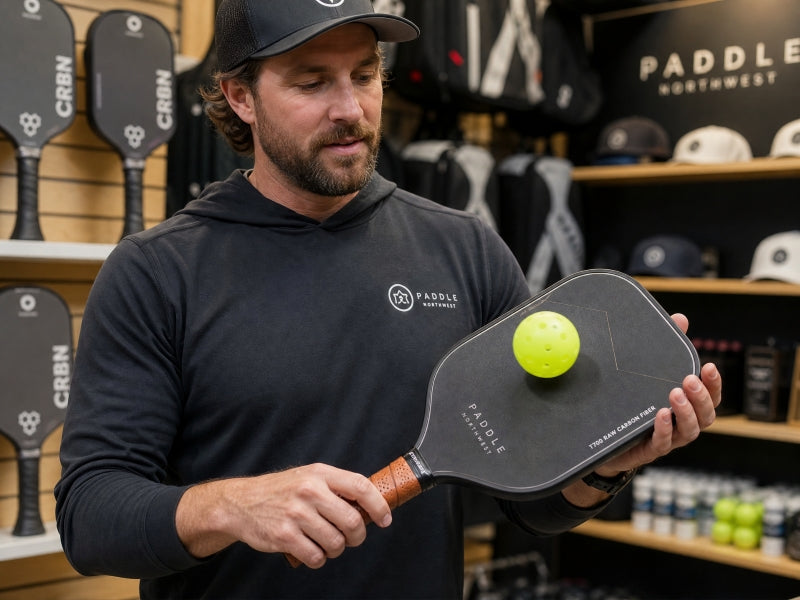
Buying a paddle based only on price, appearance, or a professional endorsement is a common mistake. High quality pickleball paddles are defined by how well their materials, balance, construction, and support policy match the way you play.
The most reliable evaluation combines five areas: face material, core construction, weight and balance, shape and handle design, and durability protection.
What Defines a High Quality Pickleball Paddle?
A high quality paddle should provide a predictable response, stable handling, and sufficient durability for normal play.
Use this basic standard before buying:
- The materials and dimensions are clearly stated.
- The weight is given as a range or tolerance, not an unexplained estimate.
- The face texture and core construction are described accurately.
- The handle feels appropriate for your hand and backhand style.
- The model has a clear return and warranty process.
- Tournament players can verify the exact model in the current approval database.
These checks create a more useful definition of quality than a high retail price alone.
Paddle Face Materials: Carbon Fiber, Fiberglass, and Composite
The face is the part of the paddle that contacts the ball, so its material strongly affects feel, energy transfer, spin potential, and durability. Common options include carbon fiber, fiberglass, graphite, and mixed composite constructions. No face material is automatically superior in every situation; the layup, texture, thickness, bonding, and core beneath it also matter.
Carbon fiber faces are popular among players who want a responsive surface and reliable spin potential. A textured carbon face can help the ball grip during a topspin or slice swing, provided the texture remains within the rules of the relevant organization. Carbon fiber can also provide a strong, lightweight face, but the actual playing feel varies substantially between models.
Fiberglass and other composite faces can produce a livelier rebound and may be attractive to recreational players who want easy depth. That extra rebound can be helpful for serves and drives, but it may require more touch on dinks and resets. A softer or more flexible face can feel comfortable, although the paddle may not provide the same crisp feedback as a stiffer carbon construction.
Do not evaluate the face in isolation. Ask these questions:
1. Is the surface smooth, textured, gritty, or coated?
2. Is the texture designed for spin, and is the model approved for competition?
3. Does the manufacturer identify the actual face material?
4. Is the face bonded consistently to the core and perimeter?
5. Does the paddle remain predictable on off-center contact?
Core Construction and Thickness: The Source of Feel and Stability
The core influences how the paddle flexes, returns energy, absorbs impact, and responds away from the center. Traditional paddles often use polypropylene or polymer honeycomb cores, while newer models may use foam, reinforced foam, or hybrid structures involving EPP and EVA. Each construction can be designed for power, control, comfort, or a combination of those traits.
Core thickness is equally important. A thicker paddle, commonly around 16 mm, often offers a more stable and controlled response on blocks, resets, and soft shots. A thinner paddle may feel quicker and more direct, and it can provide additional pop, but it may require more precise technique. Thickness is not a quality score; it is a performance choice.
Foam-core paddles deserve careful reading because “foam core” can describe different designs. A paddle may have a solid foam core, an internal foam ring, an EPP structure, EVA reinforcement, or a combination of materials. The construction should be explained clearly enough for you to understand whether it is intended to increase energy transfer, damp vibration, widen the sweet spot, or improve resistance to compression.
Compare core designs using the following practical questions:
- Does the paddle feel stable when blocking a fast drive?
- Does the response change sharply on an off-center hit?
- Can you control a third-shot drop without over-reducing your swing?
- Does the core retain its response after repeated sessions?
- Is the manufacturer’s durability claim supported by a stated test method?
A high quality core should produce a consistent response across the useful hitting area. It should not be judged solely by how loud or powerful the paddle feels during a single overhead.

Balance, Weight, Swing Weight, and Twist Weight
Two paddles with the same listed weight can feel completely different. The reason is balance. A head-heavy paddle places more mass toward the face, which can help generate power and momentum but may feel slower during quick hand battles. A handle-heavy or evenly balanced paddle may be faster to maneuver and easier to stop, although it may require more effort to produce the same pace.
Static weight is the number shown on a scale. Swing weight describes how difficult the paddle is to accelerate and decelerate. Twist weight describes resistance to twisting when you strike the ball away from the center. These measurements are useful because they explain why a lightweight paddle can still feel demanding if its mass is concentrated toward the head.
Use this simple fit guide:
|
Playing need |
Balance and specification to consider |
|
Fast kitchen exchanges |
Moderate swing weight and easy maneuverability |
|
Baseline power and singles |
More mass or leverage, provided you can swing comfortably |
|
Defensive blocks |
Stable twist response and predictable rebound |
|
Long sessions |
A weight you can control without excessive grip tension |
|
Two-handed backhand |
Adequate handle length and a comfortable circumference |
As a real product example, Srikel lists the DURAFOAM POWER X Hybrid at 8.0 oz. with a ±0.2 oz. tolerance, a 6.82 twist-weight rating, and a 114–117 swing-weight range. These figures make comparison easier, but numbers still need to be interpreted alongside shape and technique. A player who wants more reach may choose an elongated model, while another player may prefer the wider face and quicker response of a hybrid or square profile.
The correct weight is the heaviest paddle you can move quickly, accurately, and comfortably for an entire playing session—not the heaviest paddle you can swing once.
Shape, Sweet Spot, and Handle Design
Paddle shape determines more than appearance. Elongated paddles usually provide more reach and leverage, which can help with singles, deep returns, and two-handed backhands. Widebody paddles generally offer a larger hitting area and may feel more forgiving during defensive exchanges. Hybrid shapes attempt to balance reach, face coverage, and maneuverability.
The sweet spot is the area where the paddle produces a useful, stable response. A larger sweet spot can help recreational and developing players maintain depth when contact is imperfect. However, sweet-spot size is influenced by the core, perimeter weighting, face construction, and shape—not just the overall width.
Handle dimensions deserve equal attention. A handle that is too short can feel restrictive for a two-handed backhand. A circumference that is too large can encourage excessive grip tension and reduce wrist freedom. A handle that is too small may feel unstable unless you add an overgrip.
Before ordering, compare:
- Total length and width.
- Handle length and circumference.
- Shape category: elongated, widebody, square, or hybrid.
- Stated sweet-spot or stability features.
- Grip material, edge profile, and replacement options.
A high quality paddle should present these measurements clearly. If you cannot find them, contact the seller before purchasing rather than guessing from product photographs.
How to Assess Durability Before You Buy
Durability is not the same as a paddle surviving every form of abuse. Even high quality pickleball paddles can be damaged by repeated ground strikes, edge impacts, extreme heat, moisture, or unauthorized modifications. The more useful question is whether the construction and support policy are appropriate for normal use.
Inspect the product information for the following durability indicators:
- A securely bonded face and edge guard or a clearly explained edgeless design.
- A core construction designed to resist compression or breakdown.
- Consistent face texture rather than a surface that appears likely to peel.
- A handle that joins the throat without visible gaps or movement.
- A written warranty that explains covered manufacturing defects.
- Care instructions for temperature, storage, and cleaning.
A Practical Paddle Testing Checklist
The most dependable way to identify high quality pickleball paddles is to test the shots that matter in your game. Do not judge a paddle only by a powerful drive in a store or by the first few minutes of casual play.
Use this five-stage test when a demo or return period is available:
Serve and return: Hit ten serves and ten returns to a defined target. Note depth, accuracy, and whether the paddle produces unwanted pop.
Third-shot drop: Hit repeated drops from the baseline. A suitable paddle should let you vary height and speed without constantly sending the ball long.
Block and reset: Ask a partner to drive at your body and block the ball back. Observe stability, rebound, vibration, and how quickly you can prepare for the next shot.
Dink and transition: Play crosscourt dinks, then move through the transition zone. This reveals touch, maneuverability, and control under pressure.
Fatigue check: Play long enough to notice grip tension, wrist effort, shoulder fatigue, and changes in timing. A paddle that feels excellent for five swings may be tiring during a full match.
Record observations instead of using vague labels. Write down whether your returns were deeper, resets were shorter, or mishits became less severe. This creates a personal comparison that is more meaningful than a generic “power” or “control” score.
Final Buying Checklist for High Quality Pickleball Paddles
Before placing an order, save the product page and confirm each item below:
- Face: Is the material and texture clearly identified?
- Core: Is the material, architecture, and thickness stated?
- Weight: Is there a realistic range or tolerance?
- Balance: Are swing weight or balance characteristics available?
- Shape: Does it match your need for reach, forgiveness, or speed?
- Handle: Are length and circumference suitable for your hand?
- Durability: Are the edge, face bonding, and care requirements explained?
- Compliance: Is the exact model listed in the current official database if needed?
- Support: Are returns, warranty exclusions, and registration requirements clear?
- Testing: Can you use a demo, trial, or return period to evaluate the paddle?
A paddle that passes this checklist is not guaranteed to be perfect for every player, but it is far less likely to be an uninformed purchase. Quality is the combination of transparent information, sound construction, appropriate fit, and reliable support.


Leave a comment
This site is protected by hCaptcha and the hCaptcha Privacy Policy and Terms of Service apply.