


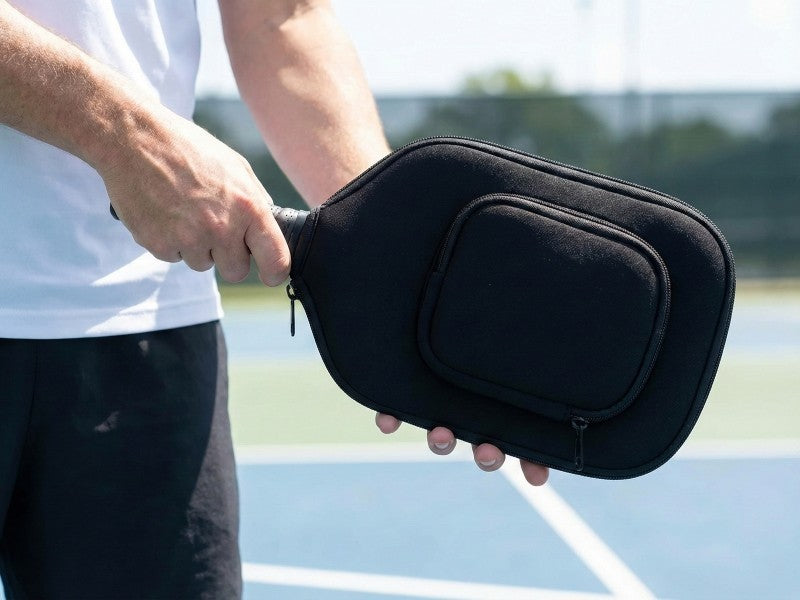
The sport of pickleball has experienced an unprecedented explosion in popularity, evolving from a casual driveway pastime to a highly competitive, globally recognized sport. Yet, a startlingly common scenario plays out at courts everywhere: a player finishes a hard-fought match, wipes the sweat from their brow, and carelessly tosses their state-of-the-art, high-performance paddle directly into the trunk of their car or loosely into a gym bag filled with keys, water bottles, and damp towels.
A few months later, they wonder why their paddle has lost its pop, why their spin has vanished, or why there is a strange rattling sound coming from the core. This brings us to the core of our discussion: the true pickleball paddle cover importance.
The Anatomy of a Modern Pickleball Paddle
To truly grasp the importance of a protective cover, you must first understand what you are protecting. Modern pickleball paddles are essentially composite sandwiches. They are relatively lightweight, highly rigid, and designed to transfer energy efficiently. However, the very materials that make them perform so brilliantly on the court also make them surprisingly fragile off the court.
The Core Materials
The "engine" of your paddle is its core. The core determines the power, control, and feel of every shot you hit. Unlike a tennis racket, which relies on string tension, a pickleball paddle relies on the compression and restitution of its core matrix.
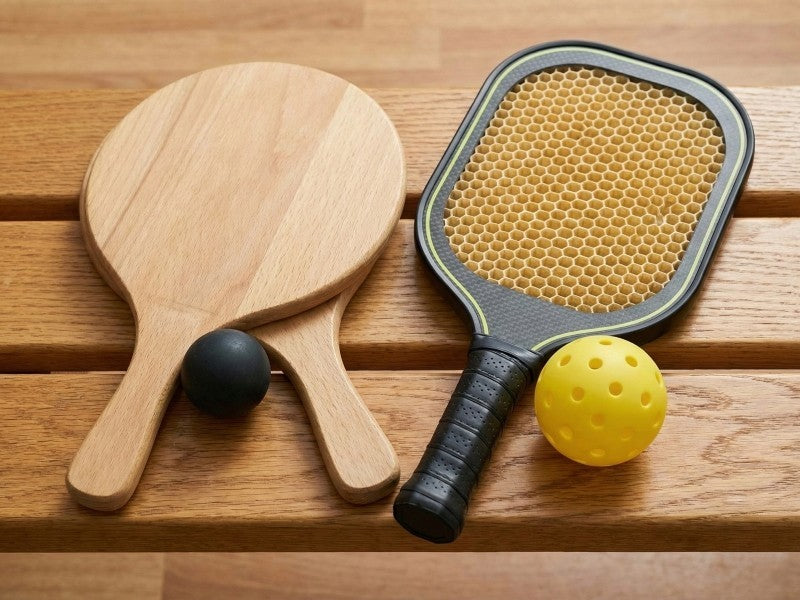
- Polymer Honeycomb Cores: This is the industry standard for most modern paddles. Polymer (a type of high-grade plastic) is formed into a honeycomb lattice. This structure provides an incredible strength-to-weight ratio, absorbing vibration and offering a soft touch. However, honeycomb structures are highly susceptible to focused, blunt-force impact. A sharp jab from a set of keys in your bag, or dropping the paddle against a hard edge, can crush individual honeycomb cells. Once a cell is crushed, it never recovers, creating a permanent "dead spot" on your paddle.
- Nomex and Aluminum Cores: While less common today, Nomex (a cardboard-like material dipped in resin) and aluminum cores are still used for players seeking ultimate power and a loud "pop." Nomex is notoriously brittle over time, and aluminum is prone to denting. If an aluminum core is dented while bouncing around in a car trunk, the face of the paddle becomes permanently deformed.

The Surface/Face Materials
The face of your paddle is your point of contact with the ball. The texture and material of this surface dictate how much friction you can generate, which translates directly into spin (topspin and backspin).
- Raw Carbon Fiber (T700 and similar): The gold standard for professional-level spin. Raw carbon fiber features a micro-texture—a tight, woven grit that bites into the plastic of the pickleball. The primary enemy of carbon fiber is not just impact, but abrasion. If your unprotected paddle is rubbing against the coarse nylon interior of a backpack, or scraping against the zippers of other compartments, that micro-texture is slowly being sanded down.
- Fiberglass and Graphite Composite: Fiberglass provides excellent pop and power, while graphite offers a lightweight, stiff feel. These materials are often finished with an applied textured coating (like a spray-on grit or peel-ply texture). These applied coatings are highly vulnerable to chipping and flaking if they are subjected to constant friction or minor impacts during transport.
Decoding Pickleball Paddle Cover Importance: 4 Critical Dimensions
Now that we understand the delicate composite nature of the equipment, we can explore the specific mechanisms of damage. Understanding pickleball paddle cover importance requires looking at four distinct dimensions of protection. A quality cover acts as a physical shield, a thermal barrier, and a micro-environment manager.
Impact Resistance Against Micro-Traumas
When we think of paddle damage, we usually picture violently smashing the paddle against a hard court surface in a moment of frustration. While that will certainly destroy a paddle, the most common cause of premature paddle death is actually "micro-trauma."
Micro-traumas are the small, seemingly insignificant impacts that occur during transit and storage.
- The Gym Bag Hazard: Your paddle shares space with heavy metal water bottles, sharp car keys, knee braces with hard plastic hinges, and other dense objects. Every time you drop your bag on the floor, those items smash into the honeycomb core of your paddle.
- The Accumulation Effect: One tiny impact might not crush a polymer cell, but hundreds of them over a three-month period will. A dense, shock-absorbing cover (such as neoprene or a padded synthetic) acts as a bumper. It dissipates the kinetic energy of these localized impacts across a wider surface area, preventing the focused pressure that crushes internal cores and dents faces.
Shielding from Environmental Extremes
This is perhaps the most critical and least understood aspect of paddle care. Pickleball paddles are held together by specialized industrial adhesives (glues). These adhesives are remarkably strong under normal playing conditions, but they are highly sensitive to extreme temperatures.
- The Oven Effect (Heat): The single worst thing you can do to a modern thermoformed or composite paddle is leave it in a hot car. Trunk temperatures in the summer can easily exceed 140°F (60°C). At these temperatures, the adhesives binding the carbon fiber face to the polymer core begin to soften and liquefy. As the core expands from the heat, the face separates from the core. This catastrophic failure is known as delamination. Once a paddle is delaminated, it is illegal for tournament play and practically useless, as it produces an unpredictable, trampoline-like effect.
- The Freezer Effect (Cold): Conversely, leaving a paddle in freezing temperatures causes the polymer core and the adhesives to contract and become brittle. A freezing cold paddle is significantly more likely to crack or snap upon hitting a hard pickleball.
- UV Degradation: Prolonged exposure to direct sunlight (UV rays) breaks down the chemical bonds in composite resins, causing the paddle face to become brittle and discolored.
A high-quality paddle cover, particularly one with thermal-lining properties, acts as an insulator. While it won't allow you to leave your paddle in a hot car indefinitely, it dramatically slows down the rate of temperature change, protecting those vital adhesive bonds from rapid expansion and contraction.
Preserving Paddle Face Grit and Spin Potential
If you are playing with a raw carbon fiber paddle, you paid a premium for that gritty, woven texture. That texture is responsible for gripping the smooth plastic surface of the pickleball.
Without a cover, your paddle face acts like a magnet for debris.
- Friction Smoothing: As mentioned earlier, rubbing against fabrics in your bag acts like fine-grit sandpaper, smoothing out the carbon weave over time.
- Clogging the Weave: The interior of a typical sports bag is filled with lint, dirt, chalk, and fabric micro-fibers. When the rough surface of an unprotected paddle rubs against these, the microscopic valleys in the carbon fiber weave become clogged with debris. When the texture is filled with dirt, the paddle effectively becomes completely smooth, severely limiting your ability to generate topspin.
A snug-fitting cover acts as a quarantine zone, ensuring that the only thing your paddle face ever makes contact with is the pickleball itself.
Moisture and Humidity Control
Pickleball is a sweaty sport. Players often throw their damp towels, sweaty wristbands, and worn socks into the same bag as their paddle.
While the polymer and carbon fiber themselves are generally waterproof, the rest of the paddle is not.
- Grip Degradation: The grip tape (overgrip and replacement grip) is highly porous. If an unprotected paddle is left in a humid, sweaty gym bag, the grip absorbs that ambient moisture. This breeds bacteria (causing terrible odors) and breaks down the polyurethane material of the grip, making it slippery and crumbly.
- Internal Seepage: If your edge guard has even a microscopic gap, high ambient humidity in a closed bag can allow moisture to seep into the honeycomb core. Water trapped inside the core will completely ruin the acoustics and the bounce consistency of the paddle.
By keeping the paddle isolated inside a water-resistant cover, you create a barrier between the damp, humid environment of your gym bag and the delicate components of your equipment.

What Happens When You Don't Use a Cover?
To truly appreciate pickleball paddle cover importance, we must look at the grim reality of what happens when you ignore it. Paddle degradation is rarely an overnight event; it is a slow, insidious process. When you forgo a protective sleeve, you expose your equipment to three primary modes of failure.
- The "Dead Spot" Phenomenon: Unprotected daily bumps crush the internal polymer honeycomb core. The paddle loses its ability to return kinetic energy, resulting in a dull "thud." This forces harder swings, ruining your mechanics and increasing the risk of tennis elbow.
- Delamination & Core Crush: Leaving a naked paddle in extreme temperatures (like a hot car) causes the carbon fiber face to separate from the core. This creates an uncontrollable "trampoline effect," ruining your soft game and rendering the paddle illegal for tournaments. A thermally insulating cover prevents this.
- The Financial Cost: Premium carbon fiber paddles cost $180–$250. Without a cover, friction and micro-impacts will ruin its performance in just 3 to 4 months, forcing frequent, expensive replacements.
Types of Pickleball Paddle Covers
Understanding that you need a cover is only half the battle; selecting the right one for your specific lifestyle and environment is equally crucial. The market is flooded with options, but they generally fall into four distinct categories, each serving a slightly different protective purpose.
Neoprene Covers (The Industry Standard)
Neoprene—the same synthetic rubber used in wetsuits—is the undisputed king of paddle protection. It is naturally shock-absorbent, highly water-resistant, and stretches to provide a snug, custom-like fit around the paddle face.
· The Verdict: This is the best all-around choice for 90% of players. It provides excellent defense against the friction and blunt impacts of a crowded gym bag while offering moderate thermal insulation.
Hard Shell Cases
Constructed from molded EVA foam or rigid plastics with a soft interior lining, hard shell cases are the fortresses of the pickleball world.
· The Verdict: If you travel frequently, fly with your gear in checked luggage, or are prone to dropping your bag on hard concrete, a hard shell case guarantees zero core-crushing impacts. The trade-off is bulk; they take up significantly more room in a backpack.
Faux Leather and Specialty Materials
Many players opt for covers made from vegan leather, canvas, or weather-treated nylons for aesthetic reasons.
· The Verdict: While these look premium, the true value lies on the inside. If you choose a specialty material, you must ensure the interior is lined with a non-abrasive material, such as plush microfiber or soft fleece. A rough interior will act like sandpaper against your carbon fiber grit.
Full Paddle Bags vs. Head Covers
A common point of confusion is whether to buy a cover that only zips around the paddle face (a head cover) or a full-length sleeve that encompasses the handle.
· The Verdict: A head cover is usually sufficient for protecting the critical strike zone and edge guard. However, if you play in highly humid environments, a full-length bag prevents ambient moisture from degrading your grip tape and oxidizing the exposed handle underbelly.

Leave a comment
This site is protected by hCaptcha and the hCaptcha Privacy Policy and Terms of Service apply.