


If you are asking, “What pickleball paddle should I buy?”, start with your playing problem rather than the most expensive model or the latest marketing claim. Players who need deeper serves may benefit from a power-oriented paddle. Players who miss resets or pop-ups may need a softer, more controlled response. Players who want heavier topspin should examine the face texture, swing mechanics, and paddle balance together.
There is no single best paddle for everyone. The right choice depends on your level, swing speed, preferred shots, hand speed, comfort, and whether you play recreationally or in sanctioned competition. This guide explains the main decisions in plain language so you can narrow your options without overspending.
Start With Your Playing Priority
Before comparing materials, decide what you want the paddle to do better. Power, control, and spin overlap, but they are not the same performance characteristic.
|
Your main goal |
Paddle traits to investigate |
Possible trade-off |
|
More power |
Head-heavy balance, lower-to-mid thickness, elongated shape, responsive face |
Less touch or slower hand speed |
|
More control |
Thicker core, stable widebody or hybrid shape, softer response |
Less effortless pace |
|
More spin |
Textured face, carbon-based surface, suitable swing weight, dwell time |
Texture may wear and require cleaner contact |
|
All-court balance |
Midweight hybrid, moderate thickness, neutral balance |
May not maximize one category |
This table is a starting point, not a rating system. A powerful paddle may be difficult to control if your timing is inconsistent. A very soft control paddle may feel underpowered if you generate pace with a fast swing. The best purchase improves your common match situations rather than one impressive shot during a short demo.
What Pickleball Paddle Should I Buy for Power?
Choose a power-oriented paddle if your serves, deep returns, drives, or put-away shots consistently fall short even when your technique is sound. Power comes from more than the face material. It is influenced by paddle mass, balance, core response, shape, thickness, and how efficiently the face returns energy to the ball.
A slightly head-heavy paddle can add plow-through because more mass sits away from your hand. An elongated shape may provide extra leverage and reach, which can help with serves and baseline drives. A thinner or more reactive construction may also produce a livelier response. These benefits can make the paddle feel fast through the ball, but they may also make soft resets and kitchen-line exchanges more demanding.
When testing a power paddle, do not hit only overheads. Hit ten deep serves, ten returns, and several third-shot drives. Then test blocks and dinks. If the paddle gives you more depth but makes your neutral shots fly long, the power may be excessive for your current game.
Power is also affected by swing weight. Two paddles can have a similar static weight but different weight distribution. The one with greater swing weight may feel stronger through contact and slower during rapid hand battles. If you have a compact swing or play mostly doubles at the kitchen line, an extremely head-heavy model may create more problems than it solves.
What Pickleball Paddle Should I Buy for Control?
Choose a control-oriented paddle if your main issue is consistency: resets float too high, dinks launch unpredictably, or you struggle to keep fast exchanges neutral. Control usually comes from a combination of a thicker core, stable construction, predictable rebound, and a balance that lets you stop the paddle quickly.
A thicker core, often around the mid-teens in millimeters, is commonly chosen by players who want a less abrupt response and more touch. It does not guarantee control, because the face, foam or honeycomb structure, weight, and balance still matter. A widebody or hybrid shape can provide a forgiving hitting area and more stability on off-center contact. A neutral or slightly handle-oriented balance may help the paddle feel quicker at the non-volley zone.
To evaluate control, hit third-shot drops, defensive blocks, crosscourt dinks, and soft resets. Pay attention to launch angle and depth. A useful control paddle should make it easier to repeat the same shot, not simply feel soft on one contact.
Players sometimes choose a control paddle that is too light. A very light model may move quickly, but it can be less stable against hard drives. The goal is not the lowest possible weight. It is a manageable weight with enough stability for your opponents’ pace.

What Pickleball Paddle Should I Buy for Spin?
Spin depends on the player as much as the paddle. A textured face can help the ball grip the surface, but the result still depends on swing path, contact point, paddle speed, ball condition, and timing. A paddle marketed for maximum spin will not compensate for a flat swing or inconsistent contact.
Look for a clearly described surface rather than relying on a vague “high-spin” label. Manufacturers may use raw carbon fiber, molded texture, grit, or a coating. Each design can feel different and may change with use. Ask how the texture is made, whether it is intended for tournament play, how to care for it, and whether normal surface wear is covered by the warranty.
Balance matters for spin because you need enough swing speed to brush the ball consistently. A very heavy or head-heavy paddle may create strong momentum but slow the acceleration needed for quick topspin. A moderate swing weight may be easier to manipulate, especially for a player who relies on wrist and forearm speed.
Test spin with serves, topspin drives, crosscourt dinks, and passing shots. Look for repeatability rather than the single highest-spin ball. Reliable spin that lands in the intended area is more useful than occasional extreme rotation that produces errors.
Materials: Core, Face, and Construction
The core is the paddle’s internal engine. Polymer or polypropylene honeycomb cores are common because they can offer a balanced combination of touch, stability, and rebound. Foam-core and hybrid constructions are newer alternatives that may be tuned for power, vibration response, or consistency across the face. Neither category is automatically superior.
The face affects feel, spin potential, and energy transfer. Carbon-based faces are popular because their stiffness and texture can support a responsive, spin-friendly response. Fiberglass and composite faces may feel lively and forgiving, although the result depends on the complete layup rather than one material name.
Construction quality matters as much as the headline material. Check whether the paddle has a secure edge, a well-bonded face, a stable handle connection, and clear specifications. Be cautious when a listing gives only adjectives such as “professional,” “explosive,” or “advanced” without publishing thickness, weight range, dimensions, or warranty terms.
If you are comparing two paddles, keep as many variables similar as possible. Compare similar thicknesses, shapes, and weights before deciding that one core or face is responsible for the difference. Otherwise, you may confuse a heavier design with a material advantage.
Shape, Weight, and Balance Explained
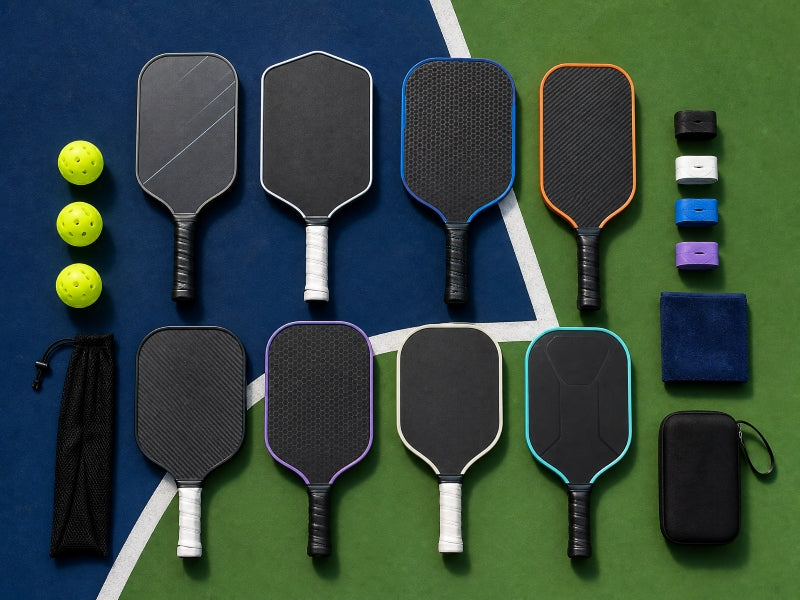
Shape changes how a paddle plays. Elongated paddles usually provide more reach and leverage, and they may suit singles players or players who use a two-handed backhand. Widebody paddles generally offer a broader hitting area and can feel forgiving during quick defensive exchanges. Hybrid shapes attempt to balance reach, stability, and maneuverability.
Static weight is the number on the scale. Swing weight describes how heavy the paddle feels during movement. A paddle with more mass toward the tip can have a higher swing weight than a similarly weighted paddle with a more central balance. Twist stability describes how resistant the paddle is to rotating when contact is off-center.
Grip length and circumference also deserve attention. A longer handle can make two-handed backhands more comfortable, but it may alter balance. A grip that is too large can reduce hand speed and increase tension; one that is too small may feel unstable. An overgrip can change the fit, but it cannot completely correct an unsuitable handle design.
When buying online, record these measurements before ordering:
- Paddle length and width
- Core thickness
- Weight range, not only average weight
- Handle length and circumference
- Swing weight or balance description
- Shape category
- Return and warranty terms
A Practical Buying Process
Use this five-step process to avoid buying based on hype.
1. Identify your biggest problem. Choose one priority: depth, resets, spin, hand speed, comfort, or stability. Trying to maximize every category usually creates an awkward compromise.
2. Match the shape to your game. Choose elongated for reach and leverage, widebody for forgiveness, or hybrid for an all-court compromise. Consider where you play most of your points.
3. Choose a manageable weight. Do not select the heaviest paddle simply because it promises power. If your hands are slow or your arm tires, a lighter and more stable model may produce better match results.
4. Check the specifications and rules. Confirm core thickness, face material, texture, dimensions, warranty, and the exact model’s approval status if you play tournaments. An approved product should still fit your game; approval does not make it automatically suitable.
5. Test more than drives. Use serves, returns, third-shot drops, blocks, dinks, and counters. Give your arm and timing enough sessions to adjust, but stop if discomfort or control problems persist.
Common Buying Mistakes to Avoid
The most common mistake is choosing a paddle by brand reputation alone. A respected brand can make power, control, and hybrid models that feel completely different. Choose the model, not only the logo.
Another mistake is treating price as a performance guarantee. Higher-priced paddles may offer refined construction, customization, or stronger service, but a cheaper paddle with the correct shape and balance may suit you better.
Do not rely on static weight alone. Balance and swing weight often explain why a paddle feels fast, slow, stable, or tiring. Also avoid assuming that more texture always means more usable spin. Surface wear, contact quality, and technique affect results.
Finally, do not ignore the return policy. A paddle can look perfect in specifications and still feel wrong in your hand. A clear return window reduces the risk of making a decision from numbers alone. Read the fine print for play restrictions, return shipping, restocking charges, registration requirements, and the deadline for reporting a manufacturing defect. These details can matter as much as the advertised construction when you are buying without a local demo.
Quick Answer: What Paddle Should You Buy?
If you want a practical default, choose a midweight hybrid paddle with a moderate-to-thick core, a comfortable grip, a stable face, and a clear return policy. It will not maximize power, control, or spin, but it gives many recreational and intermediate players a useful starting point.
Choose a power model only when you need more depth and can manage the faster rebound. Choose a control model when consistency and soft-game accuracy are your main concerns. Choose a spin-focused model when you already have a reliable swing and want a surface that supports more rotation.
Before buying, compare specifications and test the shots that decide your matches. The right paddle is the one that helps you repeat good decisions under pressure—not the one with the most impressive product description. If two models seem similar, prioritize comfort, stability, and after-sales support over small differences in marketing language. A paddle you can swing confidently for a full session is usually more useful than one that produces a slightly faster ball but increases fatigue or errors.
FAQ: Choosing a Pickleball Paddle
Should beginners buy a power, control, or spin paddle?
Most beginners are better served by a balanced or control-oriented paddle with a comfortable midweight feel. Learning contact, direction, and spacing is easier when the paddle is predictable. Once your technique becomes more consistent, you can decide whether extra power or spin would solve a specific weakness.
Is a heavier pickleball paddle always more powerful?
No. Weight distribution, core response, face material, and swing mechanics also affect power. A heavier paddle may add stability and plow-through, but it can be slower and more tiring. Compare swing weight and balance rather than looking only at the number on the scale.
Is a thicker paddle better for control?
A thicker core often supports a softer, more stable response, but thickness alone does not guarantee control. Shape, face texture, balance, and construction quality also matter. Test resets, dinks, blocks, and off-center shots before making a decision.
How long does it take to get used to a new paddle?
Allow several practice sessions to adjust to a different balance, rebound, grip, or handle length. Use the same drills each time so you can separate normal adaptation from a genuine mismatch. If discomfort or excessive errors continue, use the return policy rather than forcing the paddle to work.
What should I check before buying a paddle online?
Check the exact weight range, core thickness, shape, dimensions, handle size, face material, surface description, warranty, return period, and tournament approval status if relevant. Also confirm whether the seller explains normal wear and which defects are covered.

Leave a comment
This site is protected by hCaptcha and the hCaptcha Privacy Policy and Terms of Service apply.